Perplexity Banning Users for Negative Reactions? Discord Community Management Sparks Controversy
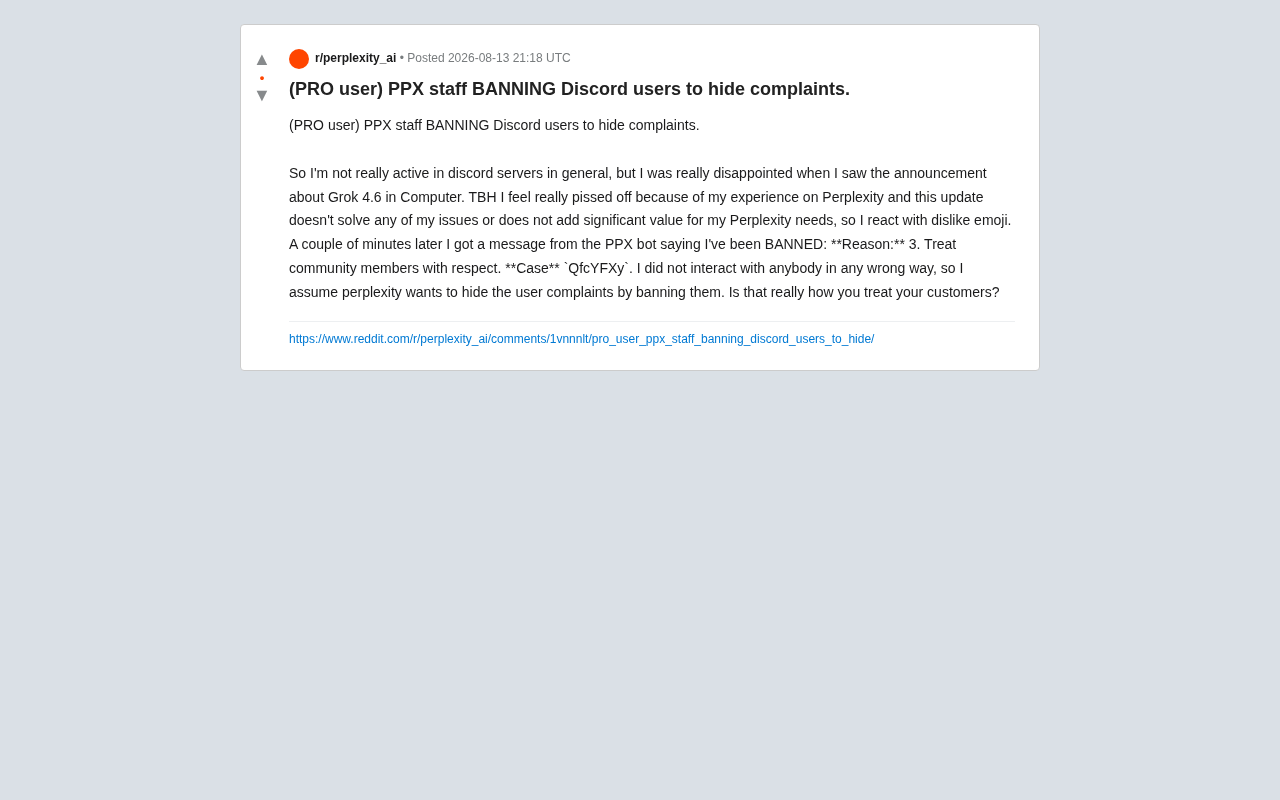
Perplexity Pro user banned from Discord for a dislike reaction, raising questions about AI community management.
A paying Perplexity Pro subscriber reported being banned from the official Discord community after leaving a dislike reaction on a Grok 4.6 integration announcement. The ban cited "disrespecting community members," sparking Reddit debate over whether the AI search company is suppressing negative feedback. The incident highlights broader challenges AI companies face in community governance, balancing moderation with user feedback rights.
The Incident: A Single "Dislike" Triggers a Perplexity Ban
Recently, a paying Perplexity Pro subscriber posted on Reddit, recounting their experience of being banned from Perplexity's official Discord community.
Perplexity AI is an AI search engine company founded in 2022 by former OpenAI researcher Aravind Srinivas. Its core product is positioned as an "answer engine" — unlike traditional search engines that return lists of links, Perplexity generates comprehensive answers with cited sources. Perplexity Pro is its paid subscription service at approximately $20/month, offering access to more powerful models, additional Pro search queries, file upload analysis, and other premium features. By the end of 2024, Perplexity's valuation had exceeded $9 billion, making it one of the most prominent players in the AI search space.
The trigger seemed trivial: the user was dissatisfied with an official announcement about Grok 4.6 integration, feeling the update neither addressed their existing pain points nor delivered meaningful value for their use cases. So they casually left a "dislike" reaction as feedback.
Grok is a large language model series developed by Elon Musk's xAI company. Grok 4.6 is an iteration in the series, known for its reasoning capabilities and real-time information retrieval. As a model aggregation platform, Perplexity frequently integrates third-party LLMs to expand user options — having previously integrated Claude, GPT-4, and others. However, for everyday users, more models don't always mean better experiences, especially when fundamental issues like core search quality and response accuracy remain unresolved. In such cases, new model integrations are seen more as "icing on the cake" rather than addressing real needs.
Yet within minutes, Perplexity's official bot sent them a ban notification, citing a violation of Community Rule #3 — "Treat community members with respect" — with case number QfcYFXy. The user emphasized that they hadn't engaged in any conflicts or made inappropriate remarks — they had simply expressed dissatisfaction with a product update.
This led them to speculate: Perplexity might be banning users who leave negative reactions as a way to suppress the growing volume of negative feedback in their community. The accusation quickly sparked discussion on Reddit — would an AI search company really treat its paying customers in such a heavy-handed manner?
The Core Debate: User Feedback Rights vs. Community Order
At its heart, the central conflict lies in defining the boundary between "expressing dissatisfaction" and "violating community guidelines." The user argues that a dislike reaction constitutes normal product feedback and shouldn't be classified as "disrespecting community members." If the true motivation behind the ban was indeed to suppress negative sentiment, it would not only violate fundamental principles of community management but could also cause lasting damage to brand trust.
It's worth noting that this incident currently relies on a single user's account and has not received an official response or explanation from Perplexity. Several possibilities exist:
Possibility One: False Ban or Automated Moderation Error
Many large Discord communities rely on automated bots for content moderation. Discord is currently one of the most commonly used platforms for tech companies to interact with user communities, with over 200 million monthly active users. Large Discord servers typically deploy multiple automated bots (such as MEE6, Dyno, Carl-bot, etc.) to assist with management. These bots can execute automatic bans, message deletions, role assignments, and other actions based on preset rules. Moderation rules typically include keyword filtering, behavior frequency limits, reaction monitoring, and other dimensions.
However, automated moderation accuracy is highly dependent on rule configuration — too lenient and genuine violations slip through; too strict and normal users get caught in the crossfire. For non-text interactions like emoji reactions, determining user intent is far more technically challenging than moderating text content. If this incident falls into this category, it's more of a technical configuration issue than intentional user suppression.
Possibility Two: Undisclosed Full Context
User accounts tend to present only the side that favors them. Whether there are other omitted interaction details cannot currently be verified. Community management decisions are typically based on complete behavioral records, and a single screenshot with a description cannot reconstruct the full picture. On platforms like Reddit, "one-sided stories" sparking public outrage are not uncommon — multiple previous tech company ban controversies ultimately revealed drastically different narratives once full context was disclosed.
Possibility Three: A Genuine Tendency to Suppress Negative Feedback
If multiple users report similar experiences, then the accusation of "banning negative feedback" warrants serious consideration. For a rapidly growing AI company, trading authentic feedback for superficial harmony is typically a shortsighted decision that costs more than it gains.
Deeper Reflection: How Should AI Companies Handle Negative Community Feedback?
This incident resonates because it touches on a universal pain point in AI product operations today: how companies handle negative voices from their core users.
As AI products transition from technical demos to commercial products, community management faces unprecedented challenges. On one hand, rapid AI product iteration means every update can trigger waves of positive or negative feedback. On the other hand, paying users have far higher quality expectations than free users, and their dissatisfaction tends to be more intense and concentrated. OpenAI, Anthropic, Google, and others have all faced backlash due to poor community management. An industry consensus is gradually forming: communities are not just user support channels but also "outposts" for product development — criticism from core users often exposes real problems more effectively than internal testing.
For AI products like Perplexity that center on search and Q&A, Pro subscribers should be the most valuable source of feedback. They continue paying because they have genuine needs for the product; when they express dissatisfaction, it means they still want the product to improve. Simply treating such feedback as "noise" or actively suppressing it is equivalent to voluntarily severing the most valuable information channel for product iteration.
In recent years, AI industry competition has intensified, with companies rolling out new model integrations and features almost every few weeks. But for users, what truly matters often isn't "which new model was just added" but rather "has my actual problem been solved?" The original poster's lukewarm response to the Grok 4.6 integration reflects the sentiment of many users — they care more about improvements to the core experience than an ever-expanding feature list.
The Right Approach to Discord Community Governance
From a community management perspective, healthy practices should include several key elements:
First, distinguish between "criticism" and "harassment." Negative product evaluations fall within the normal feedback spectrum — as long as they don't involve personal attacks, abuse, or spam, they should not be penalized. Equating a dislike reaction with "disrespecting members" is itself a definitional error. In community governance research, this practice of over-extending rule interpretation is called "rule creep" — where moderators gradually stretch vague rule provisions to cover behaviors they were never intended to address.
Second, establish transparent appeal mechanisms. Any ban decision should provide clear, specific justification and allow users to appeal for review. A case number paired with a broad rule citation is insufficient to convince users. Best practices include: providing specific descriptions of the behavior that triggered the ban, clearly stating ban duration, setting up dedicated appeal channels, and delivering appeal results within a defined timeframe.
Third, actively collect rather than suppress user feedback. Mature product teams establish dedicated feedback channels, treating negative reviews as input for their improvement roadmap rather than negative data to be "hidden." Many successful SaaS products (such as Notion and Figma) maintain dedicated "feature request" and "bug report" sections in their communities, converting user dissatisfaction into structured input for product improvement.
Conclusion: User Trust Is an AI Product's Most Precious Asset
Regardless of the truth behind this Perplexity ban incident, it serves as a wake-up call for all AI product teams. In an era where technical capabilities are increasingly commoditized, user trust and community reputation are becoming key differentiators in competition.
In SaaS business models, user retention directly determines long-term revenue. Research shows that acquiring a new customer costs 5-25 times more than retaining an existing one. For AI subscription products, user trust is especially critical — users entrust sensitive information like search queries and document contents to AI processing, which is fundamentally built on trust in the platform. Once trust is broken (through perceived unfair treatment, ignored feedback, or suppression), user churn is often irreversible. More importantly, on public platforms like Reddit and Twitter, a single user's negative experience can spread rapidly, creating brand crises that far exceed the impact of the original incident.
If a company truly uses bans to conceal criticism, what gets hidden is only the surface-level negative noise, while what's lost is the trust users have built over time. Conversely, honestly facing criticism and taking feedback seriously — while potentially appearing "unflattering" in the short term — is the only sustainable path to building lasting user relationships.
We still await an official response from Perplexity on this matter. Before the truth becomes clear, this case at minimum reminds every practitioner: how you handle user dissatisfaction often defines a company's values more than the product itself.
Related articles

ICANN Revokes Bulletproof Registrar Trustname's Accreditation: Impact and Analysis
ICANN has officially revoked bulletproof registrar Trustname's accreditation, severing its ability to harbor cybercrime. This article analyzes the impact on internet security governance.

ChatGPT Voice Mode Clones User's Voice: Root Cause Analysis and Security Implications
Reddit user reports ChatGPT voice mode cloning their voice. Analysis of OpenAI's disclosed unauthorized voice generation risk, technical causes, and safety guardrail limitations.

Building a Neural Network from Scratch: A Practical Guide to Backpropagation and Gradient Computation
A detailed guide on building neural networks from scratch with Python and NumPy, covering forward propagation, backpropagation, gradient checking, and numerical stability.