Perplexity Bets on Vertical Integration: The Agent Infrastructure Ambition Behind Vera and the Shift Away from x86

Perplexity is vertically integrating its agent stack, building its own sandbox and betting on Vera over x86.
Perplexity has signaled a strategic shift toward vertically integrating its agentic infrastructure — building its own sandbox execution environment and optimizing it for the Vera chip architecture, claiming "Vera is far superior to x86." The company has already begun deploying "Perplexity Computer" on Vera. This move enables end-to-end tuning for agent workloads and reduces reliance on third-party cloud sandboxes, while the silicon-level bet targets differentiation in energy efficiency and execution performance. The development reflects a broader trend of AI competition shifting down the stack, as model capabilities converge and infrastructure control becomes the new battleground.
Perplexity Is Building Its Own Agent Infrastructure
Perplexity recently dropped a noteworthy strategic signal on social media: the company plans to vertically integrate its agentic infrastructure, with a core focus on building its own sandbox environment and deeply optimizing it for the best available silicon. What looked like a brief statement actually reveals the ambitions of an AI application company pushing further down into the underlying infrastructure stack.
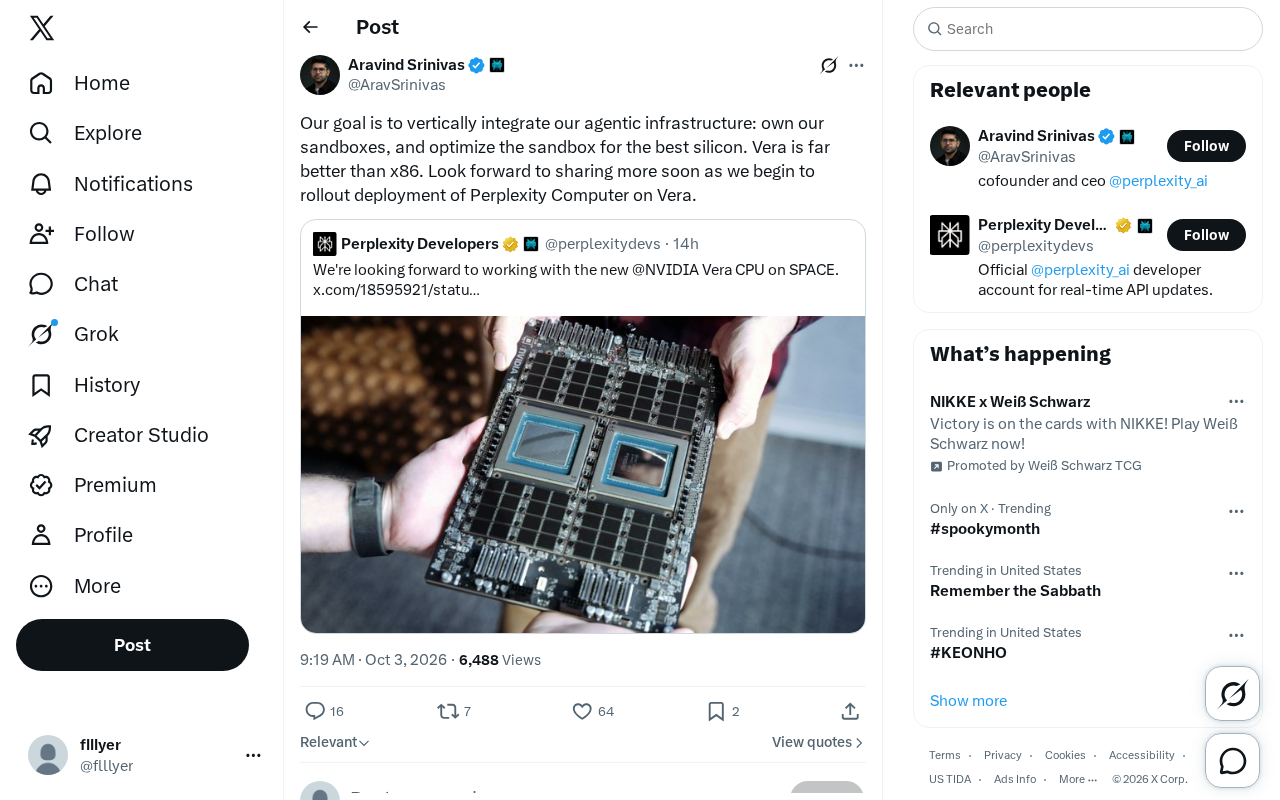
According to the official announcement, Perplexity has already begun rolling out something called "Perplexity Computer" on the Vera architecture, explicitly stating that "Vera is far superior to x86." This means the company — which started as an AI-powered search and Q&A product — is now building its technology stack all the way down to the chip selection level.
Why Vertical Integration?
Vertical integration is nothing new in tech. From Apple's in-house chips to Tesla's self-built battery supply chain, controlling more layers of the stack typically translates to stronger performance tuning capabilities and better cost control. For an AI company centered on agents, the sandbox is the isolated environment where code gets executed, tools get called, and complex multi-step tasks get run. Its performance and security directly determine an agent's response speed and reliability.
What It Means to Own Your Own Sandbox
Many AI applications today rely on third-party cloud sandboxes or general-purpose compute instances to run agentic workloads. By choosing to "own its own sandbox," Perplexity is essentially bringing this critical execution layer under its own control. The benefits are clear: end-to-end optimization for its specific agent workloads, reduced dependency on external vendors, and greater freedom when selecting underlying hardware.
For agentic systems that frequently execute code, call APIs, and handle multi-step tasks, sandbox startup speed, isolation overhead, and concurrency capacity are all critical bottlenecks affecting user experience. A self-built sandbox maximizes the room to optimize all of these.
In computer security, a sandbox refers to an isolated execution environment where programs run without direct access to the host system's files, network, or other resources — preventing damage from malicious code or erroneous operations. In the context of AI agents, sandboxes take on even greater importance: agents dynamically generate and execute code, call external APIs, and manipulate file systems, each step carrying unpredictable risks. Today's mainstream sandbox solutions are typically based on containers (like Docker) or micro-VMs (like Firecracker). Containers start faster but offer relatively weaker isolation; micro-VMs provide stronger security but come with greater cold-start latency. For platforms that need to handle large numbers of concurrent agent requests with millisecond-level response times, the trade-off between startup latency, memory overhead, and isolation granularity directly affects throughput and perceived speed. Building your own sandbox means you can tune specifically for your agents' typical workload patterns — like short, high-frequency code executions and tool-calling chains — rather than relying on off-the-shelf solutions designed for generic cloud computing scenarios.
Vera vs. x86: A Bet at the Silicon Level
Perplexity's direct statement that "Vera is far superior to x86" is the most information-dense part of the announcement. x86 is the instruction set architecture that has long dominated data centers, while Vera points to a next-generation silicon solution more closely tailored to AI workloads. The company's emphasis on optimizing its sandbox for "the best silicon" signals its belief that general-purpose x86 architecture is no longer the optimal choice for agent-intensive workloads.
This judgment aligns with a broader industry trend: as the computational characteristics of AI inference and agentic tasks diverge significantly from traditional general-purpose computing, more vendors are pursuing chips and architectures customized for specific workloads. By co-optimizing its sandbox with a specific piece of silicon, Perplexity is aiming to build an edge in energy efficiency and execution performance.
The Deployment Signal Behind Perplexity Computer
The official post mentions that Perplexity has begun the "rollout deployment of Perplexity Computer on Vera" and promises to share more details soon. This indicates the initiative has moved from concept to active deployment — not merely a vision statement. While public information remains limited, the name "Perplexity Computer" itself hints that the company may be building a complete agentic computing platform, rather than simply optimizing its existing search product.
x86 is a Complex Instruction Set Computing (CISC) architecture introduced by Intel in 1978 and later extended by AMD and others. For decades, it has dominated the personal computer and data center server markets. Its strengths lie in its mature ecosystem and exceptional software compatibility — but maintaining backward compatibility has accumulated significant technical debt, and its energy efficiency has increasingly become a liability. In contrast, ARM and other Reduced Instruction Set Computing (RISC) architectures, along with custom AI inference chips like Google's TPU and AWS Inferentia, have emerged as alternatives. Perplexity's "Vera" currently has limited publicly available technical documentation; from context, it likely refers to a server chip solution based on ARM or a custom ISA. The computational profile of AI inference and agentic tasks differs markedly from traditional general-purpose computing: these workloads are heavily dependent on matrix operations, memory bandwidth, and low-latency I/O — not the complex branch prediction and single-threaded integer performance that x86 excels at. This fundamental mismatch in computational characteristics is the core reason why more and more AI companies are moving away from x86.
What This Means for the AI Industry
An AI application-layer company proactively extending into infrastructure and silicon reflects a broader shift in where competitive battles are being fought. As upper-layer model capabilities increasingly converge, differentiation often comes down to execution efficiency, cost structure, and control over infrastructure. Whoever can run agentic tasks faster and more economically may be able to build a durable moat in both user experience and unit economics.
It's worth noting that the current information comes from a single social media post by Perplexity, with no independent performance data or third-party verification yet available. "Vera is far superior to x86" is a strong claim, and the specific performance comparisons, applicable use cases, and actual deployment scale still await official disclosure. Until more details are public, this is better understood as a clear statement of strategic direction rather than a validated technical conclusion.
For developers and practitioners tracking the evolution of AI infrastructure, it's worth watching closely for the technical details Perplexity shares going forward — to see whether it can turn this "sandbox-to-silicon" vertical integration vision into measurable, real-world advantages.
Related articles

MCP Protocol in 60 Seconds: A Real Session, Message by Message
Dissecting a real MCP session message by message: how an Agent dynamically discovers tools, forwards call requests, and has an MCP server execute them — all in just 9 JSON messages, with the model and reasoning loop untouched.

n8n 40-Minute Masterclass: Build Your First AI Automation Workflow from Scratch
Distilled from a 40-minute n8n masterclass: the core differences between automation, AI, and AI Agents, a comparison of n8n's four deployment methods, and a complete guide from dashboard to your first workflow.

Why Does a 35GB Quantized Model Blow Up an 80GB GPU? The Truth About KV Cache VRAM
Why does a 35GB 4-bit quantized LLM still blow up an 80GB GPU? This article breaks down the four components of inference VRAM, provides precise KV Cache formulas, compares GQA vs DeepSeek MLA memory, and offers production-grade OOM prevention like FP8 KV Cache.