Perplexity Computer Comes Pre-installed on HP ZBook Ultra G3a: AI Agents Move into Hardware

Perplexity Computer goes hardware-first, bundling its AI agent with HP's ZBook workstation to target professional users.
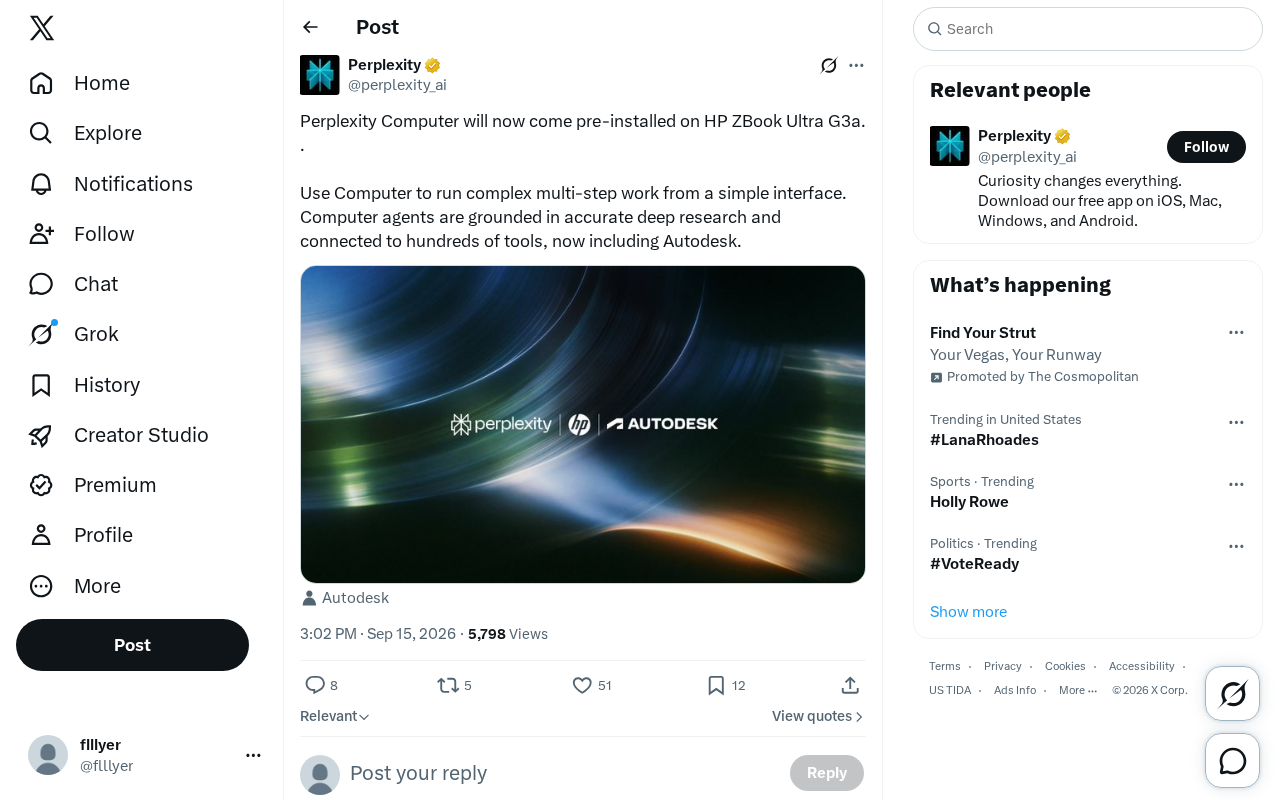
Perplexity has announced that its AI agent Perplexity Computer will come pre-installed on the HP ZBook Ultra G3a mobile workstation, marking a shift from software subscriptions to hardware-bundled distribution. The agent targets complex multi-step workflows, uses RAG to reduce hallucinations, and integrates with hundreds of tools including Autodesk for professional design and engineering. This hardware-plus-ecosystem strategy reflects Perplexity's ambition to evolve from an AI search engine into a full AI work platform — though real retention will depend on proven utility in professional settings.
Perplexity Deepens Ties with Hardware Manufacturers
Perplexity has announced that its AI agent product Perplexity Computer will come pre-installed on the HP ZBook Ultra G3a mobile workstation. This marks a significant shift for AI agents — moving beyond pure software subscriptions into hardware-bundled distribution, where users can get started the moment they power on their machine, no download required.
For Perplexity, partnering with a mainstream PC manufacturer like HP is a classic channel expansion play. The ZBook series targets professional users — engineers, designers, and content creators — an audience that maps closely to Perplexity Computer's core pitch of handling "complex, multi-step tasks." By embedding an AI agent at the hardware level, Perplexity is essentially competing for users' default habits before they even open a browser.
What Is Perplexity Computer
According to official materials, Perplexity Computer is positioned as a tool that runs complex, multi-step workflows through a clean, simple interface. This is a clear departure from traditional search-and-answer products — rather than responding to a single question, it can break down tasks and execute multiple steps in sequence until a complete job is done.
Two key capabilities underpin this positioning:
Reliability Built on Deep Research
Perplexity has long differentiated itself with "search with source citations." The company describes its Computer agent as "grounded in accurate deep research," directly addressing one of the most common criticisms of AI agents: hallucinations. In professional work contexts, traceable and accurate outputs matter far more than raw generation speed.
Hallucination refers to large language models generating content that sounds plausible but is factually wrong or fabricated — one of the biggest obstacles to deploying AI in professional settings. Perplexity's approach is Retrieval-Augmented Generation (RAG): before generating a response, the system retrieves relevant information from external sources and uses those results as context to constrain the model's output, with original links included so users can verify. This doesn't eliminate hallucinations entirely, but it significantly reduces the likelihood of the model fabricating details from thin air, and gives users a paper trail. For engineers, designers, and other professionals, a traceable and verifiable output is far more valuable than a fluent but unreliable one.
Connected to Hundreds of Tools
Perplexity Computer claims connectivity with "hundreds of tools," with particular mention of new support for Autodesk. As the dominant force in CAD, architectural design, and engineering software, Autodesk's integration signals that the agent can reach into professional design workflows. This detail directly echoes the ZBook's professional user base — workstation users are among the heaviest Autodesk software users in the market.
The Competitive Logic Behind Tool Connectivity
The core value of an AI agent doesn't come from the model itself — it comes from how many external tools it can call upon and how effectively it can orchestrate those tools into valuable workflows. Today's leading players (OpenAI, Anthropic, Google, and Perplexity) are all competing around the "tool connectivity ecosystem."
Perplexity's emphasis on hundreds of integrations and Autodesk support is essentially a move to build an agent platform for professional productivity. Whoever can cover more of the software users actually rely on will have a head start when it comes to real-world agent adoption. The combination of hardware pre-installation and a growing tool ecosystem reflects Perplexity's ambition to evolve from an "AI search engine" into an "AI work platform."
Tool Use / Function Calling is what separates modern AI agents from ordinary chat models: instead of just generating text, the model can identify task requirements, proactively call external APIs or software interfaces, and incorporate the returned results into the next step of the workflow. This enables agents to operate browsers, read and write files, interact with CAD software, and genuinely participate in users' production workflows. The real competition right now — in a landscape where general model capabilities are converging — is about building differentiation through broader tool coverage and smarter orchestration logic. The breadth and depth of a tool ecosystem determines how many real-world work scenarios an agent can handle, and directly shapes user switching costs.
The Promise and Limits of Hardware Pre-installation
The advantages of a pre-install strategy are clear: lower the barrier to entry, claim the default position, and lock in professional device users. For HP, AI capabilities become another differentiator for the ZBook line — both sides get something they want.
But pre-installation doesn't equal active use. History is full of pre-loaded software that gets uninstalled on day one. Whether Perplexity Computer can actually retain users will come down to how useful, stable, and sticky the agent proves to be in real-world work scenarios. Hardware is just a distribution channel — product value is what drives retention.
Overall Assessment
This announcement carries limited detail, but the direction it points to is worth watching: AI agents are moving from software subscriptions toward hardware bundling, and from general Q&A toward specialized professional use cases. Perplexity's choice to enter through professional workstations, reinforced by integrations with tools like Autodesk, signals a deliberate push into the productivity market. Whether the actual experience delivers on the promise of "complex, multi-step work" is something that will need to be validated by real workstation users in the field.
Related articles

Databricks Genie: The AI Analytics Assistant That Tripled a Marketing Team's Data Usage
Databricks' AI analytics assistant Genie tripled marketing team data usage. Discover how this conversational NL2SQL tool lowers the data access barrier and what it means for enterprise AI adoption.

How The Oregon Trail Became a Cultural Icon for Generations
How The Oregon Trail grew from educational software into a multigenerational cultural icon — through classrooms, "You have died of dysentery," and shared childhood memories.

Health Benefits Platform Thatch Hits $1B Valuation as Healthcare Costs Surge
Thatch raises $108M and hits a $1B valuation, backed by a16z, Index Ventures, and General Catalyst, as surging U.S. healthcare costs drive demand for flexible benefits platforms.