Perplexity Computer Launches Teardown Skill: Interactively Break Down Anything in 3D

Perplexity Computer launches the teardown skill for conversational 3D interactive breakdown of any object.
Perplexity Computer has added the teardown skill developed by creator @jakubkrehel, whose core capability is to "break apart any thing and look into it in 3d interactively," letting users rotate, zoom, and peel apart a target object layer by layer in three-dimensional space. The skill is embedded as a pluggable module within conversational interaction, requiring no professional 3D modeling expertise; each user receives 5,000 trial credits for testing and debugging. The article argues this reflects the platform's product strategy of using a skill ecosystem to fill vertical capabilities—flexible in extensibility but facing uneven quality and discovery costs. Since officials have not yet disclosed data sources, supported object categories, or teardown precision, it is more appropriately viewed at this stage as a validation of a capability direction.
From Text to Three Dimensions: Perplexity Computer Adds a Teardown Skill
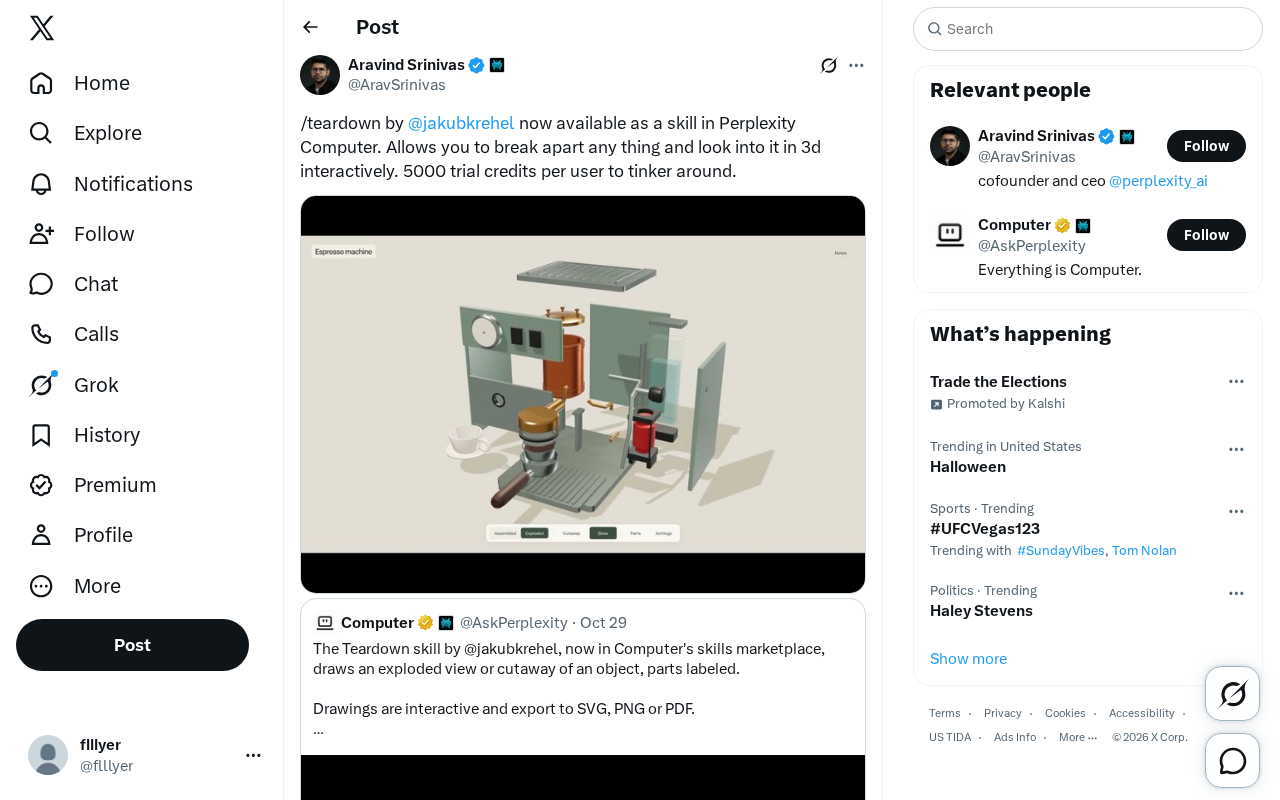
Perplexity's product Perplexity Computer has recently launched a new skill called teardown, developed by creator @jakubkrehel. According to its official tweet, the skill's core capability is to "break apart any thing and look into it in 3d interactively." This means users are no longer confined to browsing information on a two-dimensional plane—they can rotate, zoom, and take apart a target object in three-dimensional space as if holding a physical item, understanding its structure and composition from different angles.
Perplexity Computer itself is positioned to let users invoke various capabilities through natural language instructions, and the addition of teardown productizes the act of "teardown analysis." Unlike traditional 3D modeling software that requires professional expertise, it is embedded as a skill within conversational interaction, attempting to make the observation of complex objects intuitive and operable.
Perplexity Computer is a product form Perplexity launched beyond conversational search, positioned close to an "AI computer environment that can invoke multiple capabilities": users issue instructions in natural language, and the platform dispatches different skills on demand to complete tasks. What distinguishes it from traditional chatbots is that capabilities are mounted in a modular way rather than all being generated endogenously by a single model. Understanding this helps grasp the significance of teardown—it is not a standalone 3D application built in-house by Perplexity, but a plugin within this skill system, and thus naturally inherits the product logic of "on-demand invocation and usage-based billing."
Interaction Method and Trial Mechanism
According to the tweet, the teardown skill allows users to conduct three-dimensional interactive exploration of any object. Although the original text does not elaborate on the specific supported object types and precision, the phrasing "break apart any thing and look into it in 3d interactively" suggests it emphasizes the combination of two actions: teardown and look into—users can first browse the whole, then peel it apart layer by layer to focus on internal details.
To lower the barrier to trying it out, each user receives 5,000 trial credits for experiencing and debugging. This mechanism is consistent with Perplexity Computer's product approach of billing by capability invocation—first letting users get started at low cost with credits, then deciding whether to go deeper based on actual usage. For users who want to verify whether the skill fits their workflow, the credit allowance provides ample room for trial and error.
The skill mechanism is a common extension approach for current AI agent products: the platform provides a unified instruction entry point and runtime, and third-party or official developers encapsulate specific capabilities into pluggable modules that users can invoke without switching applications. Compared with plugins, skills typically place more emphasis on "autonomous orchestration and composition by the model to complete multi-step tasks" rather than merely providing a single API interface. For the platform, a skill ecosystem can cover long-tail needs at low cost; for creators, it adds another distribution channel. Released as a skill, teardown sits precisely at the intersection of the platform, creators, and users.
Application Possibilities for Teardown-Type Skills
The positioning of teardown brings to mind scenarios such as industrial design, hardware reverse engineering, and instructional demonstrations. In the past, completing a structural teardown often required physical objects, professional software, or video materials; by putting teardown capability into an AI-driven computer environment, users can initiate teardown requests in natural language and directly observe the results in a 3D view. This "conversation as operation" approach lowers the barrier to three-dimensional analysis.
However, it should be noted that the tweet does not specify what data sources the skill relies on, which object categories it supports, or provide specific metrics for teardown depth and interaction precision. Therefore, at this stage it is more appropriate to view it as a validation of a capability direction: Perplexity Computer is turning "teardown analysis" into an invocable, standardized skill rather than leaving it as a concept only in demo videos.
Trial credits are a common customer acquisition and billing transition mechanism for AI products: the platform consumes credits per capability invocation, new users first receive a certain amount of free allowance to evaluate the product's value in real tasks, and then decide whether to pay after the allowance runs out. This design decouples "experience cost" from "usage intensity"—light exploration is almost zero-cost, while heavy use naturally translates into willingness to pay. For a new skill like teardown whose details have not yet been disclosed, the 5,000 credits effectively serve as a user-side stress-testing window, and the rate at which they are consumed can also indirectly reflect the compute cost of teardown tasks.
The Significance of the Skill-Based Approach
Teardown is released as a skill rather than a standalone application or feature menu, reflecting Perplexity Computer's product strategy: encapsulating specific capabilities into pluggable modules that users invoke on demand. For creator @jakubkrehel, the skill marketplace also provides a path to distribute a personal tool project to platform users.
The advantage of this model is flexible extensibility—the platform does not need to build features in-house for every vertical scenario, but instead fills long-tail needs through the skill ecosystem; the challenge lies in uneven quality and discovery costs. Whether teardown can evolve from a "novelty skill" into a high-frequency tool depends on whether its coverage of teardown objects and interaction experience can withstand the test of real tasks. The 5,000 trial credits are a friendly starting point, but the real answer will only emerge once users actually start using it.
Summary
Perplexity Computer's teardown skill brings three-dimensional interactive teardown into a conversational AI environment, lowering the barrier to experience with 5,000 trial credits. It demonstrates the potential of the skill-based approach for vertical capabilities, but the specific scope of support and precision await further official disclosure. For readers interested in the AI tool ecosystem and three-dimensional interaction, this is a new development worth continued observation.
Related articles

FBI and USDA Hit by Cyberattacks: Critical Infrastructure Security Alarms Sound Again
FBI and USDA reportedly hit by cyberattacks; the FBI was breached for the second time in recent months, this time targeting the National Crime Information Center (NCIC). This article analyzes the incident details, NCIC's strategic value, and common security challenges facing government agencies.
How Do UK Grid Battery Storage Systems Make Money?
How UK grid battery storage makes money: stacking frequency response, capacity market, and wholesale arbitrage revenue, plus operational trade-offs and market risks.
Riemann Hypothesis Formally Verified in Lean? Joint Statement Sparks Heated Debate
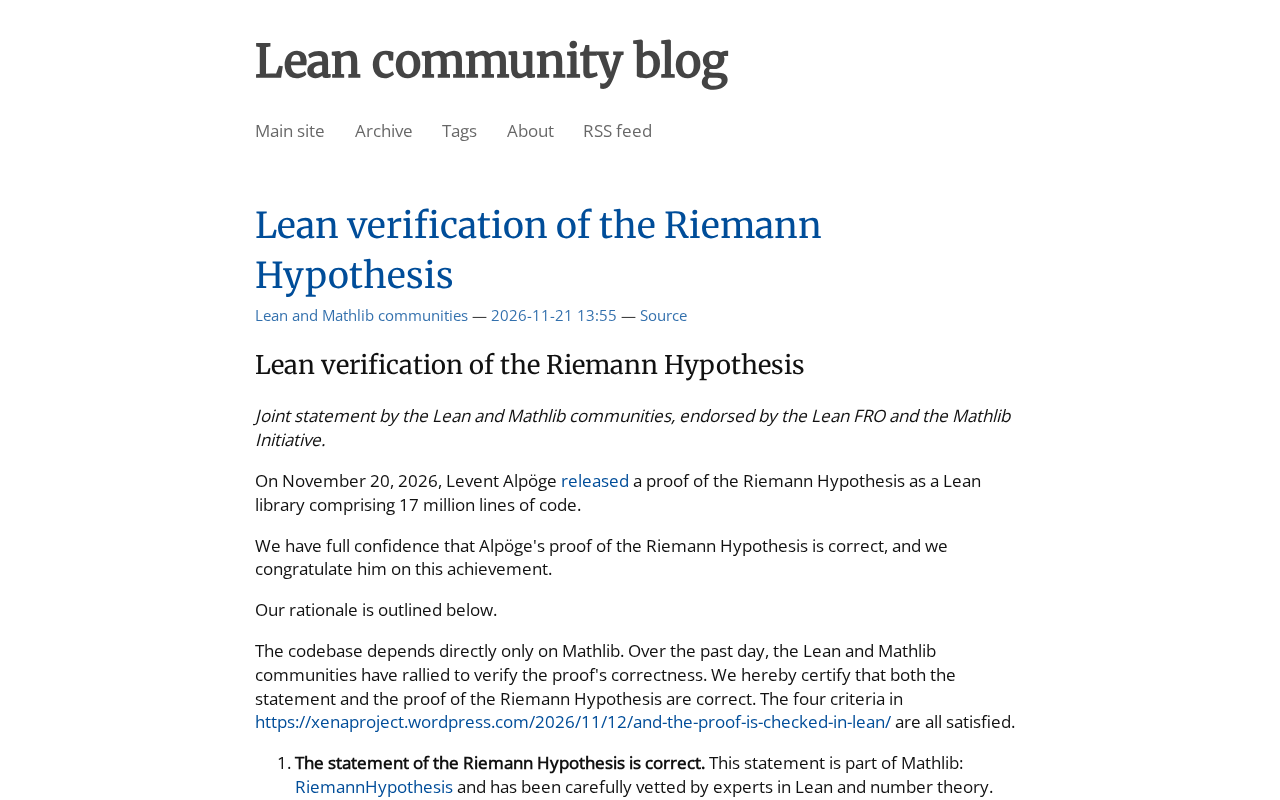
The Lean community blog published a joint statement on formal verification of the Riemann Hypothesis, sparking heated discussion on Hacker News with 359 points and 263 comments. This article analyzes the background of Lean and mathlib formal verification, polarized community reactions, and why one should not conclude the Riemann Hypothesis has been proven before reading the original text.