Perplexity Hiding Usage Query Endpoints? Pro Users Find Quota Values Return All Zeros

Perplexity's internal quota-checking endpoints are returning all zeros, affecting power users who relied on them.
A Perplexity Pro user discovered that two internal REST endpoints previously used to check remaining query counts and file upload quotas now return all zeros — though account functionality remains unaffected. Because Perplexity's official UI lacks a transparent usage dashboard, some technical users had relied on these reverse-engineered endpoints to manage their usage. Possible causes include backend data model refactoring, intentional soft deprecation, or a shift from fixed-count quotas to dynamic allocation. The incident highlights the risks of depending on unofficial endpoints and underscores the need for an official usage dashboard.
Background: A Hidden Query Endpoint That Got Cut
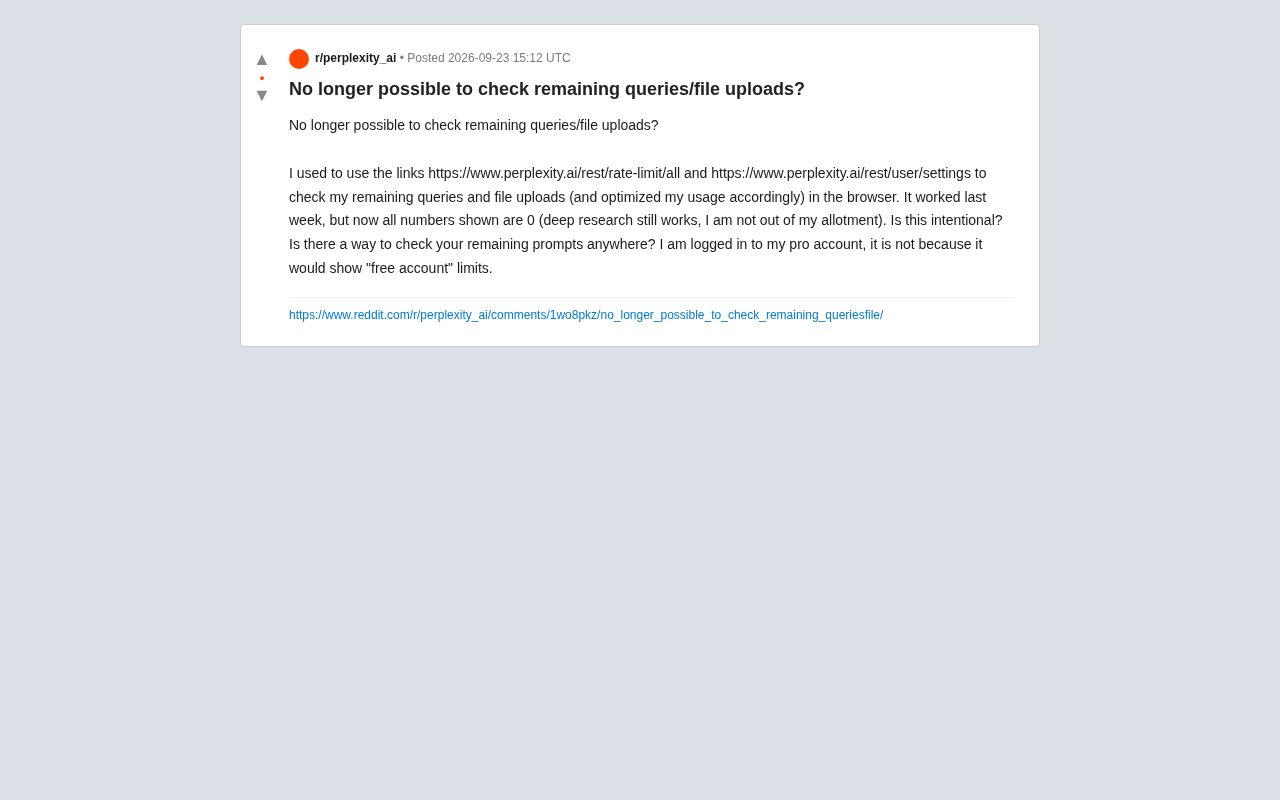
Recently, a Perplexity Pro user reported on Reddit that two previously working endpoints for checking remaining query counts and file upload quotas have suddenly stopped working. This user had long relied on two undocumented REST endpoints — https://www.perplexity.ai/rest/rate-limit/all and https://www.perplexity.ai/rest/user/settings — to directly check their account's remaining quota in the browser and optimize their usage accordingly.
According to the user, this method was working fine as recently as last week. Now, every number returned has become 0. It's worth noting that this doesn't mean the account quota is actually exhausted: Deep Research still works, the user confirmed they're still within their Pro limits, and the interface isn't showing free-tier limits either — it's simply zeroing out all values.
Why Users Depend on Unofficial Endpoints
Perplexity's official interface doesn't provide a clear, intuitive display of "remaining usage." For heavy users who pay for a subscription and have separate quotas for different features (such as Deep Research, Pro Search, and file uploads), being unable to know how many queries remain directly impacts workflow planning.
Precisely because of the lack of a transparent usage dashboard, some technically savvy users turned to calling internal REST endpoints. These endpoints were originally used for front-end page rendering and exist in a gray zone — accessible but not officially supported. Their very existence implies that they can be interrupted at any time if the company adjusts its front-end logic or adds authentication.
REST (Representational State Transfer) endpoints are the most mainstream data exchange standard for modern web applications. When rendering the user interface, front-end pages typically request data from the backend through these interfaces. Users can observe these requests in the browser's DevTools Network panel and directly access URLs that don't require special authentication — bypassing the UI to read raw data. This practice is known in the tech community as "reverse-engineering front-end endpoints" — not actual system hacking, but leveraging internal channels that exist within the product but aren't officially promised. Since these endpoints have no versioning guarantees and aren't protected by the terms of service, vendors can modify or shut them down at any time, making them inherently less stable than official public APIs.
Possible Explanations for the All-Zeros Phenomenon
From an engineering perspective, the fact that the endpoint returns all zeros rather than an error or permission denial has several possible explanations:
Backend Data Structure Refactoring
Perplexity may have restructured its rate-limit-related data model, with old fields deprecated or renamed, causing the values at the old endpoint path to default to 0. This is quite common in fast-moving products.
Intentional Internal Endpoint Consolidation
The company may have noticed that these internal endpoints were being frequently called by external scripts and proactively blocked the return values for security and data consistency reasons. Returning 0 instead of a 403 could be a form of "soft deprecation" — keeping the endpoint alive but no longer outputting real data.
HTTP 403 (Forbidden) is the standard permission-denial status code, returned by a server when the requester doesn't have access to a resource. By contrast, returning a 200 status code but zeroing out the data fields is a more covert form of "soft shutdown" — the endpoint technically remains alive, external scripts won't immediately crash upon receiving an error code, but meaningful data is no longer being output. This approach is sometimes called "silent degradation" — it allows vendors to gradually retire old endpoints without triggering user alerts or automated monitoring, while also providing a smoother transition window.
Changes to the Quota Mechanism Itself
Another possibility is that Perplexity is adjusting how it measures quotas — for example, shifting from a fixed-count model to a more dynamic scheduling strategy, making the concept of "remaining queries" no longer representable as a stable number. Many AI products have recently been moving away from hard query limits toward flexible, load-and-priority-based allocation.
Real-World Impact on Users
For the vast majority of users, this change is barely noticeable — features work as normal, and they've simply lost a "cheat window" for checking their remaining quota. Those truly affected are professional users and automation script writers who need precise usage management.
As of now, there has been no official response in the Reddit thread, and no alternative query method has been confirmed to work. If you previously relied on this approach, you may need to fall back to the most basic method in the short term: roughly gauging your quota status through usage frequency and in-app indicators.
Recommendations for Power Users
Relying on unofficial endpoints is an inherently fragile strategy. More robust approaches include:
- Watching Perplexity's official settings page to see if a formal usage dashboard gets released;
- Providing feedback in the community (Reddit, official Discord) to push the company toward transparent quota displays;
- Building proper fallback handling into automated workflows, and avoiding hard dependencies on undocumented endpoints.
This minor incident is yet another reminder: any usage technique built on "reverse-engineered front-end endpoints" should be treated as a temporary convenience, not a reliable feature. For users who genuinely need transparent usage data, the best path remains pushing for official support.
Note: This article is based on a single Reddit user's report. The described behavior has not been officially confirmed by Perplexity, and the specific cause remains to be verified.
Related articles

Chain of Thought Isn't Just for AI: How Humans Can Use CoT to Improve Thinking Quality
Chain of Thought isn't just a prompt trick for large models. Starting from a Hacker News discussion, this article analyzes why CoT works for human thinking too, breaks down actionable ways to transfer it, and highlights the key differences between human CoT and machine CoT.
Cloudflare Teams Up with OpenAI: Closi…
Cloudflare Teams Up with OpenAI: Closing the Loop from Vulnerability Discovery to Defense with AI
Cloudflare uses OpenAI Daybreak to investigate security vulnerabilities and generate reviewable remediation plans, while developers use Codex to boost coding efficiency and quality.

Orca Multi-Agent Orchestration in Practice: A Guide to Parallel Collaboration with Claude and Codex
Orca is Stable AI's free open-source agent workbench supporting 34 agents like Claude Code and Codex in parallel. Learn its Git worktree isolation, multi-model orchestration, and mobile management.