Perplexity In-Depth Usage Guide: Advanced Techniques and Real-World Scenarios

Master Perplexity AI with advanced techniques like Focus modes, Collections, and multi-source verification for superior research.
This guide explores Perplexity AI's differentiated positioning as an AI-native search engine versus ChatGPT's generative approach, diving into advanced features like Focus modes for precision retrieval, Collections for building personal knowledge bases, and Pro Search's multi-step reasoning. It provides practical scenarios including home buying research, exam prep, and decision-making, with core advice on becoming a Power User through iterative querying and source verification.
From ChatGPT to Perplexity: The Differentiated Positioning of AI Tools
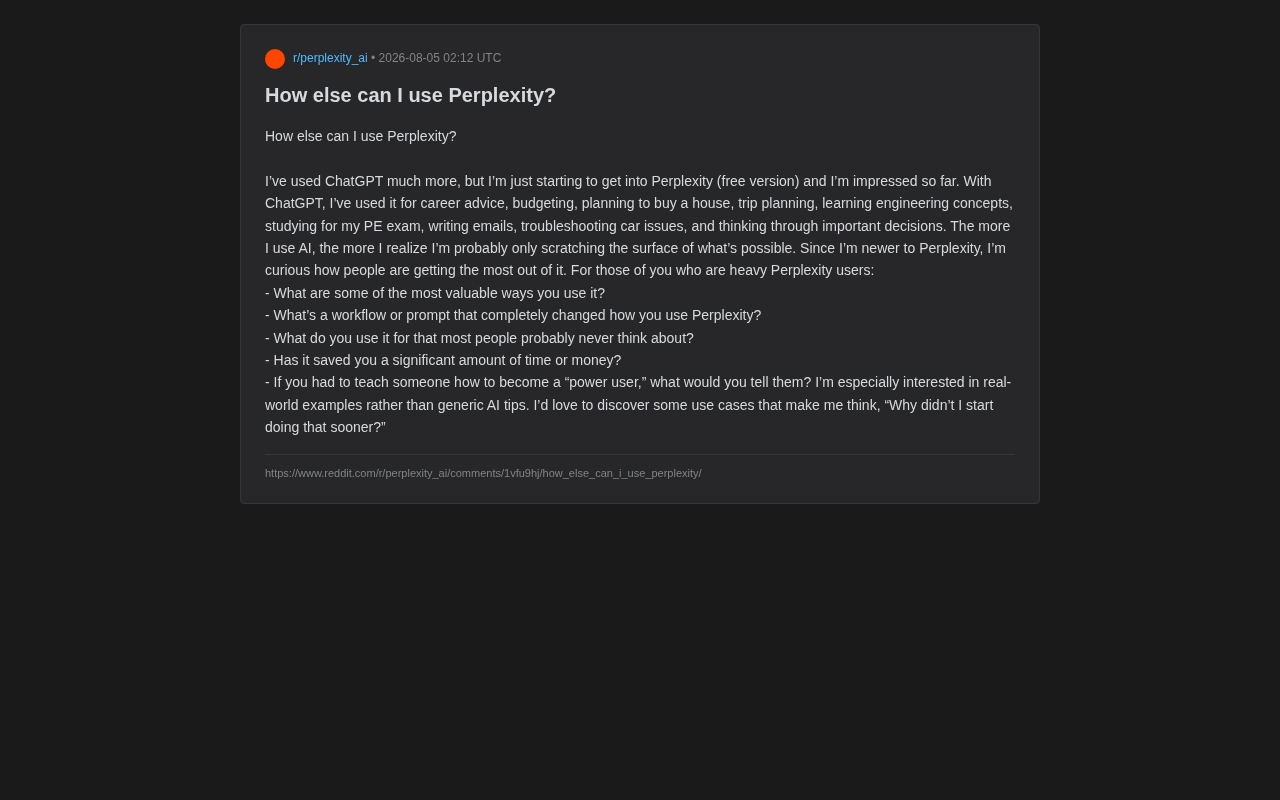
Recently on the Reddit community, a user raised a question that resonated widely: after getting accustomed to using ChatGPT for career advice, budget planning, home buying, travel arrangements, learning engineering concepts, studying for the PE license exam, writing emails, troubleshooting car issues, and even working through major decisions, he started trying Perplexity's free version and was impressed by its performance. His confusion was quite representative — "The more I use it, the more I realize I might only be scratching the surface of what AI can do."
Behind this question lies a critical insight: although both ChatGPT and Perplexity are conversational AI tools, their underlying positioning is fundamentally different. ChatGPT is essentially a generative conversational assistant, excelling at creation, reasoning, and brainstorming based on trained knowledge; while Perplexity's core identity is an AI-native search engine, with its greatest strengths being real-time web retrieval, providing answers with cited sources, and information aggregation and verification.
From a technical architecture perspective, this difference has profound underlying reasons. ChatGPT is based on a Transformer-architecture large language model (LLM), with knowledge derived from massive corpora during pre-training, having a clear "knowledge cutoff" date. The model is essentially performing probabilistic text generation during inference, rather than querying a database. This means it can produce "hallucinations" — confidently fabricating non-existent facts. Perplexity, on the other hand, employs a Retrieval-Augmented Generation (RAG) architecture that executes real-time web searches before generating answers, injecting retrieved document fragments as context into the prompt, and then having the language model generate answers based on these real sources. This architecture fundamentally reduces hallucination risk and naturally supports citation tracing.
Understanding this difference is the first step to mastering Perplexity. Users are more familiar with ChatGPT because it feels like an "omniscient conversationalist"; while Perplexity is more like a "research assistant who looks things up for you and lists the sources."
Perplexity's Most Valuable Use Cases
Queries Requiring Timeliness and Factual Accuracy
Perplexity's most irreplaceable value lies in handling time-sensitive questions that require reliable sources. When you ask ChatGPT about "the latest earnings report for a particular stock" or "this weekend's weather and events in a specific city," it might give outdated or fabricated answers; whereas Perplexity searches the web in real-time and annotates source links beneath each piece of information.
For the scenarios mentioned by the original poster, this difference is critically important:
- Home buying planning: Querying current real-time mortgage rates, price trends in specific areas, and the latest home purchasing policies — Perplexity delivers real-time data with sources.
- Travel planning: Checking current visa requirements, flight prices, and hotel reviews for your destination, with timeliness far superior to models relying on training data.
- Car troubleshooting: Searching for recall information on specific car models, latest solutions for common issues, and parts pricing.
- PE license exam prep: The PE (Professional Engineer) license is one of the most important professional certifications in the North American engineering industry, administered by the National Council of Examiners for Engineering and Surveying (NCEES). Obtaining a PE license typically requires passing the FE exam, accumulating 4+ years of engineering practice experience, and then passing the PE exam. The exam covers multiple engineering disciplines with frequently updated content — Perplexity can query the latest exam syllabus changes, pass rate statistics, and study resource recommendations in real-time, which is an extremely practical capability for exam candidates.
Deep Research and Information Aggregation
Perplexity's Focus mode and Pro Search features make it a powerful tool for deep research. When you need to quickly build a comprehensive understanding of a complex topic, it can automatically decompose questions, perform multi-round searches, aggregate multiple sources, and generate structured answers. This "researcher-style" workflow is something pure generative models struggle to replicate.
From a technical implementation perspective, Pro Search is not a simple single retrieval. It implements a multi-step reasoning-retrieval loop: first decomposing the user's complex question into multiple sub-questions, independently executing searches for each sub-question, evaluating the relevance and reliability of search results, automatically generating follow-up questions to clarify ambiguities when necessary, and finally synthesizing multi-round retrieval results into a structured answer. This mechanism is similar to the workflow of a trained researcher — first breaking down the topic, then investigating each part individually, and finally synthesizing everything into a report. Compared to single-pass RAG retrieval, multi-step retrieval can handle more complex and ambiguous queries, especially well-suited for questions like "PE exam preparation strategies" that require multi-dimensional information integration.
Advanced Techniques That Transform Your Workflow
Leverage Focus Mode for Precision Retrieval
Many new users overlook Perplexity's Focus feature. You can restrict your search scope to specific domains:
- Academic: Searches only academic papers and research literature — ideal for learning engineering concepts and verifying professional knowledge.
- YouTube: Extracts answers directly from video content — perfect for finding how-to tutorials.
- Reddit / Social: Aggregates real user discussions and experiences from communities — extremely effective for scenarios like "troubleshooting car issues" and "purchase decisions" that benefit from real user feedback.
- Writing: Switches to pure generation mode without internet access — suitable for polishing text and creative writing.
Strategically switching Focus modes can significantly improve answer relevance and quality.
Build a Personal Knowledge Base with Collections
Perplexity's Collections feature allows you to categorize and organize related search threads, and set dedicated AI instructions (Prompts) for each collection. For example, you can create a "Home Buying Research" collection with unified context prompts, so all subsequent queries operate within that context. This effectively transforms scattered searches into a continuously accumulating project knowledge base.
The design philosophy of Collections draws from best practices in Personal Knowledge Management (PKM), particularly the concept of "Progressive Summarization." Traditional search engine use is one-off — you search, get an answer, and leave, with search history scattered across browser records. Collections transform this linear process into a cumulative knowledge-building process. By setting custom System Prompts for each Collection, users effectively create an AI agent with domain-specific context that remembers all previous research leads and conclusions for that project, avoids redundant searches, and continues to deepen understanding on an existing knowledge foundation. This is particularly powerful for scenarios like home buying, exam prep, and long-term project research that require weeks or even months of continuous information gathering.
Use Perplexity as a Second Opinion for Decision-Making
The original poster mentioned using AI to "work through major decisions." Perplexity's unique value here is: when you need to compare different options, it can simultaneously search for viewpoints and data from both sides, complete with sources, letting you see the evidence behind different positions rather than giving a single, potentially biased answer. This approach of "multi-source cross-verification" is precisely the foundation of high-quality decision-making.
Multi-source cross-verification (triangulation) is a core methodology in journalism and academic research — confirming the reliability of facts by comparing multiple independent information sources. In AI-assisted decision-making, this method is particularly important because a single AI model may have training data bias, confirmation bias, or survivorship bias. Perplexity's citation mechanism allows users to directly evaluate the credibility and stance of information sources — for example, distinguishing whether an opinion comes from an industry white paper, a user forum, or marketing content. This transparency is something pure generative models cannot provide, as they "blend" all training data before outputting, making it impossible for users to trace the evidence chain behind any single conclusion. When facing major decisions like "whether to buy a house in the current interest rate environment," being able to see the arguments and data sources from different economists, real estate analysts, and ordinary users is far more valuable for decision-making than receiving a single "after comprehensive consideration, I suggest you..." answer.
Core Advice for Becoming a Perplexity Power User
For users looking to level up, the following points are worth remembering:
First, follow up and iterate. Don't settle for the first answer. Perplexity recommends related follow-up questions below each answer — use these leads to dig deeper layer by layer, often uncovering angles you hadn't initially considered.
Second, clearly distinguish between "search" and "generation" tasks. Use Perplexity when you need facts, data, and the latest information; when you need pure creation, brainstorming, or tasks that don't require external information, ChatGPT may feel more natural. The two aren't substitutes — they're complementary tools.
Third, always verify cited sources. Perplexity's greatest advantage is traceability. Develop the habit of clicking source links and verifying key information — this both prevents being misled by AI and helps you follow leads to find more in-depth original materials.
Fourth, use it to save time, not to replace thinking. The real time savings come from letting Perplexity handle the most time-consuming phase — "information gathering and initial organization" — while keeping judgment and decisions for yourself.
Conclusion: A Tool's Value Depends on How You Use It
The original poster's sentiment — "Why didn't I start using it like this sooner" — echoes the thoughts of many AI users. The capability boundaries of AI tools far exceed most people's imagination, and the key to breaking through lies not in the tools themselves, but in whether users can understand each tool's unique positioning and embed it into real work and life workflows.
Perplexity's value isn't in replacing ChatGPT, but in filling a critical gap: trustworthy, traceable, real-time information retrieval. When you position it as an efficient AI research assistant rather than just another chatbot, its true power emerges. In today's era of rapidly iterating AI tools, real competitive advantage doesn't come from mastering any single tool, but from building a "tool portfolio mindset" — understanding the core capability boundaries of each AI, invoking the right tool in the right scenario, letting each serve its purpose, and having them work together toward your goals.
Related articles

DDoS Attack on Norwegian Government IT Infrastructure: Incident Analysis and Defense Insights
Norway's government IT infrastructure hit by DDoS attack. This article analyzes the incident, DDoS attack types, why governments are targeted, and explores multi-layer defense strategies including traffic scrubbing, CDN deployment, and AI-based detection.

NVFP4 Dynamic Quantization in Practice: W4A4 Accelerated Deployment for the Full Gemma-4 Model Family
NVFP4 dynamic quantization covers all five Gemma-4 model sizes using W4A4 mixed-precision with calibrated FP8 KV Cache, dramatically reducing VRAM usage and deployment costs for efficient inference from edge to cloud.

Why CodeAct Code-First Agents Haven't Won Yet: A Deep Dive into the Paradigm's Dilemma
Deep analysis of why CodeAct code-first agents haven't replaced ReAct chat-first frameworks. Examining model training bias, protocol limitations, MCP design flaws, and sandbox challenges.