Perplexity Launches Teammates: An AI Work Agent That Goes From Writing Prompts to Assigning Goals

Perplexity launches Teammates, moving AI from writing prompts to taking on goals, planning autonomously, and multi-agent collaboration.
Perplexity officially launches Teammates as "personal agents for work," aiming to shift collaboration from repeatedly writing prompts to giving high-level goals. Agents plan autonomously, orchestrate sub-agents across parallel tasks, hand off work, and run around the clock. Built on existing projects, skills, and memory, effectiveness scales with accumulated context. Four long-chain scenarios are cited: ads, inventory, support, and code delivery. Available only to Max users on web for now, with native apps coming soon—marking a shift from answer quality to task completion.
Perplexity today officially launched Teammates, positioning it as "personal agents for work." The core proposition of this product is to change the paradigm of human-AI collaboration: users no longer need to repeatedly write prompts within a single session, but instead give high-level goals directly, and the agent plans and executes on its own. The feature is currently available to Max users on the web, with native mobile and desktop apps to follow.
From "Writing Prompts" to "Assigning Goals": A Paradigm Shift in Interaction
Perplexity explicitly states in its launch announcement that Teammates aims to shift the paradigm from "writing prompts in a conversation" to "giving high-level goals." This reflects a rethinking of how AI is currently used: prompt engineering still essentially requires humans to break down tasks, describe steps, and correct course round by round—users bear a substantial amount of "project manager" work.

The premise of Teammates is: give it a goal or a responsibility, and it creates its own plan and orchestrates multiple agents across parallel tasks. This means the AI's role shifts from "a tool that answers questions" to "an executor that takes on responsibilities," and human input rises from the operational level to the level of intent.
Prompt Engineering refers to a set of methods and techniques for guiding large language models to produce desired outputs through carefully designed input text, including role setting, few-shot examples, Chain-of-Thought guidance, format constraints, and more. It is regarded as a form of "engineering" because the same model can perform vastly differently under different prompts, requiring users to experiment repeatedly, break down steps, and revise round by round. Its limitation lies precisely here: prompt quality depends heavily on the user's domain knowledge and expressive ability, and the more complex the task, the higher the cost of manual decomposition and correction. What Teammates advocates—"giving goals rather than writing prompts"—essentially replaces manual prompt orchestration with the agent's autonomous planning capability, elevating the human role from "operator" to "delegator."
Agents Can Hand Off Work to Each Other
The bottleneck of single-agent systems often lies in serial task execution and broken context. Perplexity's solution is to let Teammates pass work to each other and operate around the clock.

The phrase "around the clock" points to continuous operation rather than one-off Q&A—tasks can be relayed through a network of agents without requiring the user to sit in front of a conversation window pushing the next step. For business flows that span long periods, this relay mechanism is closer to how a real team works than single-turn dialogue.
Multi-Agent System refers to an architecture composed of multiple AI agents with a degree of autonomy that collaborate to achieve goals through message passing or task handoffs. Compared with a single agent, its advantage lies in splitting long-chain tasks into parallel subtasks handled by different agents, and handing off work when an agent's context is exhausted or its expertise doesn't match—thereby alleviating the single-agent bottlenecks of "serial execution and broken context." Common designs include role division (planner, executor, reviewer), shared memory, and task queues. The challenges lie in information loss during handoffs, state consistency, and the propagation of errors across agents. Perplexity's emphasis that Teammates can "pass work to each other and operate around the clock" is precisely the multi-agent collaboration approach landing in a consumer product.
Reusing Existing Projects, Skills, and Memory
Teammates doesn't start from scratch. The official description says it builds on the projects, skills, and memory already in the user's computer.

This is worth noting: an agent's effectiveness depends heavily on the contextual assets it can draw on. Existing project structures, accumulated skill configurations, and historical memory form the agent's "working drafts," and determine how many detours it can avoid when taking on a goal. In other words, the value of Teammates is positively correlated with the depth of what the user has previously accumulated within the Perplexity ecosystem.
Agent Memory refers to the mechanism by which AI systems persistently store information outside of a session for use in later tasks, typically divided into short-term memory (the context window of the current task) and long-term memory (user preferences, historical decisions, project materials, etc. stored across sessions). The accompanying Skills can be understood as pre-packaged reusable capability modules or tool-call configurations, so the agent doesn't need to describe from scratch how to complete a certain type of operation each time. Memory and skills together constitute the agent's "working drafts": memory provides facts and background, while skills provide the means of action. This is also why agent effectiveness is positively correlated with the user's existing accumulation—the richer the contextual assets, the fewer clarification and trial-and-error steps the agent needs when taking on a goal.
Four Categories of Use Cases Listed by the Official Announcement
The capability examples Perplexity provides cover four lines: operations, supply chain, customer support, and R&D—running ad campaigns, managing inventory, scaling customer support, and shipping code.

What these four scenarios share is: long task chains, many steps, and the need for continuous follow-up. They happen to be the areas that traditional single-session AI struggles most to cover—users can't manage the entire workflow of an ad campaign with a single prompt. "Shipping code" is especially notable, as it places agent capabilities directly into engineering production rather than just assisting with Q&A.
Release Cadence and Availability
Currently, Teammates is only available to Max users on the web, with native mobile and desktop apps marked as "coming soon." This staged strategy indicates the product is still in an early rollout phase, and the cross-platform experience is not yet complete. For users who rely on mobile scenarios, the full form will require waiting.
From a product positioning standpoint, Perplexity is shifting the competitive focus from "quality of retrieval and answers" to "completeness of task execution." When agents can plan autonomously, hand off work to each other, and reuse memory, the standard for evaluating AI products will change accordingly: no longer whether a single answer is accurate, but whether, given a goal, it can get the job done.
Max is the highest tier among Perplexity's paid subscriptions, typically including access to the most powerful models and priority access to the latest features. Opening new features to Max users first is a common staged rollout strategy for AI products: on one hand, it gathers real-world usage feedback from users with high willingness to pay and controls early load; on the other hand, it creates a differentiating selling point for the subscription tier. For features like Teammates that involve long-running execution and multi-agent orchestration, staged rollout also allows validating task execution stability within a controllable cost range before gradually expanding to broader users and more devices.
FAQ
Is Teammates available now? It is available to Max users on the web; native mobile and desktop apps have not yet launched.
How is it different from ordinary conversational AI? Ordinary conversation requires writing prompts step by step within a session, whereas Teammates accepts high-level goals and plans on its own while orchestrating agents across parallel tasks.
How do agents collaborate? Multiple Teammates can pass work to each other and operate continuously around the clock.
What existing resources can it draw on? It can work based on the projects, skills, and memory already in the user's computer.
One-line Summary
Perplexity launches Teammates, moving AI from writing prompts to taking on goals, planning autonomously, and collaborating across multiple agents.
Paragraph Summary
Perplexity has officially launched Teammates, positioning it as "personal agents for work," with the core proposition of shifting human-AI collaboration from "repeatedly writing prompts in a session" to "giving high-level goals." Agents can create plans autonomously, orchestrate multiple sub-agents across parallel tasks, hand off work to each other, and operate around the clock. It builds on the user's existing projects, skills, and memory, with effectiveness positively correlated to accumulated context. The official announcement lists four long-chain scenarios: ad campaigns, inventory management, customer support, and code delivery. Currently available only to Max users on the web, with native mobile and desktop apps coming soon. This marks a shift in competitive focus from retrieval and answer quality to the completeness of task execution.
Related articles
 Tech Frontiers
MuJoCo: An Analysis of DeepMind's Open-Source General-Purpose Physics Simulator
An in-depth analysis of Google DeepMind's open-source physics simulator MuJoCo: high-performance C++ kernel, MJCF modeling format, contact solving principles, MJX GPU acceleration, and robot reinforcement learning use cases.
 Tech Frontiers
Claude API Quick Start: The Official Quickstarts Project Collection
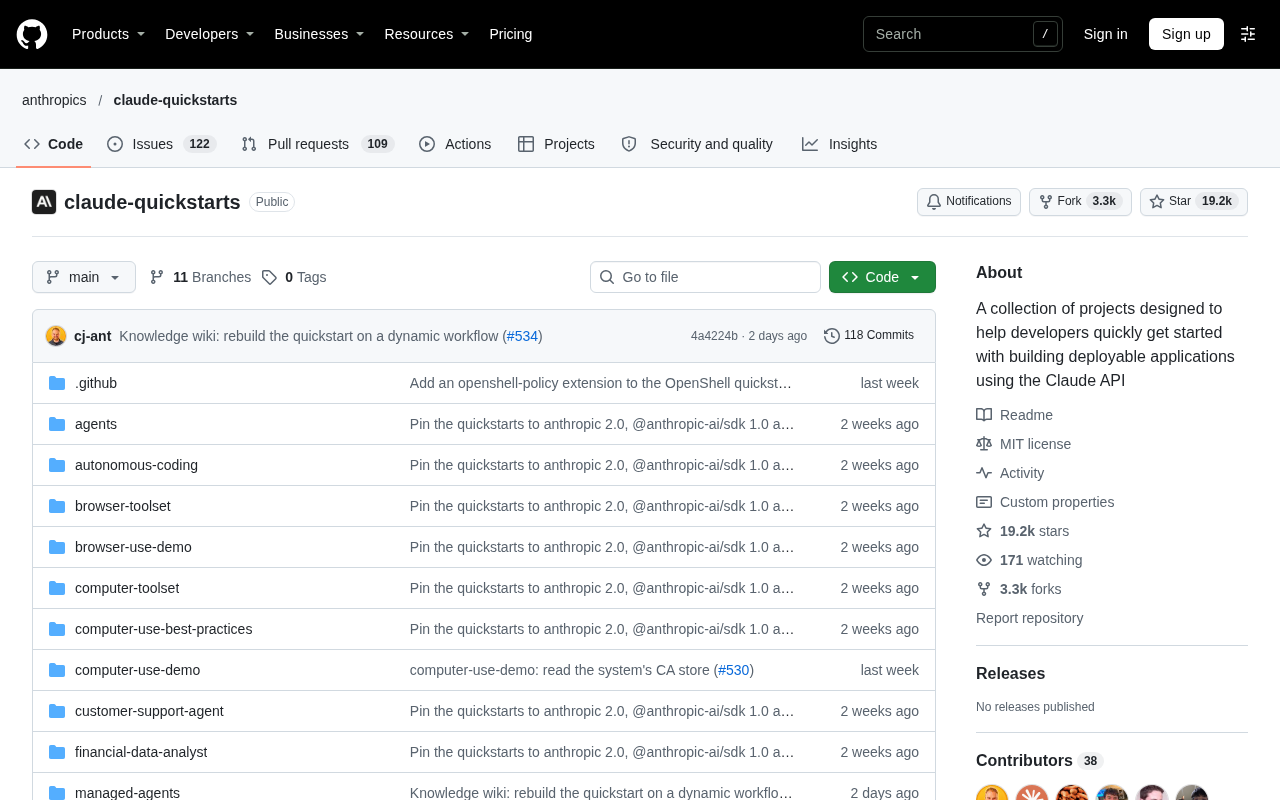
Anthropic's official claude-quickstarts project collection helps developers quickly build deployable apps with the Claude API. Nearly 20k stars, Python-based, great for beginners and prototyping.
 Tech Frontiers
AI Agents Connecting Directly to APIs: Which Calls Can Be Safely Allowed?
AI agents can call any API, but the real challenge is deciding which calls can be safely allowed. This article analyzes allowance decisions from three dimensions—intent matching, least privilege, and controllable impact—and argues that the control layer should sit outside the agent, combined with audit traceability to build a trustworthy API call governance mechanism.