Perplexity Pro Experience in Decline: Silent Model Switching and Quality Drop Frustrate Paying Users
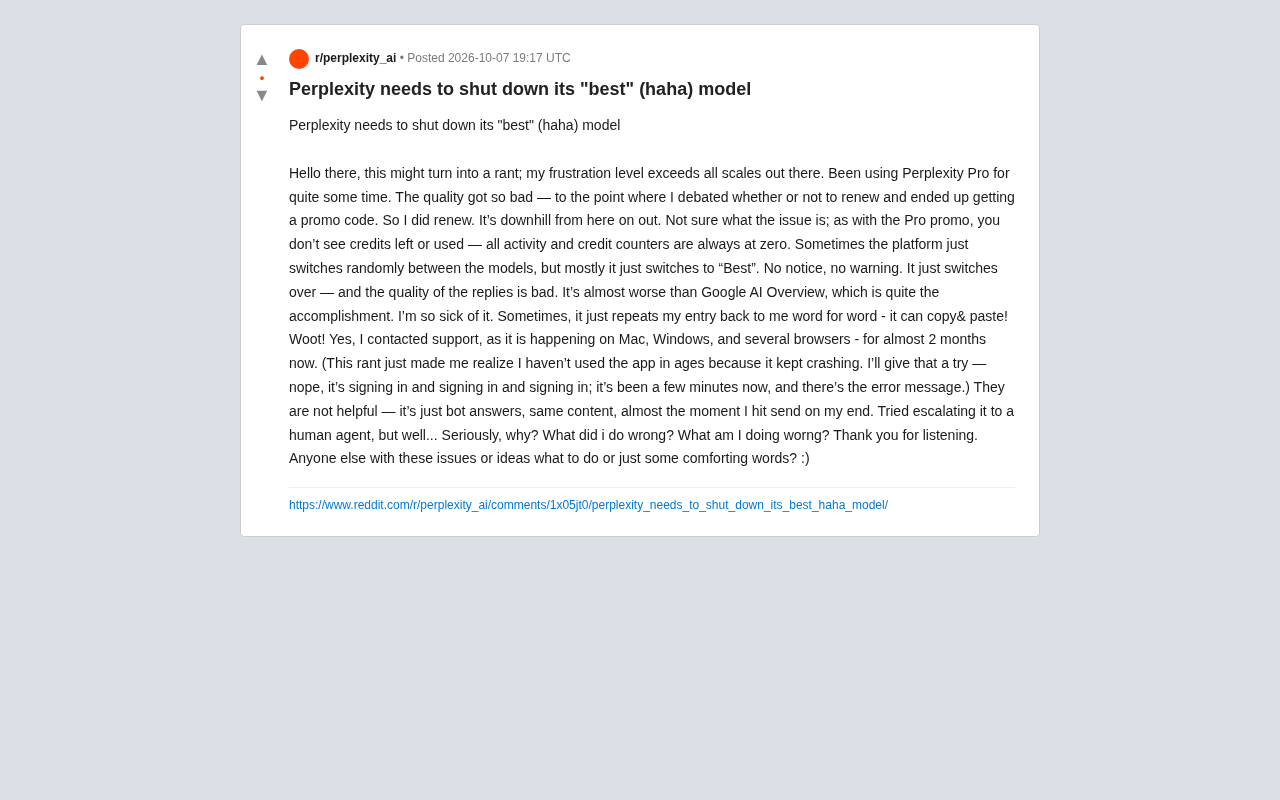
A Perplexity Pro user documents silent model downgrades, opaque credits, app crashes, and bot support as signs of product decline.
A long-time Perplexity Pro subscriber detailed a sharp decline in experience on Reddit: the platform silently switches chosen high-performance models to "Best" auto-routing without notice, causing a significant drop in answer quality — including cases where the model simply echoed the question back. On a promo code account, usage credits are invisible, making it impossible to diagnose the cause. The desktop app has been crashing on both Mac and Windows for nearly two months, and customer support replies are near-instant bot responses that fail to resolve anything. The case highlights systemic gaps in AI subscription products around model transparency, usage visibility, cross-platform stability, and human support coverage.
A Paying User's Real Frustration
A long-time Perplexity Pro subscriber recently posted a scathing review of the product on Reddit. This wasn't a technical breakdown — it was a raw user experience rant. Yet it reflects a broader challenge facing AI search tools today: product stability and transparency.
The user said they had been on Perplexity Pro for quite a while, but the product had deteriorated so badly that they seriously considered not renewing. They eventually re-subscribed with a promo code — but things didn't improve. In their own words: "From here it was all downhill."
The Core Complaint: Models Being Silently Switched to "Best"
The most prominent grievance in the post was that the platform randomly switches the underlying model without any notification — and most of the time, it switches to one called "Best."
"No notice, no warning, it just switches over — and the quality of the answers is terrible. Almost worse than Google AI Overview, which is really saying something."
The user described a particularly absurd experience: sometimes the model would return their question back to them word for word. "It copy-pastes! Great!" The sarcasm barely masked the underlying despair over answer quality.
For paying users, the ability to choose a model is supposed to be one of the core value propositions of a Pro subscription. When the platform quietly swaps in a lower-quality model without the user's knowledge, it not only undermines the point of paying — it erodes fundamental trust in the product.
Lack of Transparency: Invisible Usage Counters
Another notable issue is usage transparency. The user mentioned that because they were on a promo code, they couldn't see any remaining or used credits — "All activity and credit counters always show as zero."
This left them completely unable to assess their usage status or understand why the model kept switching. Whether there's a connection between credit exhaustion and model switching, or whether promo accounts are subject to different backend policies — all of this was a black box. Without visible usage metrics, troubleshooting becomes nearly impossible, which only amplifies the frustration.
Perplexity Pro's credit system uses a tiered metering model: calls to high-compute models like GPT-4o and Claude consume "premium query" quotas (typically capped daily or monthly), while using the in-house model or "Best" mode consumes fewer or no credits. Under a standard paid account, this is reflected in the interface so users can track their consumption. However, promo code accounts may have different backend permissions and metering logic compared to standard paid accounts — which could explain why the credit panel always showed zero. This not only cuts off the user's ability to monitor their own usage, but makes it impossible to verify whether a model downgrade was triggered by hitting a quota limit. It creates a dead-end of information asymmetry.
Stability and Support: A Double Disappointment
The problems didn't stop at answer quality. While writing the post, the user "happened to realize" they hadn't opened the desktop app in a while — because it kept crashing. They tried logging back in on the spot and got stuck in a login loop, eventually greeted by an error message.
Cross-platform consistency was equally poor: the issue persisted on Mac, Windows, and multiple browsers — for nearly two months.
The customer support experience was just as discouraging. After reaching out, the user received what were essentially bot replies — generic, and sent "almost the instant I hit send." Attempts to escalate to a human agent went nowhere. For a paid subscription service, that level of support is hard to accept.
This Isn't an Edge Case — It's a Product Signal
Setting aside the emotional tone, the issues raised in this post have broad relevance:
- Silent model downgrading: When AI products automatically switch to cheaper models under load or cost pressure without telling users, they directly damage the paid experience and erode trust.
- Opaque metering: If credit and model-call mechanics are invisible to users, both troubleshooting and communication hit a wall.
- Cross-platform stability: Basic experience issues like app crashes and login loops often matter more to user retention than model capability.
- The limits of support automation: Pure bot responses fall short when handling complex, ongoing issues — without a human fallback, user frustration compounds.
It's worth noting that this is a single user's subjective experience and can't represent all Perplexity Pro users. Some specific issues may also be tied to the particular configuration of promo accounts. But it offers a perspective from a real paying user — a reminder to AI product teams that model capability matters, but so do transparency, stability, and support quality when it comes to keeping subscribers.
A Few Tips for Users in Similar Situations
If you're experiencing something similar, consider: checking whether you can manually lock your preferred model in settings; clearing the app cache or switching to the web version to troubleshoot login issues; and including specific timestamps and screenshots when contacting support to improve your chances of reaching a human agent. Of course, if problems persist, reassessing the subscription's value is entirely reasonable.
Background: How Perplexity's Model Selection Works
It's worth briefly explaining Perplexity's model selection mechanism. One of Perplexity Pro's core selling points is letting users manually specify which underlying model to use — including third-party flagship models like GPT-4o, Claude 3.5 Sonnet, and Gemini 1.5 Pro, as well as Perplexity's own Sonar series. The "Best" (or "Auto") mode is a platform-managed routing option that automatically selects a model based on query type; which model is actually called is opaque to users and may shift dynamically based on platform policy.
During peak usage or under cost pressure, the auto-routing system may prioritize lower-compute models over the high-performance ones users expect. The core problem with this kind of "silent downgrading" is that the platform provides no notification when a switch occurs — leaving users to receive degraded answers without knowing why, with no way to detect it.
Related articles

How Big Can Stars Really Get? The Physical Limits of the Largest Stars
Red supergiants are the largest stars by volume, with radii up to 2,000 times the Sun, engulfing the inner solar system. But there is no precise upper limit on stellar size—models predict up to 15,000 solar radii. The most massive blue stars are far smaller than red supergiants—biggest and heaviest are two different things.

Apple HomeView Smart Display Full Feature Breakdown: Wall-Mount or Desktop, $299
Apple launches HomeView, a $299 smart display with wall-mount and desktop options, 12MP camera for facial recognition, smart home control, music playback, and recipe step-by-step cooking. Full breakdown of watch faces, apps, privacy, and cooking integration.

Where Did the Promised New Studio Go? Craft Computing Answers After Five Years
Craft Computing's host responds to viewer questions: the new studio promised five years ago was shelved as construction costs soared from $30,000 to $75,000, and was replaced by a 168-square-foot garage conversion.