Perplexity Pro Image Generation Quota Controversy: Paid Users Hit Monthly Limit After Just 1 Image

Perplexity Pro users hit image quota after 1 generation; system contradictorily suggests upgrading to Pro.
A Perplexity Pro subscriber reported being blocked from generating a second image after hitting the monthly quota limit — despite being a paid user. The system's error message paradoxically suggested upgrading to Pro, revealing potential bugs in quota calculation, account status recognition, or AI-generated error prompts. The incident highlights broader transparency issues in AI subscription quota management.
The Incident: Pro Subscriber Blocked After First Image Generation
Recently, a Perplexity Pro paid subscriber shared a perplexing experience on Reddit. The user mentioned they rarely used Perplexity and one day opened the app to try image generation for the first time, successfully producing a "rocket launch pad coloring page." However, when they attempted to generate a second image — a coloring version of an aerial photo of a wetland/swamp delta — the system displayed a quota limit notification.
The full message returned by the system was:
"You've reached your monthly image generation limit, so I wasn't able to create the aerial wetland/swamp delta coloring page for you this time. The rocket launch pad coloring page was generated successfully earlier, but this second request for the aerial wetlands image hit your monthly image generation quota. The system suggests you can wait a few days for the limit to reset, or upgrade to Pro or Max for higher generation limits."
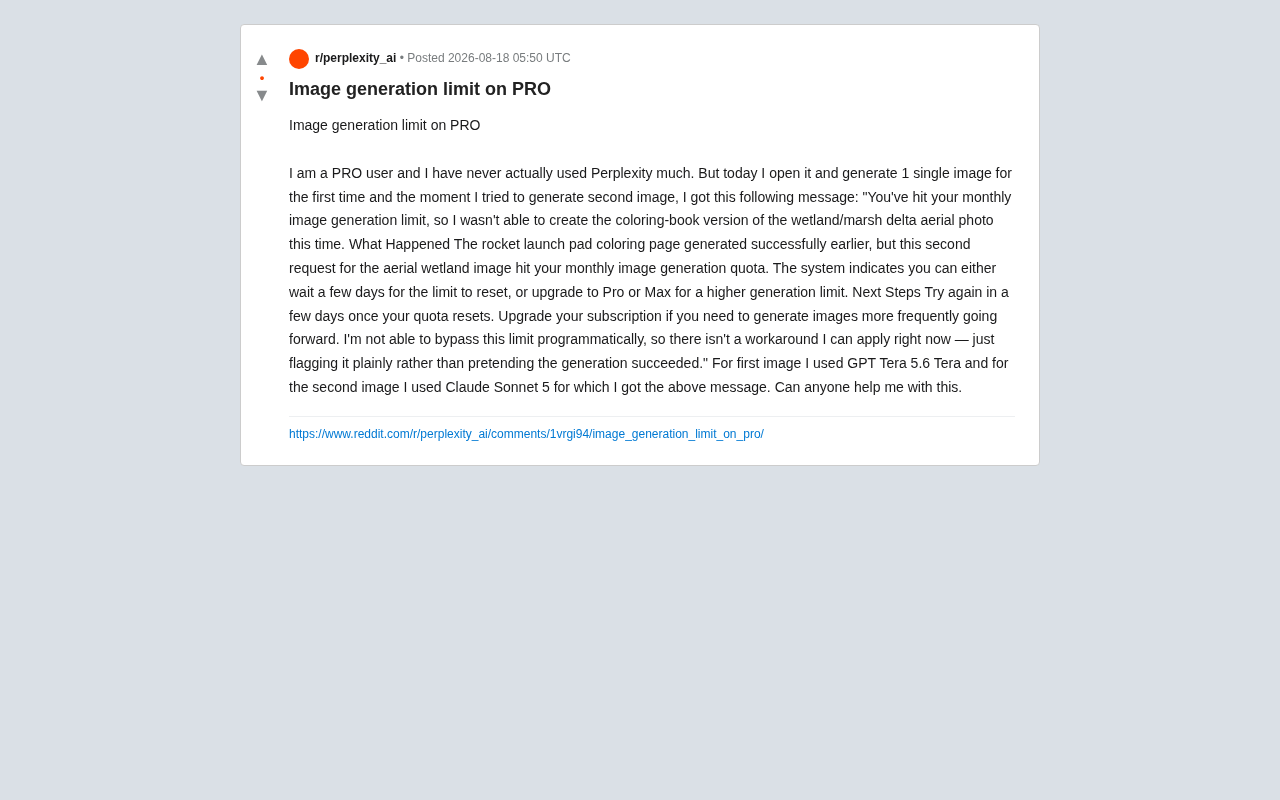
Here's a notable detail: the user explicitly pointed out that they were already a Pro subscriber, yet the system advised them to "upgrade to Pro or Max." This self-contradictory prompt only deepened the confusion and frustration.
What Is Perplexity?
To understand the context of this incident, it helps to know Perplexity AI's product positioning. Founded in 2022, Perplexity AI is an AI search product centered on being an "Answer Engine" — unlike traditional search engines that return lists of links, it directly generates structured answers with cited sources. Its Pro subscription plan costs approximately $20 per month, offering access to more powerful models, higher query limits, and additional features like image generation. As of 2024, Perplexity has raised over $700 million in funding with a valuation exceeding $9 billion. Its user base is growing rapidly, making it a major player in the AI search space competing directly with Google SGE, You.com, and others. For a company with such a high valuation in a rapid expansion phase, the quality of the paid user experience directly impacts its market reputation and growth momentum.
Breaking Down the Problem: Why Did a Paid User Hit the Quota After Just 1 Image?
Possible Technical Causes
Several noteworthy clues emerge from the user's description. The user employed different underlying models for the two generation tasks: the first image used "GPT Tera 5.6 Tera," while the second — the one that triggered the limit — used "Claude Sonnet 5."
Some background on these models is useful here. GPT Tera 5.6 Tera belongs to OpenAI's GPT family of large language models, while Claude Sonnet 5 comes from Anthropic — an AI safety company founded by former OpenAI researchers. Perplexity's distinctive feature as an aggregation-style AI platform is that it allows Pro users to freely switch between multiple underlying LLMs. However, this multi-model architecture means the backend must simultaneously manage API call relationships, cost accounting, and quota allocation across multiple providers — a complexity far exceeding that of single-model products. API call costs vary significantly between models, and image generation typically invokes dedicated vision models (such as DALL-E 3 or Stable Diffusion), whose per-inference cost is substantially higher than pure text generation.
This detail suggests several possibilities:
- Quota calculation anomaly: Perplexity's image generation quota may have a billing or counting logic bug, causing a single image generation to be incorrectly recorded as exhausting the entire monthly quota. In distributed systems, quota counting typically relies on distributed counters or rate limiters. When data synchronization between multiple microservices experiences latency or inconsistency, such erroneous determinations can occur.
- Model switching effects: Different model calls may correspond to different quota pools, and switching models may have triggered a restriction mechanism that wasn't clearly communicated. For example, image generation quotas for certain models may have been set extremely low or even to zero, with the system failing to warn users at the time of model selection.
- Account status misidentification: The system may have encountered issues recognizing the user's subscription tier, misclassifying a Pro user as a free user and applying the stricter free-tier limits. This could happen in scenarios such as subscription status cache expiration or synchronization delays between the payment system and the permissions system.
Why Does AI Image Generation Require Strict Quota Management?
The fundamental reason AI image generation requires independent and typically stricter quota management is that its computational cost far exceeds that of text generation. Current mainstream image generation models (such as DALL-E 3, Midjourney, Stable Diffusion XL, etc.) are built on diffusion model architectures, requiring dozens to hundreds of denoising iteration steps on GPUs per generation. Inference time for a single image typically ranges from a few seconds to over ten seconds, with significant GPU memory and compute consumption. By comparison, a single text conversation inference may cost only one-tenth or even less than image generation. This explains why virtually all AI platforms impose separate and stricter quota limits on image generation — but that doesn't mean "running out after one image" is reasonable.
The Logical Contradiction in the Prompt
The most striking aspect is that the system's advice to a Pro user was to "upgrade to Pro or Max." This obvious contradiction indicates either that the AI experienced hallucination when generating the prompt text, or that the backend's user tier determination was genuinely flawed.
AI "hallucination" is one of the most central challenges in the LLM field, referring to instances where AI models generate information that appears plausible but is actually incorrect or nonexistent. In this case, the AI model generating the prompt text may not have queried the user's actual subscription status in real time, instead generating an incorrect suggestion based on generic error templates or common patterns from training data. This phenomenon is particularly dangerous in AI customer service and error handling scenarios, as users naturally expect system prompts to be precise factual information rather than speculative model output. The industry is currently employing techniques such as Retrieval-Augmented Generation (RAG), factuality verification layers, and structured output constraints to reduce hallucinations, but in seemingly simple scenarios like error prompts, the hallucination problem is often overlooked.
This contradiction also reflects a clear shortcoming in current AI products' error handling and user communication. When an AI system needs to explain system-level restrictions to users, if the explanation itself is generated by AI rather than returned as structured information directly from the engineering system, these kinds of absurd situations easily arise.
The Quota Transparency Problem in AI Subscription Products
Reasonable Expectations of Paid Users
The reason this incident sparked community discussion is that it strikes at the heart of paid users' reasonable expectations. When users pay for a Perplexity Pro subscription, they typically expect usage limits far exceeding those of free users. The experience of "generating one image and exhausting the monthly quota" — whether a bug or a design issue — severely violates this expectation.
To its credit, the AI's tone in the prompt was relatively honest — it explicitly stated, "I can't programmatically bypass this limit, so there's no workaround available right now — I'm just being straightforward about it rather than pretending the generation succeeded." This level of transparency in AI interactions is commendable.
Lack of Clear Quota Rules
This case exposes a widespread shortcoming in quota rule transparency across many AI subscription services.
For industry context: OpenAI's ChatGPT Plus has dynamic message limits for GPT-4o, with independent metering for different models and features (text, images, code interpreter); Google's Gemini Advanced similarly has implicit limits on image and video generation. This complexity stems from the high cost of AI inference — generating a single AI image may cost between $0.02 and $0.12, while video generation represents an order-of-magnitude increase. Consequently, quota systems need to complete user authentication, subscription tier determination, current usage queries, and remaining allowance calculations within millisecond-level response times. When systems involve multiple microservices, multiple model providers, and distributed databases, latency or inconsistency in any single component can lead to quota determination errors.
Users often have no way to clearly understand the following until they actually hit a limit:
- Specific image generation caps for each subscription tier
- Whether different models consume different quotas
- Quota reset cycles and calculation methods
- Real-time access to view current usage
For a product like Perplexity whose core positioning is as an "Answer Engine," image generation is a relatively new capability, and its quota management system may not yet be mature. This explains why such an obvious experience gap could occur. In the competitive landscape where AI products rapidly stack new features, the engineering priority of quota management systems often falls below that of developing and launching new features — but this incident demonstrates that the cost of neglecting this aspect may be greater than anticipated.
Recommendations When Encountering Perplexity Quota Limits
For users experiencing similar issues, the following steps are recommended:
- Contact Perplexity's official support: Since the prompt itself contains a logical contradiction (advising a Pro user to upgrade to Pro), this is very likely a system bug. Report it to the official team and request verification of your account status.
- Check your account subscription status: Confirm that your Pro subscription is properly activated, payment was successful, and the system correctly identifies your account as a paid user. Pay particular attention to whether a failed payment caused a subscription downgrade, or whether a free trial period ended without proper renewal.
- Wait for quota reset and observe: Follow the system's suggestion to wait a few days before retrying, and observe whether the limit returns to normal to determine if it was a temporary glitch or a persistent issue.
- Keep usage logs: Retain generation records and error screenshots as evidence for filing a complaint with the company. Details such as the model name used, timestamps, and the complete system prompt text can help the engineering team pinpoint the root cause.
Conclusion
This seemingly minor "image generation quota" incident reflects a challenge commonly faced by AI subscription products during rapid iteration: the pace of feature expansion often outstrips the refinement of quota management, error handling, and user communication systems. For Perplexity, having a paid user hit a limit after generating just one image — and then receiving a self-contradictory upgrade suggestion — is an experience that undoubtedly damages brand trust.
As more AI products incorporate high-compute features like image generation and video generation into their subscription tiers, how to manage user quotas clearly, transparently, and fairly will become a key factor in determining product reputation. Transparent rules, accurate status identification, and honest error prompts are all indispensable. From a broader perspective, this is also a maturity threshold that the entire AI industry must cross in its transition from being "technology-driven" to "product-driven" — when users pay for AI capabilities, they're not just purchasing compute power and model access, but a predictable, trustworthy service experience.
Related articles

Apple Watch ECG Detects Atrial Fibrillation, Saves Triathlete's Life: A Real-World Story
Triathlete Connor's heart rate spiked to 219 bpm during a race. His Apple Watch ECG detected AFib, leading to open-heart surgery that fixed a hidden heart condition.

Norcross Maine Forest Fire Maps: A Century-Old Cartographic Legacy and Data Visualization Pioneer
Explore Archie G. Norcross's 1918–1922 Maine forest fire maps—a hand-drawn cartographic masterpiece that pioneered early data visualization and remains valuable for climate research, historical GIS, and AI fire monitoring.

Apogee: A Privacy-First Browser Summarization Extension Rebuilt with Local AI After Mozilla Killed Orbit
After Mozilla killed Orbit, an indie developer rebuilt a fully local AI browser summarization extension called Apogee using Ollama, WebGPU, and Transformers.js—no user data ever leaves your device.