Perplexity Pro Renewal Date Suddenly Changed: Shrinking Free Perks Spark Contract Dispute
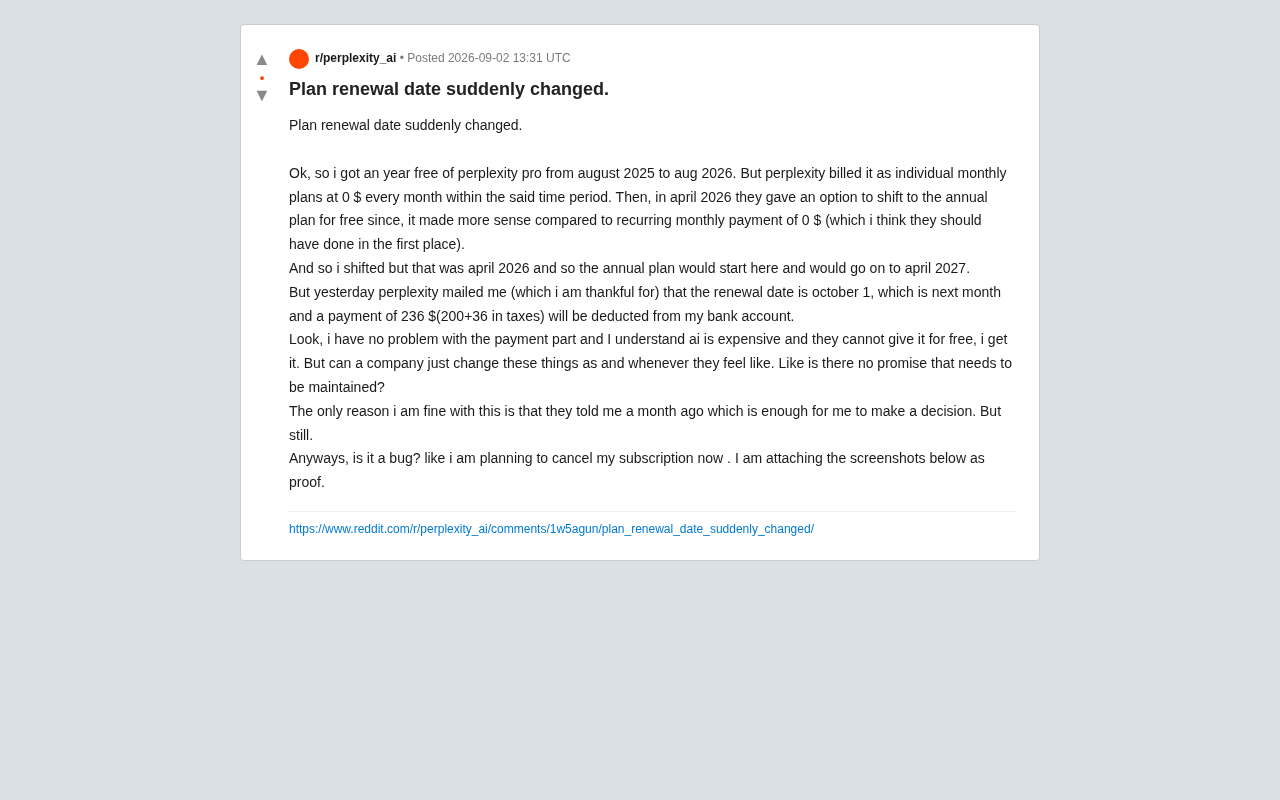
Perplexity Pro user faces surprise early renewal and $236 charge after free subscription period is cut short.
A Reddit user reported that their one-year free Perplexity Pro subscription was unexpectedly shortened, with a $236 renewal charge scheduled six months earlier than expected. After the free plan was restructured from monthly $0 billing to an annual plan, the renewal date jumped forward without explanation. The incident highlights growing concerns about contractual integrity, billing system transparency, and user trust in the rapidly expanding AI subscription economy.
How It Started: From a Free Year to Sudden Charges
Recently, a Reddit user posted about a puzzling renewal date change on their Perplexity Pro subscription, quickly sparking a heated community discussion about the contractual integrity of AI subscription services.
Perplexity is an AI search engine company founded in 2022 by former OpenAI researcher Aravind Srinivas. Its core product combines large language models with real-time web search, automatically citing sources when answering questions — positioning it as an AI alternative to traditional search engines. Perplexity Pro, its paid subscription tier, is currently priced at $20/month or $200/year, offering access to more powerful AI models (including GPT-4, Claude, etc.), unlimited Pro searches, file upload analysis, and other premium features. By the end of 2024, Perplexity's valuation had exceeded $9 billion, with over 15 million monthly active users.
The story begins in August 2025. This user received a one-year free Perplexity Pro subscription. In the AI industry, such free perks are a common user acquisition strategy, typically originating from bundled partnerships with carriers or hardware manufacturers (e.g., T-Mobile, Samsung, and other partners offering free subscriptions), promotional codes, early adopter reward programs, or specific credit card benefits. The business logic behind this strategy is to cultivate user habits and dependency during the free period, hoping to convert them into paying customers once it ends.
In theory, this free benefit should have lasted from August 2025 to August 2026. However, rather than processing it directly as an annual free plan, Perplexity handled it as a "Personal Monthly plan at $0/month" — in other words, the system generated a $0 invoice every month. This approach itself harbored hidden risks: when free subscriptions are entered into billing systems in special ways that differ from standard paid subscription logic, they're prone to technical compatibility issues whenever they expire or undergo structural adjustments.
The turning point came in April 2026. Perplexity offered the user an option: switch from the monthly plan to an annual plan for free. The user found this more reasonable than the recurring $0 monthly invoices (he also noted this was what the company should have done from the start), so he accepted the switch. By any reasonable expectation, this annual plan should have run from April 2026 to April 2027.
The Surprise Renewal Notice: A $236 Charge Warning
However, just yesterday, the user received an email notification from Perplexity: the renewal date had been set for October 1 — next month — at which point $236 ($200 subscription fee plus $36 in taxes) would be charged to their bank account.
This was a full six months earlier than the expected "April 2027 renewal." Neither the originally promised free period (through August 2026) nor the switched annual plan (through April 2027) was honored. Instead, they were replaced by a payment date that arrived far ahead of schedule.
One notable detail: the user's attitude toward this experience was remarkably rational. He explicitly stated:
"I have no problem paying — I understand AI costs are high, and the company can't offer it for free forever. I get all that."
The one thing he appreciated was that Perplexity notified him of the change via email a month in advance, giving him enough time to make a decision. That was the main reason he wasn't more upset.
The Core Dispute: Contractual Integrity and Unilateral Changes in AI Subscriptions
What this incident truly touches on is a deeper issue within subscription-based services: Can companies unilaterally change their commitments to users at any time?
The user was blunt in his post:
"Can a company just change these terms on a whim? Aren't there commitments that need to be honored?"
This question strikes at a pain point of today's AI subscription services. When users make decisions based on a clear time commitment (free through August 2026, annual plan through April 2027) and the provider then dramatically moves up the renewal date, the damage to user trust is undeniable.
From a legal perspective, the user's concerns are backed by clear regulatory frameworks. In the United States, the Federal Trade Commission (FTC) passed the "Click-to-Cancel" rule in 2024, requiring subscription services to make cancellation as easy as sign-up and to obtain explicit consumer consent before any material terms change. California's Automatic Renewal Law requires businesses to provide clear disclosure before auto-renewals and send reminder notices before charging. The EU's Consumer Rights Directive is even stricter, granting consumers a 14-day cooling-off period. However, in practice, most AI services include catch-all clauses in their user agreements that allow the company to modify terms. Users often face prohibitively high costs for evidence gathering and litigation when trying to assert their rights, which means "contractual integrity" frequently amounts to little more than words on paper.
System Bug or Strategic Adjustment?
The user himself also pondered: was this a billing system bug or a deliberate move by Perplexity?
From a technical standpoint, this kind of situation could indeed stem from billing system confusion. Modern SaaS subscription billing systems are far more complex than they appear on the surface. A mature billing system needs to handle multiple scenarios: converting from free trials to paid periods, switching between monthly and annual billing (involving proration logic for calculating remaining days), stacking promo codes and discounts, calculating taxes across different tax jurisdictions, and handling price differences during upgrades and downgrades. Many companies use third-party billing platforms like Stripe, Chargebee, or Recurly to manage this complex logic, but when a subscription undergoes multiple state changes during its lifecycle, the probability of errors in date tracking and cycle mapping increases significantly.
Looking back at the entire process, Perplexity's handling itself involved multiple back-and-forth changes:
- Initially packaging a one-year free offer as a "$0/month monthly plan" instead of a straightforward annual free plan
- Later offering an option to switch to an annual plan mid-stream
- Ultimately moving up the renewal date to October, which didn't match either of the two expected dates
This pattern of repeatedly changing the billing structure within a single subscription lifecycle is inherently prone to generating date calculation errors. If the annual plan's start and end dates fail to correctly inherit the remaining time from the free period, the renewal date could be erroneously "reset" — for example, the system might have mistakenly backdated the annual plan's start date to around October 2025 (when the free subscription was first activated), causing the first "paid year" to expire right in October 2026.
Practical Takeaways for AI Subscription Users
Whether this was a bug or a strategic adjustment, this incident offers several cautionary lessons for AI service subscribers.
First, save all subscription records. The user deliberately included screenshots as evidence in his post — a critical asset for any subsequent dispute resolution. Whether it's a free perk, a promotional offer, or a plan switch, every step should be documented with email confirmations and interface screenshots.
Second, pay close attention to billing notifications. The user was able to respond in time entirely thanks to Perplexity sending an email reminder a month in advance. Making it a habit to regularly check billing notifications from service providers is the only way to react before unexpected charges occur. It's also advisable to use virtual credit cards or set up spending alerts when subscribing to AI services, so you can catch and address unexpected charges immediately.
Third, beware of billing "traps" lurking behind free perks. Many AI products acquire users through free trials or complimentary memberships, but these benefits are often processed in special ways within billing systems. When they expire or undergo structural changes, unpredictable charges can result. This user's final decision was to cancel his Perplexity Pro subscription.
Conclusion
This seemingly ordinary renewal date change reflects the rough management behind the rapid expansion of the AI subscription economy. As competition intensifies among paid AI services like Perplexity, ChatGPT Plus, Claude Pro, and others, every company is using various free perks to capture users — but billing system transparency and the reliability of commitments may not be keeping pace with the speed of growth.
The AI paid subscription market has now formed a multi-tiered competitive landscape. OpenAI's ChatGPT Plus ($20/month) and Pro ($200/month), Anthropic's Claude Pro ($20/month), Google's Gemini Advanced (approximately $20/month), and Perplexity Pro make up the first tier. The global AI subscription services market is estimated to have exceeded $10 billion in 2024, yet churn rates remain stubbornly high — with the industry average monthly churn rate between 5% and 10%. This means every billing dispute or trust crisis could quickly drive users toward competitors.
For companies, even a $0 free plan should be presented in a clear, consistent manner, and any changes must be communicated well in advance. As this user acknowledged, a one-month advance notice, while not perfect, at least shows basic respect. For users, staying vigilant about billing details while enjoying the benefits of AI may well be an essential skill in this subscription era that cannot be overlooked.
Related articles

Python 3.15 New Feature: Is the sentinel Type Better Than None?
Python 3.15 adds the sentinel type, using named unique sentinel objects to replace None and bare object(), resolving confusion among missing values, explicit emptiness, and invalid input while avoiding type hint failures.

Deep Learning's Three Architectures and the Universal Approximation Theorem: A Complete Guide to MLPs, CNNs, and Transformers
Explaining the inductive bias differences among MLP, CNN, and Transformer, the existence meaning of the Universal Approximation Theorem (UAT), and the role of Taylor expansion in approximation analysis, while clearing up common misconceptions.

GitLab Emergency Patch Release: Analysis of Critical Security Fixes
GitLab releases critical patch 19.5.1, sparking 355 points of discussion on Hacker News. This article analyzes the background, upgrade steps for self-hosted instances, and verification points to help DevOps teams respond quickly to security updates.