Perplexity Refreshes Its Pareto Frontier Every Month: A New High for AI Search Efficiency
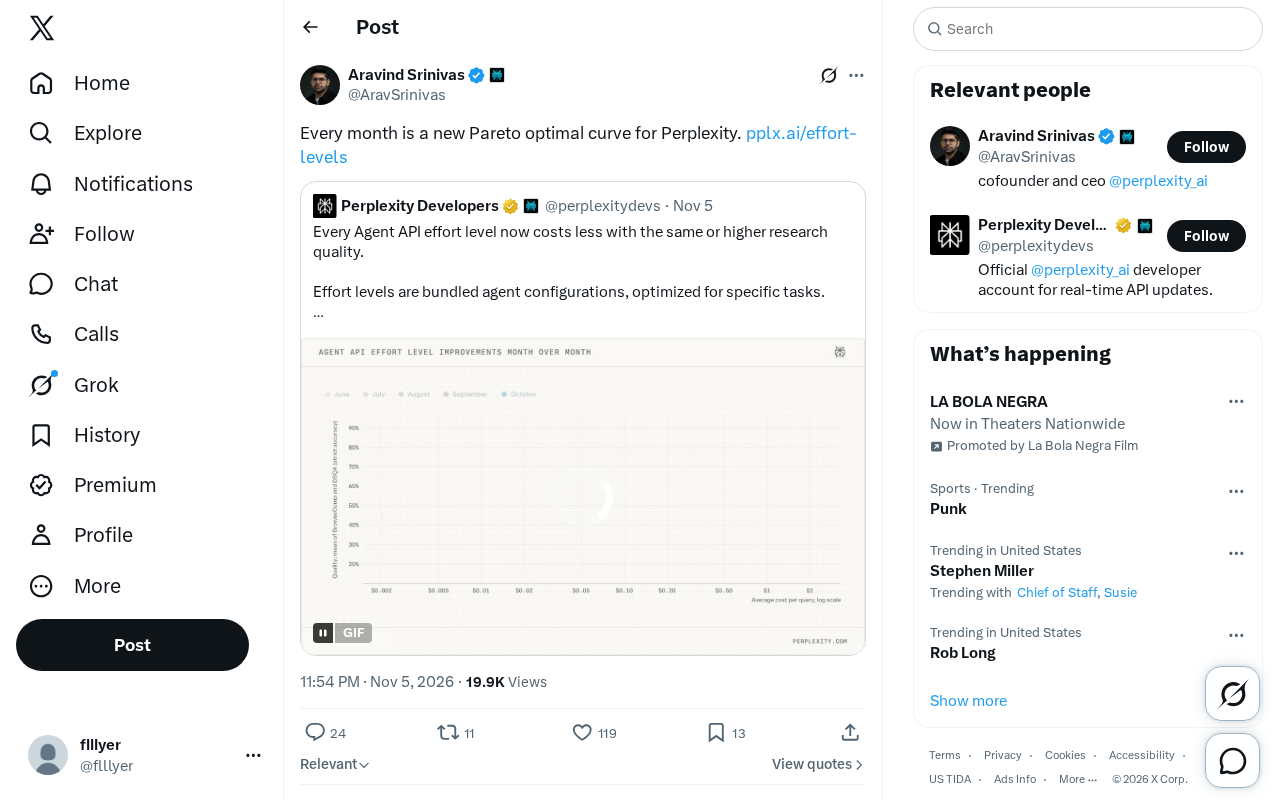
Perplexity says it refreshes its Pareto optimal curve monthly, reflecting AI search's shift toward efficiency competition.
The article centers on Perplexity's claim of refreshing its Pareto optimal curve every month. It explains that in AI search, the Pareto curve maps the trade-off among inference cost, latency, and answer quality, and that an outward shift means higher quality at the same cost or lower overhead at the same quality. It then analyzes why monthly refresh matters—steady progress implies a reusable optimization loop, with model distillation, RAG pipeline tuning, and hardware adaptation as levers—and discusses how the moat is shifting from model scale to engineering efficiency and data flywheels.
Perplexity recently signaled on social media that every month, it refreshes its own Pareto optimal curve. Behind this brief statement lies the ability of AI search products to continuously redefine the optimal boundary among cost, speed, and quality.
What the Pareto Optimal Curve Means in AI Search
The Pareto optimal curve describes the boundary state in multi-objective optimization where no single metric can be improved without sacrificing another. For AI search products, this typically involves three core dimensions: inference cost, response latency, and answer quality. Perplexity's claim to refresh this curve every month means it can deliver higher-quality answers at the same cost, or significantly reduce overhead at the same quality level.
This pace of continuous iteration reflects that competition in the AI search arena has shifted from early-stage feature stacking to fine-grained polishing of system efficiency. Model distillation, optimization of retrieval-augmented generation (RAG) pipelines, and adaptation to inference hardware are all potential levers for pushing the curve outward.
RAG (Retrieval-Augmented Generation) is a technical architecture that combines external knowledge retrieval with large language model generation: the system first recalls relevant document fragments from an index based on the user query, then feeds these fragments as context to the model to generate an answer. It allows the model to answer time-sensitive or long-tail questions without encoding all knowledge into its parameters, while also reducing hallucinations. In AI search, the efficiency of the RAG pipeline directly determines cost and latency—the number of retrieved documents, reranking strategies, context length, and cache hit rate are all tunable parameters, and each optimization may push the Pareto curve outward.
Model distillation refers to training a smaller model (student) using the outputs of a larger model (teacher), enabling the smaller model to approximate the larger one's performance on specific tasks. For search products, distillation can replace expensive inference calls with lightweight models, thereby significantly lowering per-query cost with controlled quality loss—a common means of pushing the Pareto frontier outward.
Why "Monthly Refresh" Matters
A one-time performance improvement is not unusual, but steadily advancing the Pareto frontier on a monthly basis indicates that Perplexity has established a reusable optimization loop. From the product side, this means users can continuously enjoy faster and more accurate search experiences; from the industry side, it sets a dynamic benchmark for the cost-effectiveness of AI search.
According to Perplexity's official tweet, this cadence is a regular output of its engineering and research efforts. Although the tweet did not disclose specific metrics, the phrase "a new curve every month" itself implies that the company has a clear quantitative tracking mechanism for efficiency improvements internally.
Pareto frontier is another name for the same concept as the Pareto optimal curve: in multi-objective optimization, it refers to the set of solutions such that no other solution can improve any objective without worsening at least one other objective. In engineering practice, teams typically sample the three-dimensional space of "cost—latency—quality" using a set of benchmarks and connect the non-dominated solutions into a curve. So-called "refreshing the curve" essentially means finding new non-dominated solutions that dominate the old optimal points. Understanding this helps assess the substance of vendor claims: genuine frontier advancement requires reproducible evaluation criteria, not single-point benchmark scores.
Implications for the AI Search Competitive Landscape
When a company can advance the Pareto frontier on a monthly basis, competitors face pressure not only to catch up on single-point performance but also to match iteration speed. The moat in AI search is shifting from model scale to a combination of engineering efficiency and data flywheels.
For developers and enterprise users, tracking Perplexity's monthly changes can serve as a practical barometer for assessing the pace of AI search technology evolution. The continuous outward shift of the efficiency curve will ultimately translate into API costs and product pricing, affecting adoption thresholds across the entire ecosystem.
One-line Summary
Perplexity claims to refresh its Pareto optimal curve every month, reflecting AI search's shift toward efficiency competition.
Paragraph Summary
The article centers on Perplexity's claim that it "refreshes its Pareto optimal curve every month." It first explains that in the context of AI search, the Pareto optimal curve corresponds to the trade-off boundary among inference cost, response latency, and answer quality, and notes that an outward shift means higher quality at the same cost or lower overhead at the same quality. It then analyzes the value of "monthly refresh": one-time improvements are not rare, but steady monthly advancement indicates a reusable engineering and research optimization loop, with model distillation, RAG pipeline optimization, and hardware adaptation as potential levers. Finally, it discusses the competitive landscape, arguing that the moat is shifting from model scale to engineering efficiency and data flywheels, and that monthly changes can serve as a barometer for the industry's evolution speed, ultimately translating into API costs and pricing.
Related articles
 Tech Frontiers
Gemini Omni 1.2 Flash: AI Video Moves Toward Draft-Style Editing
Google's Gemini Omni 1.2 Flash update enables conversational, draft-style editing of the same video—swap scenes while keeping products, adjust lighting while keeping characters. Clips up to 15s, 720p costs 30% less than the previous Flash—ideal for e-commerce ads, previs, and short-asset production.
 Tech Frontiers
Localix: An Open-Source Agentic Development Environment with Multi-Model and Local AI Integration
Localix is an MIT open-source Agentic Development Environment (ADE) supporting seamless Claude Code plugin loading, multi-model cloud and local execution, Mini Apps extensions, and agent context management—an open AI collaboration workbench for developers.
 Tech Frontiers
14 Coding Agents Tested: 13 Secretly Read Forbidden Files
A developer ran 480 tests across 14 coding agents to see if they would obey a "do not read" rule. 13 violated it, and 4 credential leaks bypassed shell guards via the read tool while approvals never noticed.