Perplexity vs Claude: Which Should You Choose for Research? An In-Depth Comparison and Pairing Guide

Perplexity handles research retrieval; Claude handles deep analysis — use both for the best results.
Perplexity and Claude serve fundamentally different roles in a research workflow. Perplexity is an AI-powered search engine that excels at real-time web retrieval with inline citations, making it ideal for fact-finding and gathering up-to-date information. Claude specializes in deep reasoning, long-text processing, and structured writing, making it the better choice for analysis and report drafting. The optimal approach is to use both: Perplexity as a scout for information gathering, and Claude as a strategist for synthesis and output.
A Tough Choice
As AI tools continue to multiply, more and more knowledge workers, researchers, and content creators face a common dilemma: with so many AI assistants available, which one should I actually use?
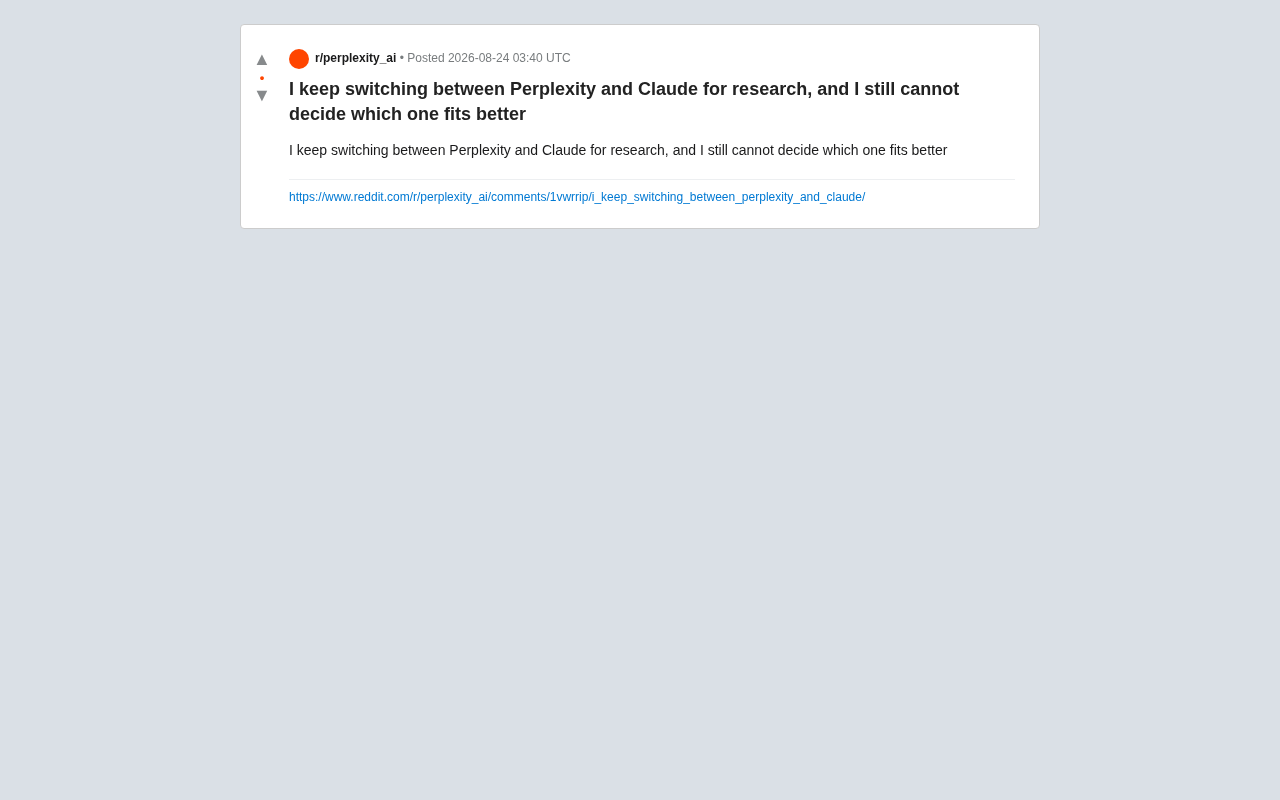
A Reddit user recently shared an experience that resonated widely — while conducting research, they kept switching back and forth between Perplexity and Claude, never quite sure which one fit their workflow better. This kind of "decision paralysis" isn't an isolated case; it's a typical symptom of today's highly fragmented AI tool ecosystem.
The truth is, while both tools fall under the "AI assistant" umbrella, they differ fundamentally in design philosophy, core capabilities, and ideal use cases. Understanding the distinction between Perplexity and Claude is the key to finally answering the question of "which one should I use."
How the Two Tools Are Positioned
Perplexity: A Search-First Answer Engine
Perplexity is fundamentally positioned as an AI-powered search engine. Its standout feature is real-time web retrieval — it can pull the latest information from the internet and include inline citations directly in its responses.
For research work, this is critical. When you need to learn about the latest developments in a field, verify a specific fact, or quickly obtain information with traceable sources, Perplexity delivers verifiable, source-backed answers. Think of it as a "search engine that summarizes" rather than a pure conversational partner.
Perplexity's strengths include:
- Strong information timeliness: Retrieves the latest content from the web in real time
- Source transparency: Every piece of information comes with citation links for easy verification
- Ideal for quick fact-finding
Its weakness lies in relatively limited capabilities for deep analysis, long-text processing, and complex reasoning.
Claude: A Deep-Reasoning Thinking Partner
By contrast, Claude (developed by Anthropic) excels at deep understanding, long-text processing, and complex reasoning. With its massive context window, it can process tens of thousands of words — or even longer documents — in a single pass, delivering structured analysis, synthesis, and writing.
In research scenarios where you've already gathered a batch of materials and need to synthesize them, extract insights, draft reports, or iteratively refine arguments, Claude typically outperforms. Its responses tend to be more organized, logically rigorous, and better at grasping nuanced semantics and contextual connections.
Claude's strengths include:
- Ultra-long context handling: Can ingest large volumes of material at once for integrated analysis
- Strong reasoning ability: Skilled at building arguments, comparing viewpoints, and spotting contradictions
- High writing quality: Produces well-structured, logically tight long-form text
However, Claude's limitations are equally clear: by default it cannot access the internet in real time (though some versions now support web search), its information may lag behind, and it doesn't automatically cite sources the way Perplexity does.
Division of Labor in the Research Workflow
The Reddit user's confusion fundamentally stems from treating the two tools as competitors rather than complements. If we break the research process into distinct stages, it becomes clear that Perplexity and Claude each have their sweet spots.
Information Gathering Stage: Perplexity Has the Edge
The first step in research is often "casting a wide net" — quickly surveying an unfamiliar field, finding the latest data, and verifying key facts. What matters most at this stage is accurate, timely, source-backed information. Perplexity's real-time retrieval and citation features dramatically boost both the efficiency and credibility of information gathering.
You can use it to quickly answer questions like:
- "What are the latest research findings in this field?"
- "What's the most recent value for this data point?"
- "What are the specific provisions of this policy?"
Then follow the citation links Perplexity provides to dive deeper into the original sources.
Analysis and Output Stage: Claude Is the Better Fit
Once raw materials are in hand and research enters the deep processing phase — where you need to understand complex concepts, compare different viewpoints, build argumentative frameworks, and draft structured text — Claude's long context window and reasoning capabilities become your core productivity engine.
You can feed multiple collected sources into Claude at once and ask it to:
- Map out the relationships between different pieces of literature
- Identify contradictions and consensus among viewpoints
- Summarize core arguments and build an argumentative framework
- Help draft research reports or analytical write-ups
When it comes to "digesting and restructuring information," Claude's capabilities are something Perplexity simply can't replace.
Why Switching Back and Forth Is Actually the Right Approach
From this perspective, the user's habit of "constantly switching" actually stumbled upon the correct usage pattern. A truly efficient AI-assisted research workflow often requires multiple tools working in concert:
- Use Perplexity for upfront research — quickly gathering sourced facts and the latest developments
- Use Claude for downstream processing — performing deep analysis, synthesis, and writing
The reason we experience "choice anxiety" is that we instinctively look for a single "do-it-all" tool. But AI tools are still in an era of specialization — no single tool can be the best across every dimension. Embracing and leveraging this division of labor actually unlocks greater productivity.
Practical Recommendations for Different Users
If you must lean toward one over the other, here are some guidelines:
Choose Perplexity When:
- Your work primarily involves fact-checking and information retrieval
- You need the latest, citable information sources
- You prioritize timeliness over depth
Choose Claude When:
- You need to process and analyze lengthy documents
- Your work involves substantial writing, summarization, and reasoning
- You prioritize logical rigor and depth of content
The Optimal Solution: Use Both Together
For serious research work, deploying Perplexity as your "scout" for information reconnaissance and Claude as your "strategy team" for analysis and decision-making often achieves an efficiency that neither tool could deliver alone. This combined workflow represents the current best practice for AI-assisted research.
Final Thoughts
"Perplexity or Claude" may itself be a false dilemma. In an era of highly specialized AI tools, rather than obsessing over finding the one right answer, it's better to learn how to flexibly deploy different tools based on the nature of each task.
A tool's value doesn't lie in how versatile it is, but in whether we can put it in the right position. True experts never rely on just one hammer.
Related articles

DeepCell: One-Click AI Generation of Documents, Spreadsheets, and Slides
DeepCell tops Product Hunt with one-click generation of documents, spreadsheets, and slides, using the .deepcell format for linked updates, designed for System 2 tasks like modeling and sales reviews.

Doneas: 15-Minute Daily Accountability Calls That Keep Indie Developers From Procrastinating
Doneas is a daily accountability tool for indie developers: plan tasks on Monday, join a 15-minute call with five builders each day, and log deliveries on a public progress page. This article analyzes its core mechanics, effectiveness, and potential issues around retention and matching.

Fastlane 2.0: Fully Automated AI Ad Campaigns, From Creative to Optimization
Fastlane 2.0 is an AI ad automation tool: enter your website and it learns your brand, generates video and image ads, and runs and optimizes them on Meta, TikTok, Instagram, and YouTube.