PersonaChatBench: Evaluating Chat Assistants with Diverse Simulated Users
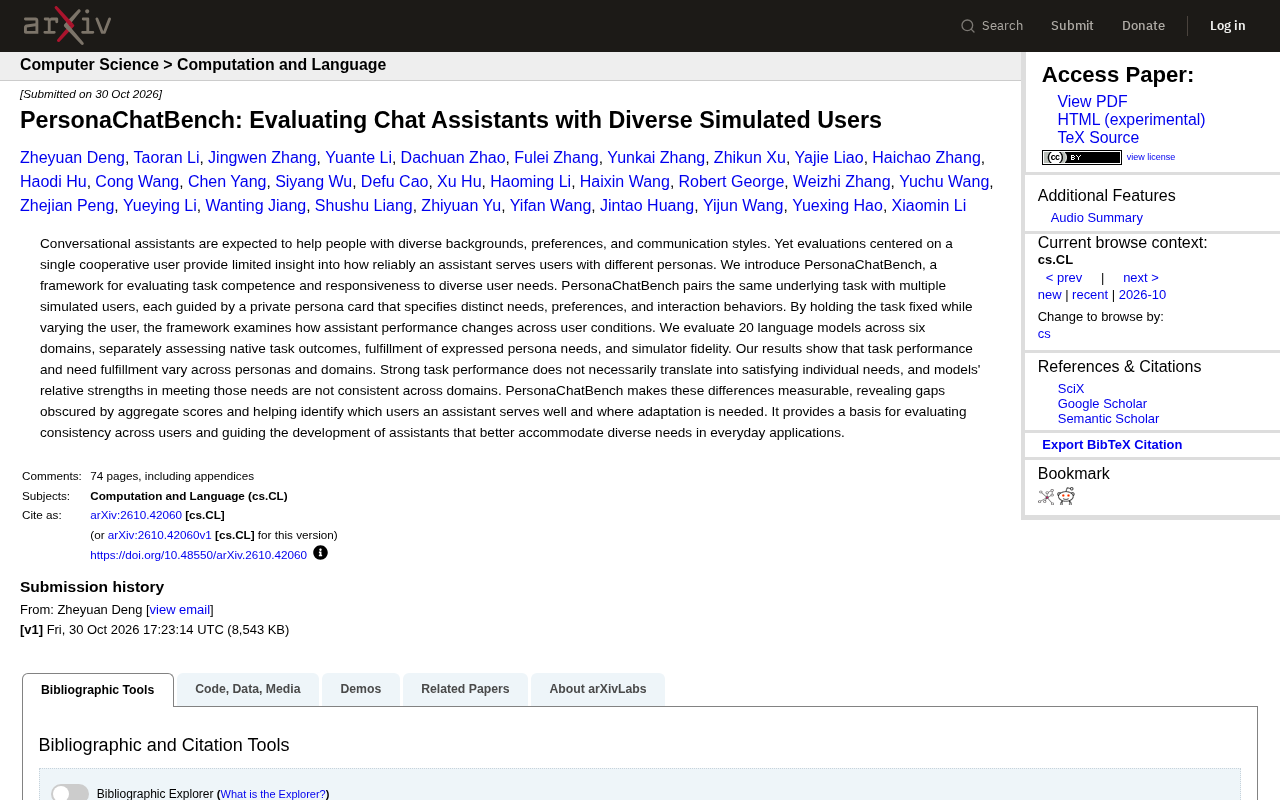
PersonaChatBench evaluates chat assistants with diverse simulated users, showing that strong task performance doesn't mean good service.
Meta's research team introduces PersonaChatBench, which evaluates chat assistants' responsiveness to different user needs by fixing tasks and varying simulated users driven by private persona cards. It covers 20 language models and 6 domains, measuring task outcomes, persona need satisfaction, and simulator fidelity. Strong task performance doesn't guarantee high need satisfaction, and aggregate scores mask differences.
Why Isn't Single-User Evaluation Enough?
Chat assistants need to serve users with different backgrounds, preferences, and communication styles. However, most current evaluations revolve around a single "cooperative" user and fail to reflect how well assistants truly adapt to different populations. Meta's research team introduces PersonaChatBench, a framework for evaluating task capability and responsiveness to needs through diverse simulated users. It pairs the same task with multiple simulated users, each driven by a private "persona card" that specifies their unique needs, preferences, and interaction behaviors. Tasks stay fixed while users vary, making it possible to observe how assistant performance changes with user conditions.
Framework Design: Fixed Tasks, Varying Users
The core design of PersonaChatBench is a "controlled variable" approach to conversation evaluation. Each test case combines the same underlying task with different persona cards. Persona cards are not disclosed to the model and are used only to guide the behavior of simulated users. Simulated users express preferences, ask follow-up questions, or show impatience and other interaction habits just like real users. The evaluation covers 20 language models and 6 domains, assessing three metrics respectively: native task outcomes, satisfaction of expressed persona needs, and simulator fidelity. This separation allows researchers to distinguish between "doing the task well" and "serving the user well."
Persona Card is the core control unit in PersonaChatBench, essentially a structured user profile description that includes dimensions such as the user's need priorities, communication style preferences (e.g., formal/casual, detailed/concise), knowledge background, emotional tendencies, and interaction habits (e.g., follow-up frequency, patience level). It is not directly exposed to the model under test but serves as the system prompt or behavioral constraint for the simulated user (an LLM-driven user agent), ensuring that "user-side" behavior in each conversation remains consistent with the specified persona.
Simulator Fidelity is a meta-evaluation metric used to verify whether simulated users authentically embody the characteristics defined by persona cards. Evaluation methods typically include having independent judge models or rules check whether simulated users consistently maintain the specified preferences and interaction style across multi-turn conversations, avoiding simulated users "drifting" into generic assistant-style responses. A low fidelity score means the persona conditions for that evaluation round may not have been effectively applied, thereby weakening the interpretability of results.
Key Findings: Strong on Tasks ≠ Good at Service
Experimental results show that task performance and need satisfaction fluctuate significantly across personas and domains. A model that scores high on benchmarks may not necessarily satisfy the personalized needs of specific users well. More specifically, a model's relative advantage in meeting needs is not consistent across domains—a model that excels at understanding user intent in domain A may perform mediocrely in domain B. This inconsistency is masked by aggregate scores, while PersonaChatBench makes the differences measurable.
According to the paper, strong task performance does not necessarily translate into satisfactory individual need fulfillment. This means selecting or optimizing assistants based solely on task accuracy may overlook experience gaps for specific user groups.
Aggregate Scores Mask Differences refers to the fact that traditional benchmarks typically average scores across all test cases into a single total score, smoothing out a model's extreme performance across different user personas or domains. For example, a model may perform excellently on 80% of cooperative users but drop sharply on users who need patient explanations or frequent confirmation, yet still appear "good" after averaging. PersonaChatBench exposes this variance by breaking down results by persona and domain, enabling stratified evaluation rather than a single ranking.
Implications for Developers: From Average Scores to User Segmentation
PersonaChatBench provides a method for evaluating consistency across users. Developers can use it to identify which users an assistant serves well and in which situations adaptive adjustments are needed. For example, if a model responds well to one communication style (e.g., direct and concise) but performs worse on another (e.g., needing more explanation), interaction strategies can be improved accordingly. The framework also provides an evaluation foundation for better accommodating diverse needs in everyday applications.
Limitations and Outlook
The current framework relies on simulated users, and although their fidelity is evaluated separately, a gap with real users remains. The construction of persona cards, domain coverage, and the naturalness of simulated interactions all affect the generalizability of conclusions. Future work may need to incorporate more real user data to calibrate simulators and extend evaluation to more task types and complex multi-turn conversations.
The value of PersonaChatBench lies in turning "user diversity" from a slogan into a quantifiable evaluation dimension, driving chat assistants from "good on average" toward "good for everyone."
The Gap Between Simulated and Real Users is a common limitation of such frameworks. Simulated users are driven by language models, and their ways of expressing preferences and emotions are constrained by the underlying model's distribution, potentially lacking features of real users such as slips of the tongue, cross-turn memory bias, cultural contextual cues, or irrational decision-making. In addition, simulated users often have a fairly complete understanding of the task itself, whereas real users may make vague requests when information is incomplete. These differences may cause evaluation results to overestimate or underestimate an assistant's adaptability in real scenarios, so calibrating simulators with real user data is a key step to improving external validity.
One-line Summary
PersonaChatBench evaluates chat assistants with diverse simulated users, revealing that strong task performance does not equal good service.
Paragraph Summary
Meta's research team introduces PersonaChatBench, which evaluates chat assistants' responsiveness to different user needs by fixing tasks and varying simulated users (driven by private "persona cards"). The evaluation covers 20 language models and 6 domains, measuring native task outcomes, persona need satisfaction, and simulator fidelity respectively. Key findings are: strong task performance does not necessarily bring high need satisfaction, and model advantages in meeting needs are not consistent across domains; aggregate scores mask these differences. The framework helps developers identify which users an assistant serves well and where adaptive adjustments are needed, driving progress from "good on average" toward "good for everyone," though it is currently still limited by the gap between simulated and real users.
Related articles

World's First Humanoid Robot Company Agility Lists on Nasdaq: Buy or Not?
Agility becomes the world's first pure-play humanoid robot company to list on Nasdaq. This article analyzes what the landmark event means for the industry and investors, unpacking the commercialization test and investment framework for the pure humanoid robot sector.

Agent-Browser: A Browser Automation CLI for AI Agents
Vercel Labs open-sources agent-browser, a Rust-built browser automation CLI designed for AI agents, with over 45,000 GitHub stars and command-line-first browser control.

LZ4: The Open-Source Benchmark for Blazing-Fast Compression
Explore the LZ4 blazing-fast compression algorithm: its design philosophy, performance advantages, and wide use in the Linux kernel, databases, and more. How a 12k+ star open-source project became the speed benchmark.