Pharo 14 Released: The Modern Evolution of Open-Source Smalltalk

Pharo 14 released, continuing the modern Smalltalk path with progressive improvements; community focuses on its interactive development experience.
Pharo 14 is officially released. As an open-source Smalltalk environment, it continues the path of live programming, visual debugging, and a complete toolchain within a single image. Version 14 is not a radical reconstruction but progressive optimization in VM performance, image startup speed, and toolchain responsiveness. Hacker News discussion (228 points, 57 comments) shows steady community interest. Pharo suits exploratory programming, prototyping, and teaching, but large-scale parallelism or strong typing requires extra engineering. Teams already using Pharo should verify dependency compatibility in a test environment before upgrading.
Pharo 14 has officially been released, once again proving the vitality of dynamic languages in modern development with this open-source Smalltalk environment. The discussion on Hacker News, with 228 points and 57 comments, reflects the developer community's continued interest in the Smalltalk revival.
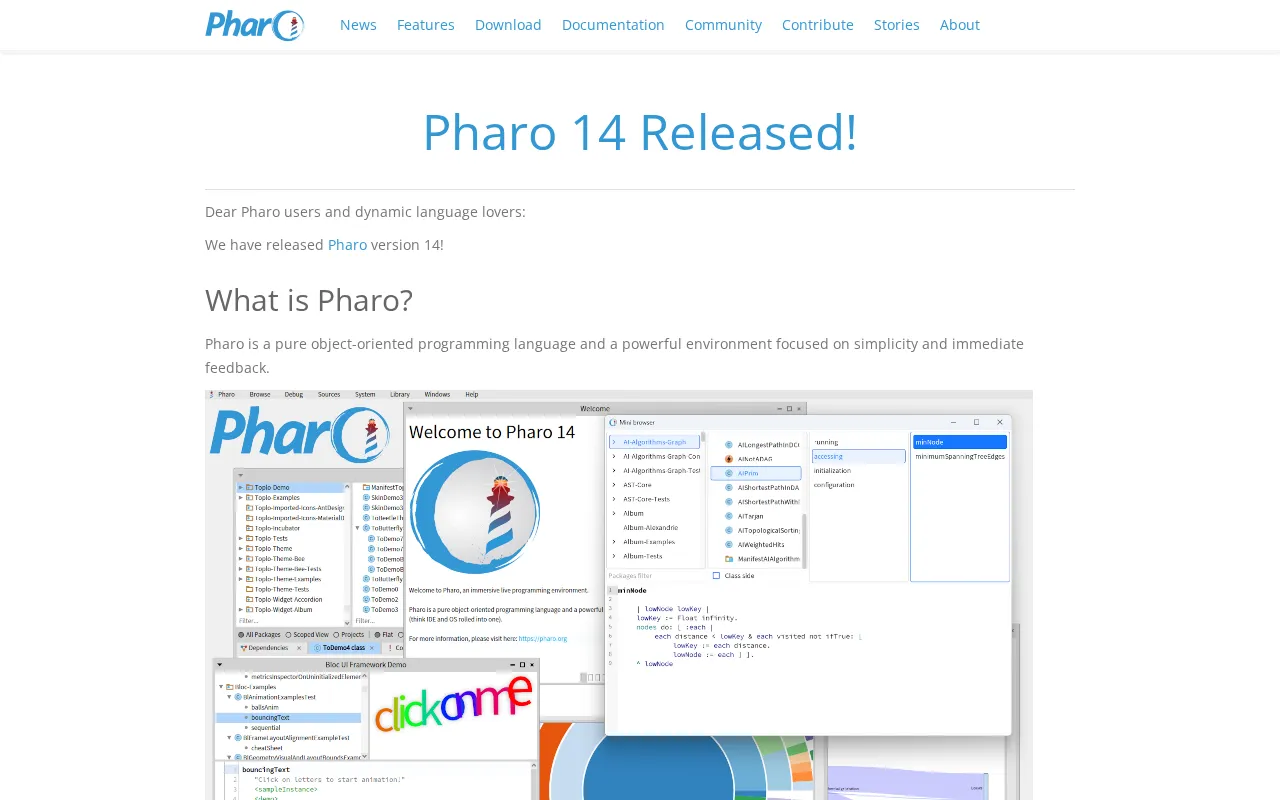
Pharo 14's Core Positioning: Not Nostalgia, but Reconstruction
Pharo has never been an "archaeological" language implementation. It is based on Smalltalk's pure object-oriented model, but is aimed at contemporary development scenarios: live programming, visual debugging, and a complete toolchain within a single image. Pharo 14 continues this approach, maintaining a minimalist language core while continuously refining the development experience.
Judging from the Hacker News discussion, the community's focus is on Pharo's lightweight workflow and the consistency of "everything is an object." This design allows code changes to take effect immediately without restarting services, making it particularly suitable for exploratory programming and prototyping.
Smalltalk's "Image" concept is key to understanding how Pharo works. Unlike most languages where source code files are the single source of truth, the Smalltalk system persists classes, methods, object instances, and even the development tools themselves in a binary file called an "image." When a developer starts Pharo, they are actually restoring a runtime snapshot containing the state of all objects, and code changes act directly on this live object graph. This explains the source of the article's statement that "code changes take effect immediately without restarting services," and also means that version control requires tools like Monticello/Metacello to export changes from the image as trackable packages, rather than directly diffing source files.
Progressive Improvements to the Language and Toolchain
Pharo 14's updates are not radical reconstructions, but progressive optimizations centered on stability and usability. According to the official release notes, the new version includes adjustments to virtual machine performance, image startup speed, and toolchain responsiveness.
Continuous Refinement of the Development Environment
Pharo's core competitiveness lies in its integrated development environment. The browser, debugger, and code version control all run within the same image, allowing developers to inspect the state of any object at runtime. Pharo 14 makes detailed improvements to this experience, making transitions between tools smoother.
"Everything is an object" and the pure object-oriented model: In Smalltalk, integers, booleans, code blocks (BlockClosure), classes themselves, and even nil are all objects, and method calls uniformly use "message sending" syntax (e.g., 3 + 4 is actually sending the + message to the object 3). Classes are also objects, so they can reflectively query and modify their own structure. This consistency eliminates the divide between primitive types and reference types, enabling the debugger to inspect program state at any level. The cost is that some operations rely on dynamic message dispatch, and scenarios pursuing extreme performance or requiring static type constraints need to compensate through virtual machine optimizations or additional engineering methods.
Continuation of the Community Ecosystem
Pharo's package management tool Metacello and code hosting platform continue to be maintained, and third-party library compatibility has been verified in version 14. For teams relying on Pharo to build internal tools or teaching environments, the upgrade path remains smooth.
The division of labor between Metacello and Monticello: Monticello is Pharo's package-level version control tool, responsible for exporting a set of classes and methods from the image as .mcz package files and recording dependencies; Metacello provides project-level configuration management on top of it, using baselines to describe the versions and load order of project dependencies, and supports resolving dependencies from multiple repositories. Together, they allow the Pharo ecosystem to maintain the flexibility of live development within the image while also publishing reproducible dependency configurations externally. When upgrading major Pharo versions, whether dependency libraries provide Metacello baselines compatible with 14 is a key checkpoint for verifying compatibility.
Community Sentiment Revealed by the Hacker News Discussion
The 228 points and 57 comments indicate that Pharo still has a stable audience in the technical community. The discussion includes long-time users sharing production experience as well as new users asking about the learning curve and applicable scenarios.
A recurring viewpoint is that Pharo is suitable for projects requiring high interactivity and rapid feedback, such as data analysis scripts, domain modeling tools, and teaching demonstrations. However, for systems requiring large-scale parallelism or strong type constraints, Smalltalk's model requires additional engineering adaptation.
Who Should Pay Attention to Pharo 14
If you are interested in dynamic languages, live programming environments, or the purest form of object-oriented design, Pharo 14 is worth a try. It does not seek novelty in syntax, but takes the concept of "the development environment is the runtime" to the extreme. For educational scenarios, Pharo's visual object inspector can help beginners intuitively understand program state.
For teams already using Pharo, version 14 provides a more stable runtime and toolchain. It is recommended to verify dependency compatibility in a test environment before upgrading.
Pharo 14's release is not a subversion, but another confirmation of the modernized Smalltalk路线 (path). In an era chasing new frameworks, projects that continuously refine the underlying experience seem all the more rare.
One-line Summary
Pharo 14 is released, continuing the modernized Smalltalk path with progressive improvements, with the community focused on its interactive development experience.
Paragraph Summary
Pharo 14 has officially been released. As an open-source Smalltalk environment, it continues the path of live programming, visual debugging, and a complete toolchain within a single image. The article notes that version 14 is not a radical reconstruction, but progressive optimization in virtual machine performance, image startup speed, and toolchain responsiveness. The Hacker News discussion with 228 points and 57 comments shows the community's steady interest in Smalltalk modernization. Pharo is suitable for exploratory programming, prototyping, and teaching scenarios, but large-scale parallelism or strongly typed systems require additional engineering adaptation. For teams already using Pharo, it is recommended to verify dependency compatibility in a test environment before upgrading.
Related articles

Vibe Coding Full-Stack in Practice: AI Programming from Beginner to Enterprise Deployment
From Cursor to Claude Code, this Bilibili AI programming course uses four progressive projects to cover full-stack development, open-source secondary development, and team collaboration. The article analyzes the shock to frontend roles, the efficiency shift from 50 people to 5, and the methodology required for enterprise-grade projects.

David Blaine's Global Quest for Real Magic: From South Africa to Japan and India
David Blaine travels to South Africa, Japan, and India in his Do Not Attempt special, documenting Spinning drivers, black mamba rescuers, iaijutsu masters, and ascetics—exploring the boundary between magic and real human极限 challenges.

Is a Touchscreen MacBook Coming? Vergecast Reveals Apple Executive's Response
Vergecast podcast reveals a conversation between a reporter and Apple executive John Ternus about a touchscreen MacBook and Apple Pencil support. Ternus says iPad is the best device for a stylus, while the reporter bets MacBook will eventually support Apple Pencil.