ΦasmaNet: A Spectral Token-Refinement Architecture for Instant Gravitational-Wave SNR Computation

ΦasmaNet uses a lightweight neural network to speed up gravitational-wave SNR computation by two orders of magnitude, with accuracy above 99%.
ΦasmaNet is a compact neural network designed for fast prediction of gravitational-wave SNR, with only about 732k parameters. Its core is to treat staged spectral refinement as an architectural prior, using ordered attention-mechanism stages and subspace mixing modules to effectively capture high-order correlations among parameters. With one million training samples, the model achieves 99.39% accuracy in the detection-relevant regime (ρ>8) with R² of 0.9998; a single GPU can perform about 120,000 SNR evaluations per second, processing a million-injection catalog in only 8.3 seconds, roughly two orders of magnitude faster than traditional CPU methods. The model supports accurate distance rescaling, facilitating detectability assessment in population studies. Current validation is limited to a fixed single-detector configuration, and extension to detector networks remains to be tested.
Title
ΦasmaNet: A Spectral Token-Refinement Architecture for Instant Gravitational-Wave SNR Computation
Meta Description
ΦasmaNet uses a staged spectral token-refinement architecture to achieve breakthroughs in both accuracy and speed for gravitational-wave SNR prediction: approximately 120,000 SNR evaluations per second on a single GPU, end-to-end processing of a million-injection catalog in about 8.3 seconds, roughly two orders of magnitude faster than traditional CPU methods.
Article Content
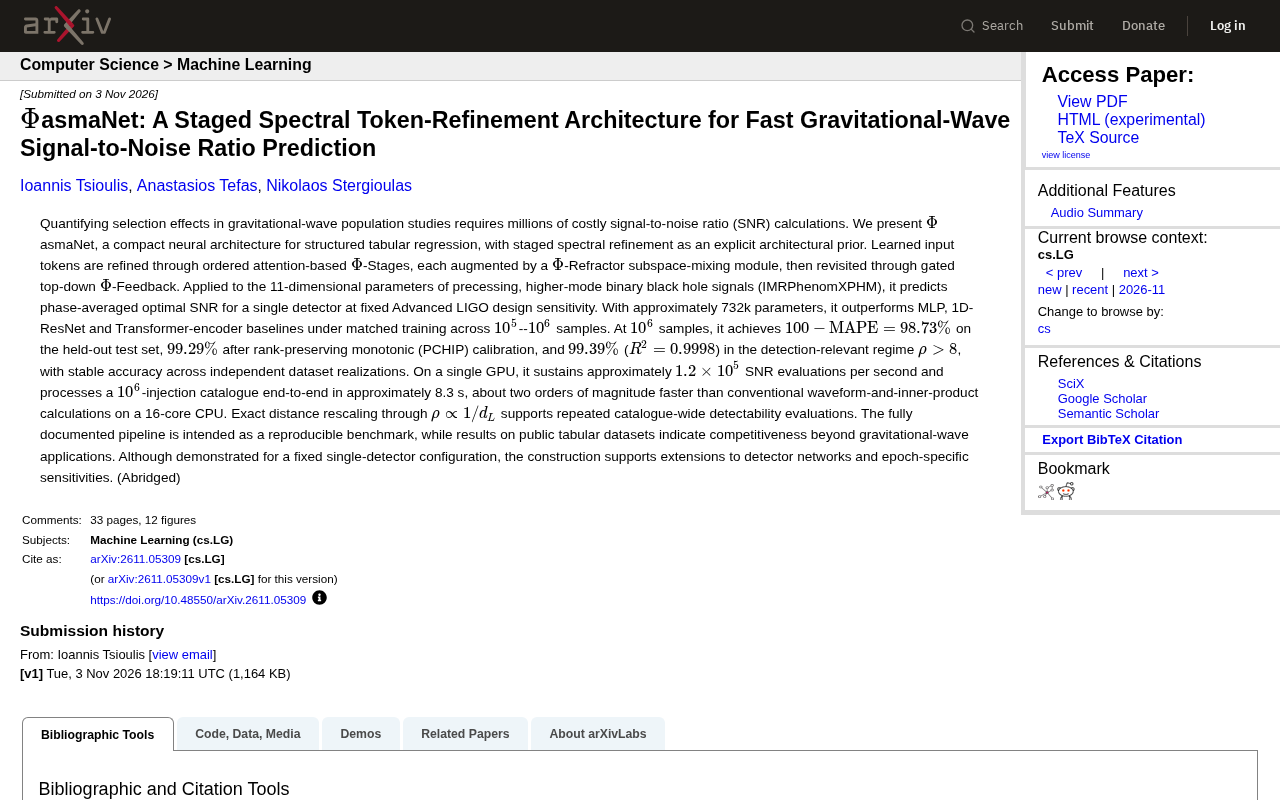
Gravitational-wave astronomy is entering the era of big data, but a long-standing computational bottleneck stands in the way of researchers: quantifying selection effects in population studies often requires millions of expensive signal-to-noise ratio (SNR) computations. Traditional waveform generation and inner-product operations are extremely time-consuming, severely limiting the efficiency of large-scale parameter-space scans. A study titled "$Φ$asmaNet: A Staged Spectral Token-Refinement Architecture for Fast Gravitational-Wave Signal-to-Noise Ratio Prediction" proposes a compact neural network architecture that attempts to fundamentally change this situation.
Core Architecture: Spectral Tokens and Staged Refinement
$Φ$asmaNet does not simply stack generic network layers; instead, it embeds "staged spectral refinement" as an explicit architectural prior into the model design. The core idea is to treat input parameters as learnable tokens and progressively refine them through a series of ordered attention-mechanism stages (Φ-Stages), each supplemented by a subspace mixing module called Φ-Refractor, and finally revisited and integrated through a gated top-down Φ-Feedback mechanism.
This design enables the model to more effectively capture high-order correlations among parameters when handling structured tabular regression tasks. The research team applied it to precessing binary black hole signals including higher-order modes (IMRPhenomXPHM), with 11-dimensional parameters as input and the phase-averaged optimal SNR of a single detector under fixed Advanced LIGO design sensitivity as output.
Interestingly, the model has only about 732k parameters, making it a fairly lightweight architecture. Under matched training conditions with training sample sizes from $10^5$ to $10^6$, it outperforms baseline models such as MLP, 1D-ResNet, and Transformer-encoder. This suggests that inductive biases designed for specific physical problems are often more effective than brute-force stacking of generic architectures.
SNR and Optimal SNR: In gravitational-wave detection, the signal-to-noise ratio (SNR) measures the ratio of signal power to detector noise power and is a key statistic for determining whether a signal can be detected. Matched filtering is the standard method for computing SNR, requiring an inner product between the theoretical waveform and the detector data. The "optimal SNR" is the theoretical maximum for a given waveform and noise spectrum, typically used to assess detection capability. For the phase-averaged optimal SNR, it can be obtained by optimizing over the template phase, avoiding the extra computational burden of a phase search. In population studies, SNR must be computed quickly for a large number of simulated signals to statistically assess their detectability—precisely the step where traditional methods are computationally expensive.
IMRPhenomXPHM waveform model: IMRPhenomXPHM is an approximate waveform model for describing binary black hole mergers, belonging to the IMRPhenom family. It includes precession effects (orbital-plane precession caused by spins not aligned with the orbital angular momentum) and higher-order modes (such as l=3, m=3, etc., beyond the dominant quadrupole mode). These effects are particularly important for systems with large mass ratios and high spins, and can significantly increase the energy and complexity of the signal. The model gives analytical expressions in the frequency domain, is fast to compute, and is often used for parameter estimation and population studies. Input parameters typically include masses, spins, distance, inclination, etc.; this paper uses 11-dimensional parameters for network training.
Performance: A Double Breakthrough in Accuracy and Speed
At the $10^6$ sample scale, $Φ$asmaNet achieved $100-\mathrm{MAPE}=98.73%$ on the held-out test set. After rank-preserving monotonic (PCHIP) calibration, this metric further improved to $99.29%$; within the detection-relevant regime ($\rho>8$), accuracy reached $99.39%$ with $R^2=0.9998$. The study also emphasizes that the model's accuracy remains stable across independent dataset realizations, indicating that the results are not the product of accidental overfitting.
The speed improvement is even more直观—more intuitive. On a single GPU, $Φ$asmaNet can perform approximately $1.2\times10^5$ SNR evaluations per second, and end-to-end processing of a catalog containing $10^6$ injections takes only about 8.3 seconds. By comparison, running traditional waveform and inner-product computations on a 16-core CPU takes about two orders of magnitude longer. This gap means that computational tasks that originally required days or even weeks can now be completed in the time it takes to drink a cup of coffee.
In addition, the model supports accurate distance rescaling via $\rho\propto1/d_L$, making repeated detectability assessments for the same catalog very efficient. This is a practical feature for population studies that frequently adjust distance priors.
MAPE and PCHIP calibration: MAPE (mean absolute percentage error) is a commonly used evaluation metric in regression tasks, computed as the average of the absolute difference between predicted and true values as a percentage of the true value. This paper reports 100-MAPE, i.e., accuracy (percentage), where higher is better. PCHIP (piecewise cubic Hermite interpolating polynomial) is a shape-preserving interpolation method that maintains the monotonicity and shape of the data. In this work, PCHIP is used to calibrate the network output, possibly by learning a monotonic mapping from a small set of high-precision data to correct systematic bias, thereby further improving accuracy. After calibration, 100-MAPE improved from 98.73% to 99.29%, indicating that calibration effectively improved prediction accuracy.
Multi-Source Corroboration and Applicability Boundaries
It should be noted that the current analysis is mainly based on a single-source paper abstract and lacks independent third-party reproduction and validation. However, judging from the completeness of the architecture description and benchmark comparisons, the study provides a fully documented pipeline and explicitly positions it as a reproducible benchmark. The authors also note that preliminary results on public tabular datasets suggest that the architecture's competitiveness may extend beyond the gravitational-wave domain, with potential for transfer to broader tabular regression tasks.
Regarding applicability boundaries, the current demonstration is limited to a fixed single-detector configuration. The authors acknowledge that although the construction supports extension to detector networks and epoch-specific sensitivities, such validation has not yet been carried out in this paper. This means that when research scenarios involve joint multi-detector observations or non-stationary noise sensitivity, the actual performance of $Φ$asmaNet remains to be tested.
Reproducible benchmark and domain transfer: A reproducible benchmark means that the study provides complete data generation, model code, and evaluation procedures so that others can independently reproduce the results. This is crucial for methodological research and can accelerate validation and improvement within the field. The authors also point out that the architecture is competitive on public tabular datasets, suggesting it may be applicable to a broader range of tabular regression tasks. Tabular regression is a common problem in machine learning, involving predicting continuous values from structured features. ΦasmaNet is designed to target high-order correlations among parameters and may be suitable for scenarios such as physical simulation and financial forecasting that require capturing complex interactions.
Practical Significance for Gravitational-Wave Population Studies
Quantifying selection effects in population studies is essentially a statistical inference problem that requires repeated large-scale simulations. Under traditional methods, researchers have to compromise between computational accuracy and affordable simulation scale. The fast SNR prediction capability provided by $Φ$asmaNet makes it possible to explore a larger parameter space within an acceptable time, thereby reducing the risk of systematic bias introduced by insufficient simulation scale.
From a broader perspective, this work demonstrates how structural priors of a physical problem can be translated into concrete neural network architecture designs. Mechanisms such as staged refinement, subspace mixing, and gated feedback are not stacked for the sake of architectural novelty, but serve the clear goal of "approximating expensive physical computations while remaining lightweight." For researchers at the intersection of AI and scientific computing, this problem-driven design approach may be more valuable as a reference than the model's performance numbers themselves.
One-line Summary
ΦasmaNet uses a lightweight neural network to speed up gravitational-wave SNR computation by two orders of magnitude, with accuracy above 99%.
Paragraph Summary
ΦasmaNet is a compact neural network designed for fast prediction of gravitational-wave SNR, with only about 732k parameters. Its core is to treat staged spectral refinement as an architectural prior, using ordered attention-mechanism stages and subspace mixing modules to effectively capture high-order correlations among parameters. With one million training samples, the model achieves 99.39% accuracy in the detection-relevant regime (ρ>8) with R² of 0.9998; a single GPU can perform about 120,000 SNR evaluations per second, processing a million-injection catalog in only 8.3 seconds, roughly two orders of magnitude faster than traditional CPU methods. The model supports accurate distance rescaling, facilitating detectability assessment in population studies. Current validation is limited to a fixed single-detector configuration, and extension to detector networks remains to be tested.
Related articles

Claude Code in Practice: Building Your Own AI Coding Assistant from Scratch
A practical guide to Claude Code: environment setup, switching to domestic models, Git workflows, and its command system, to help developers build their own AI coding assistant.

Claude Sonnet 6 Suspected Leak: Anthropic's Internal Model Acceleration Is Astonishing
Anthropic suspected leak of Sonnet 6; Meter reports its AI R&D accelerated 1.9x; OpenAI releases GPT-6 Cyber, GPT-6.2 Astra may be coming; Google Gemini Omni 1.2 Flash tops video generation leaderboard; Meta stealth models and real-time avatars unveiled; despite market volatility, Google still invests $17 billion in data centers.

How Accurate Are Sci-Fi's Predictions About AI?
How accurate are sci-fi's predictions about AI? Drawing on a Hacker News discussion, this article analyzes sci-fi's foresight and blind spots in AI development, arguing its true value lies in inspiring thought rather than precise prediction.