PhD Student's Practical Guide: How to Effectively Divide Work Between Humans and AI in Academic Writing

PhD student's guide: AI handles execution, humans must own core contributions and academic rigor.
A second-year PhD student at Tongji University shares hands-on experience with human-AI collaboration in academic writing, drawing clear boundaries across structure, language, and figures. Core contributions must be decided by the researcher; AI frequently produces defensive language, skips evidence chains, and drifts from the main argument — all requiring human correction. Data visualizations can be safely delegated to AI, while architecture diagrams still need researcher oversight. Long-context memory is highlighted as a key factor in maintaining narrative coherence throughout a paper.
Who Does What in Academic Writing: Humans vs. AI
A second-year PhD student at Tongji University recently shared hands-on insights after submitting a paper, focusing on a specific question: in academic writing, how exactly should humans and AI collaborate? This isn't a vague "AI can write papers" discussion — it's a practical breakdown of collaboration boundaries across three dimensions: structure, language, and figures.
For this demonstration, he switched from his usual Codex to MiniMax Code, citing its strong long-context comprehension and multimodal capabilities — both of which are essential for academic writing. The central logic throughout the entire post comes down to one statement: AI handles execution and organization; humans handle direction and core contributions.
Paper Structure: Directional Decisions Must Come from Humans
The classic paper structure is Introduction, Related Works, Method, Results, and Discussion. But the author admits that where he struggles most — and debates most with AI — is how to articulate the key contribution points.
His observation is straightforward: asking AI to summarize contributions always feels "off," and the more it tries, the further it drifts. The reason is that the research is his own work. He naturally has a clearer sense than any AI of "what makes my research different from previous work," "what the biggest gap in the field is," and "what I most want to emphasize." So for directional decisions, the researcher must be deeply involved — you need to articulate the contributions yourself, not delegate that authority to an AI agent.
His recommended workflow: first feed the AI the field background, research goals, methods, and results, and ask it to generate several contribution statement options (Option A, Option B, etc.) as reference. Then the human makes the final call on three to four core contributions. Once those are locked in, more can be handed off to AI — structuring the logic, drafting sections, or iterating between human drafts and AI revisions.
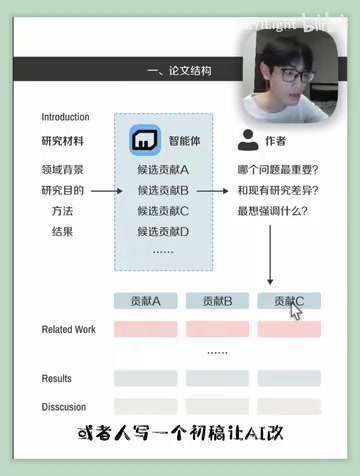
One key principle runs through everything: the entire paper must revolve around those contribution points. If Related Works is divided into three or four subsections, each should correspond to Contribution A, Contribution B, etc. — not a flat list of papers. Results and Discussion should loop back to those same contributions. He specifically notes that many models lose track of context and "forget" the core contributions by the time they reach Results or Discussion. MiniMax's long-context performance allowed it to retain all three contribution points across multiple rounds of conversation, which is critical for maintaining the paper's throughput line.
The "Contributions" section in academic writing serves a specific function: it typically appears at the end of the Introduction as a bulleted list, and it's the first anchor reviewers use to judge a paper's value. The wording of contribution statements directly affects review outcomes — too conservative and the paper looks mediocre; too bold and reviewers flag it as "Overclaiming." This is why the author emphasizes that "having AI summarize contributions always feels off": contribution statements aren't objective descriptions of research content. They're the researcher's subjective strategic positioning of their own work — involving differentiation from prior work and an understanding of current field gaps. Without sufficient context, AI simply can't accurately grasp these nuances. Letting the researcher lock in the contributions, then having AI build the full paper around those anchors, is a sensible division that puts AI's execution strengths and human judgment in exactly the right places.
File Handling and Citation Verification: Where Agent Capabilities Add Real Value
Beyond the writing itself, the author demonstrated several efficiency-boosting features. When he handed his entire project to MiniMax with a simple instruction to read through it, the model produced a complete breakdown of the project's organizational logic and a working paper outline in about 1 minute and 26 seconds.
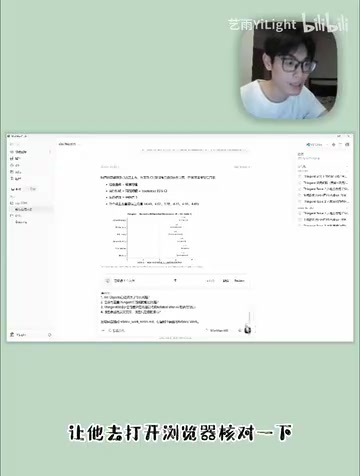
Even more noteworthy is the browser control capability. When verifying the authenticity of references, he simply sent the file to the AI and asked it to open a browser, search for a specific paper, and confirm whether it was a real publication — including browsing the full page and opening the PDF. In his view, fast browser functionality is a crucial capability for any agent, as it directly addresses one of the most common pitfalls before paper submission: fabricated references.
Hallucinated references are one of the most-watched problems in AI-assisted academic writing. Large language models can generate entirely fabricated citations with perfect formatting, plausible author names, and convincing titles — papers that simply don't exist. Because the format is flawless, researchers who don't verify each one individually can easily include them in a reference list, only to have them discovered during peer review or after publication, causing serious damage to academic credibility. This is why the author's demonstration of "having AI open a browser to directly verify citation authenticity" is genuinely significant — it integrates the verification step into the writing workflow rather than relying on manual searching. The fundamental difference between agents with browser control and pure text-generation models is that they can access real external information sources, allowing them to fact-check their own outputs.
Academic Language: Three High-Risk Areas That Need Human Oversight
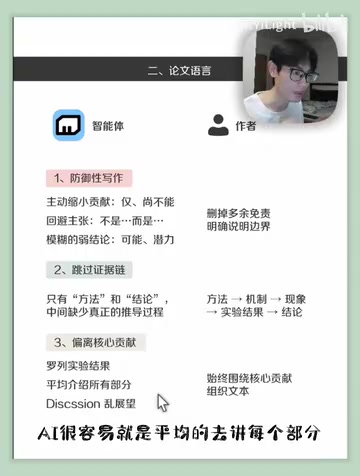
Language is what the author calls the "danger zone." He identified three areas where AI consistently causes problems.
Defensive Writing
The author specifically called out GPT-class models (he mentioned a "5.6" version) as especially prone to this, producing language that actively undersells contributions — phrases like "this study can only demonstrate... and does not yet show," or evasive hedges like "not proven, but providing the possibility for proving," or vague conclusions like "has potential in certain respects." His stance is pragmatic: if something is proven, state it directly; if it's genuinely ambiguous, leave it out; unnecessary disclaimers should be deleted; and the boundaries of what's claimed should be made explicit by the human. These kinds of revisions are rarely satisfying when left to AI — they need to be done by hand.
Skipping the Evidence Chain
AI tends to jump straight from "method" to "conclusion," with the derivation steps in between simply disappearing — especially in the methods and experiments sections. His approach is to proactively supply the full chain: "what method was used → through what mechanism → producing what phenomenon → yielding what experimental result → ultimately proving what conclusion." AI shouldn't be allowed to skip steps.
Drifting from Core Contributions
This is the problem the author returns to repeatedly throughout the post. In the Results section, AI tends to present data in a flat, undifferentiated list — but the correct approach is to highlight only the results that support the three contribution points. When describing the system, AI tends to "spread effort evenly," while the researcher should spend more space on the most important modules and trim sections borrowed from other work. In the Discussion, AI often goes off on tangential future directions and needs to be reined back in toward the core contributions.
The author also shared an efficient habit: using voice input for on-the-fly revisions. When a passage isn't working, he just speaks the issue aloud and lets the AI adjust it. MiniMax's speech recognition converts quickly, and combined with long-context memory, the interaction feels fluid.
"Hedging" in academic writing has a legitimate purpose: using "suggests" rather than "proves," or "may contribute to" rather than "solves," reflects standard scientific rigor. However, AI models' defensive writing isn't rooted in academic norms — it's a generalization of a training tendency toward "not over-committing," which indiscriminately softens every conclusion even when the data fully supports a strong claim. This is the opposite of what academic writing requires: reviewers will actually question whether a paper with excessively vague language truly validated its hypotheses. The author's principle of "if it's proven, state it directly; if genuinely ambiguous, leave it out" maps precisely onto what academic writing calls "Claim Strength" management: the strength of a conclusion should match the strength of the evidence — neither underselling nor overclaiming — and that calibration can currently only be done by the researcher themselves.
Paper Figures: Data Visualizations Are Safe to Delegate; Diagrams Still Need Human Oversight
Figures fall into two categories, and the author offers very different advice for each.
Data figures (experimental visualizations) can safely be handed to AI. With MiniMax's strong coding capabilities and multimodal image understanding, you can give it reference figures and data, and it will replicate the chart. There's only one prerequisite: the data must be completely accurate. After that, organizing the data, writing the Python code, and producing the figure can be fully delegated to the agent. In his demonstration, he simply told the AI where the raw data file was, and it organized the data and produced the figure. When small issues like overlapping text came up, a single sentence resolved them quickly.
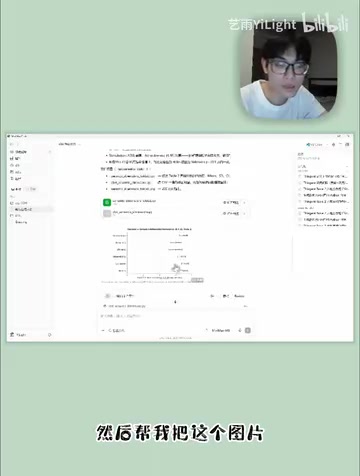
Diagrams (workflow diagrams, architecture figures) require more human involvement. His approach is to send a reference figure from a paper he likes, ask the AI to analyze how it was constructed, get an HTML or SVG example, and then revise from there. But he admits that due to his high standards for field-specific diagram aesthetics, he often ends up redrawing them himself — AI still can't fully meet these requirements. Multimodal capabilities are still useful here, though: you can send a figure from a paper or a PDF and have the AI break down its structure and suggest ways to adapt it.
A Collaboration Breakdown: What AI Does, What Humans Do
The author closes with a clear summary.
Four things AI is good at: organizing materials (reading through an entire project, organizing experimental data and user interview notes); iterative revision (rapid editing paired with voice input); generating code and figures; multimodal analysis (parsing reference figures and PDFs).
Four lines humans must hold:
- Anchor the core contributions — continuously remind AI throughout the writing process that all content must revolve around the core contributions;
- Guard the evidence — correct defensive language and overclaiming, and be precise about what has been proven and where the boundaries lie;
- Maintain the paper's throughput — AI often underemphasizes the important and overemphasizes the peripheral; humans must continuously recalibrate the narrative logic;
- Final verification — textual errors, factual accuracy of conclusions, and the authenticity of every single reference must all be reviewed by a human.
The underlying logic of this division is actually quite simple: AI is a powerful executor and organizer, but understanding the research itself, judging its core value, and upholding academic rigor remain responsibilities that researchers cannot delegate. The more powerful the tool, the more it tests whether the user has a clear sense of what they must do themselves.
Related articles

Chain of Thought Isn't Just for AI: How Humans Can Use CoT to Improve Thinking Quality
Chain of Thought isn't just a prompt trick for large models. Starting from a Hacker News discussion, this article analyzes why CoT works for human thinking too, breaks down actionable ways to transfer it, and highlights the key differences between human CoT and machine CoT.
Cloudflare Teams Up with OpenAI: Closi…
Cloudflare Teams Up with OpenAI: Closing the Loop from Vulnerability Discovery to Defense with AI
Cloudflare uses OpenAI Daybreak to investigate security vulnerabilities and generate reviewable remediation plans, while developers use Codex to boost coding efficiency and quality.

Orca Multi-Agent Orchestration in Practice: A Guide to Parallel Collaboration with Claude and Codex
Orca is Stable AI's free open-source agent workbench supporting 34 agents like Claude Code and Codex in parallel. Learn its Git worktree isolation, multi-model orchestration, and mobile management.