Philips AI Smart Toothbrush Launches: Motion Tracking to Help You Brush Better

Philips' new DiamondClean 9900 Prestige uses AI motion tracking to turn brushing into quantified oral health management.
Philips Sonicare has launched the flagship DiamondClean 9900 Prestige in Europe and the US, with a broader global rollout planned for 2027. The standout innovation is AI-powered motion tracking, which uses built-in sensors to analyze brushing behavior in real time, identify neglected areas, and deliver personalized feedback — elevating daily brushing from routine habit to measurable health management. Priced from $429.99, it targets the premium segment, while a discounted previous-gen model provides a lower-cost alternative. The product is a prime example of AI penetrating small everyday consumer devices, though it also raises questions around data privacy and whether its premium is justified.
Philips Unveils Next-Generation AI Smart Toothbrush
The new Philips Sonicare DiamondClean 9900 Prestige smart toothbrush — first announced back in July — has officially gone on sale in Europe and the United States, with a broader global rollout not expected until 2027. Officially branded as the "Next-Gen DiamondClean," it represents a significant upgrade over the previous flagship model.
Notably, the previous-generation model remains on sale and has been discounted from its original price of $429.99. This gives consumers a choice between the latest flagship and a reduced-price predecessor.
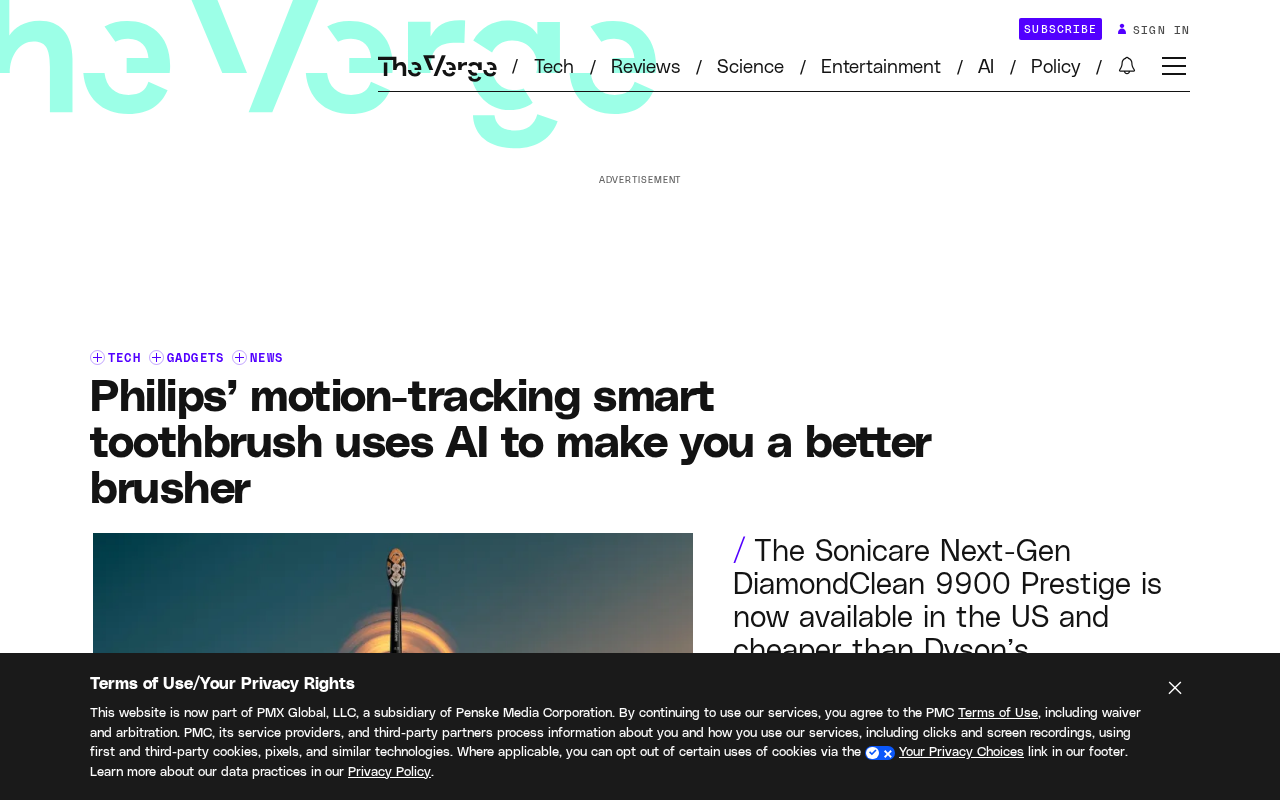
How AI and Motion Tracking Improve Your Brushing
The centerpiece of this toothbrush is its motion-tracking technology, which uses AI algorithms to analyze brushing movements and help users develop better habits. Traditional electric toothbrushes rely primarily on high-frequency vibrations to clean teeth — but with AI in the mix, the product attempts to address a deeper problem: whether users are actually reaching every area of their mouth.
Brushing may seem straightforward, yet many people have blind spots — certain areas of the mouth that get chronically neglected, or incorrect pressure application. The value of AI motion tracking lies in quantifying this "invisible behavior," giving users targeted feedback to make their daily oral care more effective and evidence-based.
Motion tracking typically relies on a built-in inertial measurement unit (IMU) — comprising an accelerometer and gyroscope — to capture the toothbrush's spatial position and movement in real time. AI algorithms then divide the mouth into zones (usually more than a dozen quadrants covering upper, lower, front, back, inner, and outer surfaces) and measure how long the user spends in each zone and how much pressure is applied. A companion smartphone app visualizes this data as an oral map, highlighting neglected or over-pressured areas. The concept is similar to how fitness bands track gait — except the confined space inside the mouth demands much higher signal-processing precision. Current systems still have limitations, particularly when distinguishing between adjacent teeth, so the feedback is best understood as a habit-forming guide rather than a medical-grade diagnostic tool.
The Trend of AI Integration in Smart Hardware
From an industry perspective, this Philips product is a textbook example of AI "trickling down" into consumer electronics. AI is no longer confined to smartphones and computers — it is steadily making its way into everyday small devices like toothbrushes and home appliances, using sensors to collect data and algorithms to deliver personalized recommendations.
The business logic behind such products is to transform a one-time hardware purchase into an ongoing health management service. The toothbrush is no longer just a cleaning tool; it becomes a gateway to oral health data. That said, this model raises questions worth considering: data privacy, the real-world effectiveness of AI recommendations, and whether the premium price is justifiable for mainstream consumers.
Converting hardware into a data gateway — and then building a subscription or service ecosystem around it — is a business model that consumer electronics manufacturers have broadly pursued in recent years, commonly referred to as "Hardware as a Platform." The Philips Sonicare companion app does more than log brushing data; it can also connect with select dental clinic systems to share users' oral care records with their dentist, creating a closed loop from home care to professional treatment. This model has precedents in health hardware such as glucose meters and smart scales. Its core value proposition is "prevention over cure" — using long-term data accumulation to identify potential issues and reduce future healthcare costs. However, data ownership and the transparency of third-party sharing agreements are key points consumers should carefully review in the privacy policy before purchasing.
Pricing and Market Strategy
At a starting price of $429.99, Philips is positioning the next-gen DiamondClean firmly as a premium flagship. Keeping the discounted previous-generation model in circulation creates a clear price ladder — catering both to early adopters who want the latest technology and to price-sensitive consumers.
The decision to push full global distribution back to 2027 also reflects a cautious approach to supply chain management and market education for premium smart hardware. For anyone interested in intelligent health devices, this product is worth watching as real-world user feedback and performance data begin to emerge.
Related articles

Python 3.15 New Feature: Is the sentinel Type Better Than None?
Python 3.15 adds the sentinel type, using named unique sentinel objects to replace None and bare object(), resolving confusion among missing values, explicit emptiness, and invalid input while avoiding type hint failures.

Deep Learning's Three Architectures and the Universal Approximation Theorem: A Complete Guide to MLPs, CNNs, and Transformers
Explaining the inductive bias differences among MLP, CNN, and Transformer, the existence meaning of the Universal Approximation Theorem (UAT), and the role of Taylor expansion in approximation analysis, while clearing up common misconceptions.

GitLab Emergency Patch Release: Analysis of Critical Security Fixes
GitLab releases critical patch 19.5.1, sparking 355 points of discussion on Hacker News. This article analyzes the background, upgrade steps for self-hosted instances, and verification points to help DevOps teams respond quickly to security updates.