Photon Raises $4.5M to Replace Mobile Apps with AI Agents

Photon raises $4.5M betting AI agents on messaging platforms will replace traditional mobile apps.
Photon is an AI startup that staged a theatrical "funeral for mobile apps" and just closed a $4.5M funding round. Its platform gives developers tools to build AI agents that run natively inside iMessage, SMS/RCS, and email — letting users accomplish tasks like searching, ordering, and booking through natural conversation, without ever downloading an app. The bet is that sufficiently capable agents will make traditional graphical apps unnecessary. Key challenges remain, including platform policy dependencies, safety and compliance concerns, and the deep inertia of the existing app economy.
Throwing a Funeral for Mobile Apps
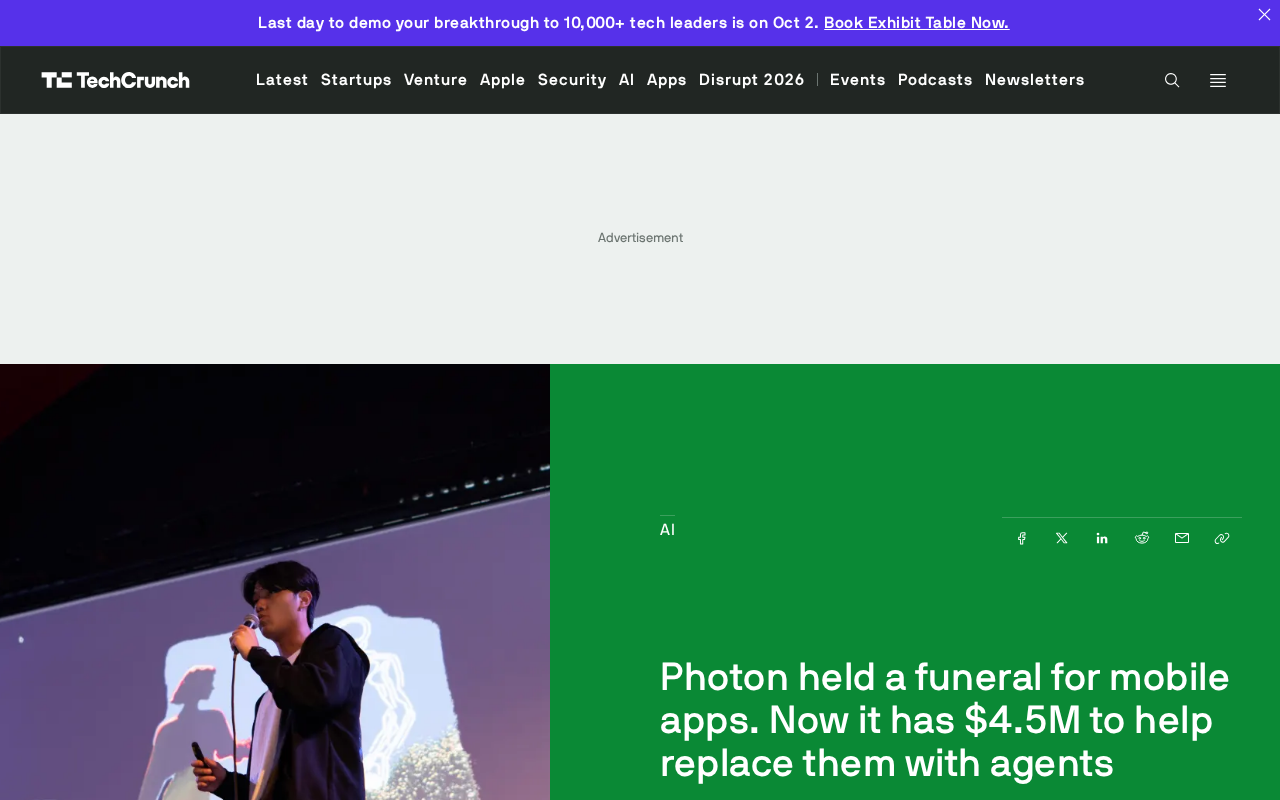
A startup called Photon made its product philosophy known in a rather theatrical way — by staging a literal funeral for mobile apps. Behind this dramatic gesture lies a clear and bold bet: as AI agent capabilities mature, consumers will increasingly turn away from downloading and using traditional mobile apps, relying instead on agents to get things done.
The company has now raised $4.5 million to advance its core vision — giving developers the tools to build AI agents that run across messaging platforms, gradually replacing the rows of app icons on our phones.
What Photon Actually Does
Photon is positioned as a developer platform for building AI agents that work across messaging channels. According to public information, these agents can operate within iMessage, SMS/RCS, email, and other messaging surfaces.
In practice, users no longer need to download a dedicated app. Instead, they can interact with an agent directly within the chat or email interface they already use — accomplishing tasks that would previously have required opening a separate app. Whether it's looking something up, placing an order, making a reservation, or something else entirely, the agent acts as a new interface between users and services.
The elegance of this model lies in its foundation: it builds on communication channels users already have, with no additional installation friction. SMS and email are capabilities that virtually every smartphone user has natively, eliminating the entire cycle of app store downloads, account registrations, and onboarding flows.
What is RCS? RCS (Rich Communication Services) is the upgraded standard for traditional SMS, supporting group chats, read receipts, high-resolution image and file transfers, and more — often described as "next-generation texting." Google has long championed RCS, and Apple formally adopted the protocol in iOS 18 in 2024, completing support across both major mobile platforms. For platforms like Photon, the widespread adoption of RCS is significant: it enables richer message interactions (such as buttons and structured card formats) and provides a more standardized commercial messaging channel, allowing AI agents to present more complex interactive experiences without requiring a standalone app.
A Bet on a New Interaction Paradigm
Photon's fundraise is fundamentally a wager on the future of human-computer interaction. For over a decade, mobile apps have been the primary gateway between consumers and digital services, with the App Store and Google Play forming a massive distribution ecosystem. But that ecosystem has accumulated real pain points: users must download a separate app for each service, consuming storage space and fragmenting attention — and many low-frequency apps get downloaded once and forgotten.
Proponents of agents argue that when AI is smart enough to understand natural language and autonomously invoke various services, "one interface for everything" becomes achievable. Users simply express their needs conversationally, and the agent orchestrates the necessary capabilities in the background — no graphical app interface required.
From this perspective, Photon's choice of messaging platforms as its entry point makes a lot of sense. Conversational interaction is a natural fit for how agents work, and messaging platforms are where conversations happen.
What is an AI Agent? An AI agent is an AI system capable of perceiving its environment, autonomously planning, and executing multi-step tasks — distinct from a standard chatbot that only handles single-turn Q&A. The core capability is tool use (also called function calling): agents can automatically determine which external APIs or services to invoke based on user intent (e.g., checking weather, initiating payments, querying databases) and synthesize the results into a response. This capability theoretically allows a single conversational interface to replace multiple vertical apps. Today's leading large language models — including GPT-4, Claude, and Gemini — all have mature tool-calling capabilities, which is exactly the technical foundation Photon is betting on. That said, agent reliability and accuracy remain key bottlenecks for real-world deployment, especially in high-stakes scenarios like financial transactions or medical appointments, where a single execution error carries far greater consequences than a misclick in a traditional app.
Opportunity and Challenge in Equal Measure
As compelling as this vision is, actually "replacing" mobile apps is no small feat. The mobile app ecosystem has been entrenched for years, backed by mature business models, developer habits, and deeply ingrained user expectations. For agents to disrupt that landscape, they'll need to prove themselves across reliability, security, and breadth of service.
Relying on platforms like iMessage and SMS/RCS also means Photon is, to some degree, at the mercy of Apple's and Google's policies and the degree to which they keep their interfaces open. Messaging channel regulations, anti-spam mechanisms, and commercial messaging compliance requirements are all real-world obstacles that can't be ignored.
That said, a $4.5 million raise signals that at least some investors are willing to back this direction. In an era of rapidly evolving generative AI and agent technology, the imagination space for a "post-app era" is drawing increasing capital and entrepreneurial energy. Photon's effort is a notable example of this trend worth watching.
Closing Thoughts
Photon's funeral stunt for mobile apps is certainly a marketing move, but the question it raises is genuine: when AI agents are powerful enough, do we still need so many standalone apps? The answer may not arrive anytime soon, but what's certain is that a shift in interaction paradigms is being seriously explored. For developers and consumers alike, this is a direction worth keeping a close eye on.
Related articles

Chain of Thought Isn't Just for AI: How Humans Can Use CoT to Improve Thinking Quality
Chain of Thought isn't just a prompt trick for large models. Starting from a Hacker News discussion, this article analyzes why CoT works for human thinking too, breaks down actionable ways to transfer it, and highlights the key differences between human CoT and machine CoT.
Cloudflare Teams Up with OpenAI: Closi…
Cloudflare Teams Up with OpenAI: Closing the Loop from Vulnerability Discovery to Defense with AI
Cloudflare uses OpenAI Daybreak to investigate security vulnerabilities and generate reviewable remediation plans, while developers use Codex to boost coding efficiency and quality.

Orca Multi-Agent Orchestration in Practice: A Guide to Parallel Collaboration with Claude and Codex
Orca is Stable AI's free open-source agent workbench supporting 34 agents like Claude Code and Codex in parallel. Learn its Git worktree isolation, multi-model orchestration, and mobile management.