PHP Multi-Branch Synchronized Release: 8.5.12 Ships Alongside Three Maintenance Branches
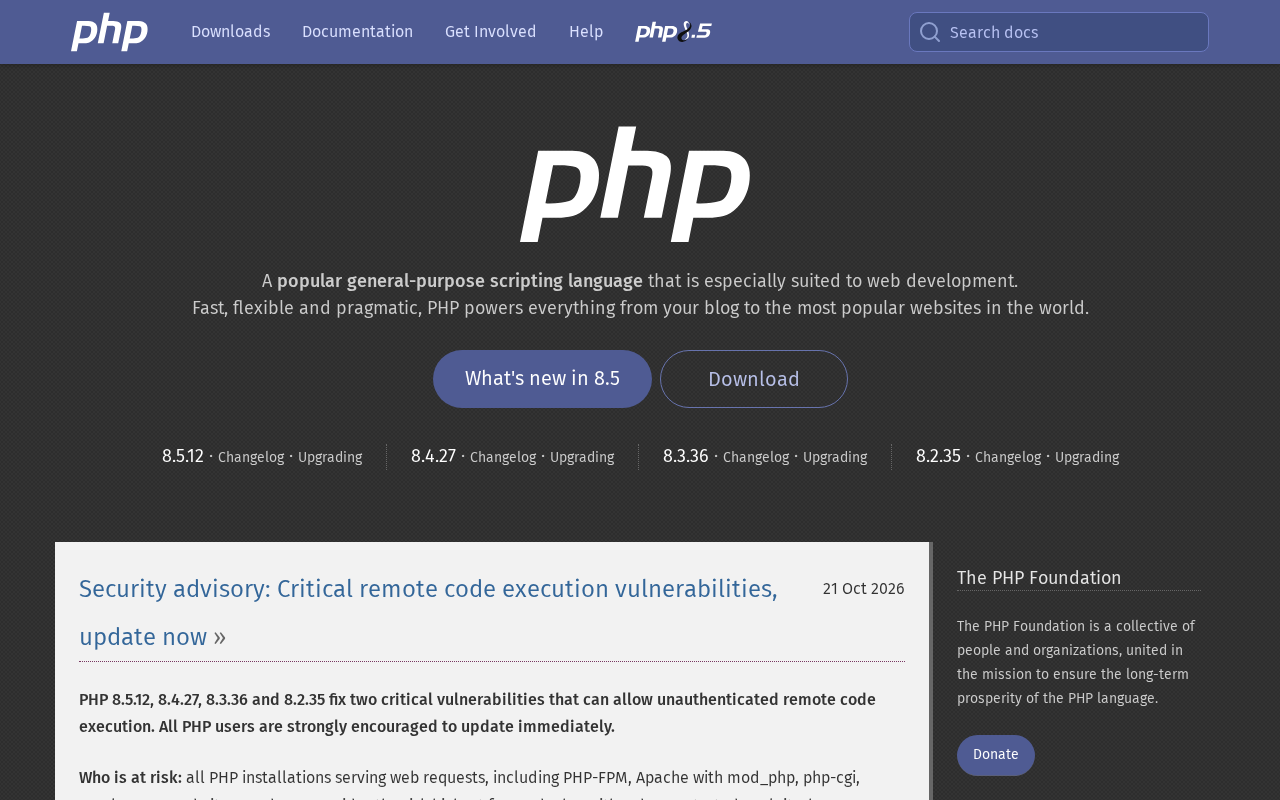
PHP ships synchronized patch updates across four branches, reflecting its multi-branch maintenance strategy and ecosystem maturity.
PHP has officially released patch versions 8.5.12, 8.4.27, 8.3.36, and 8.2.35, covering the current mainline and older versions still in security maintenance. This cross-branch synchronized fixing lets projects on older versions receive same-source security updates, reducing forced-upgrade pressure. While patch releases introduce no new features, they are critical to production stability, and shipping four versions on the same day helps teams align upgrade windows. The high-attention, low-discussion pattern on Hacker News reflects the community's de-eventization of routine maintenance, confirming the maturity of the PHP ecosystem. Developers should review each version's changelog before upgrading to confirm compatibility.
PHP has officially released synchronized updates across four branches: 8.5.12, 8.4.27, 8.3.36, and 8.2.35. The move itself isn't surprising—PHP has long maintained multiple branches in parallel—but with 8.5 now running stably, shipping all four versions on the same day still sends a signal worth noting.
According to discussion on Hacker News, the release announcement scored 276 points but drew very few comments, suggesting the community has grown quite accustomed to PHP's routine updates. This "quiet" is precisely a normal state for a mature language ecosystem.
The Rhythmic Logic Behind Parallel Multi-Branch Maintenance
PHP's versioning strategy has always been clear: once each major version enters its maintenance period, security fixes continue to be backported to earlier branches. 8.5.12 is the latest patch for the current mainline, while 8.4.27, 8.3.36, and 8.2.35 correspond to older branches still within their support cycles. Four version numbers incrementing simultaneously means the official team synchronized the same batch of fixes across branches.
For developers, the practical impact of this release model is: even if a project remains on 8.2 or 8.3, it can still receive security fixes from the same source as the mainline, without being forced to upgrade a major version just for a patch. For teams maintaining multiple legacy projects, this is a key mechanism that reduces upgrade pressure.
PHP's version support cycle follows clear rules: each major version (such as 8.2 or 8.3) receives roughly two years of active support after release (including new features and bug fixes), then enters a two-year security maintenance period during which it only receives security-related patches. When the official team publishes cross-branch synchronized updates, it means the same batch of security vulnerabilities or critical defects has been fixed across multiple supported branches, but each branch's patch version number increments independently without affecting the others. Developers can confirm the PHP branch currently running via composer.json in their project or phpinfo, and reference the official support schedule to plan upgrade paths—avoiding the situation where a branch reaches end-of-life (EOL) before they realize security updates are no longer available.
The Real Value of Patch Releases: Stability Above All
Patch releases typically don't introduce new features; their core goal is fixing defects and security issues. The significance of such updates for production environments is often underestimated—they bring no functional excitement, yet directly affect the stability of online services.
From an operations perspective, four versions released on the same day also means a concentrated upgrade window. Teams can align patches across multiple environments in one go rather than handling them at different times, reducing the complexity of change management. For teams using container images or CI/CD pipelines, the opportunity to batch-update base image tags also arises.
You may not have noticed that cross-branch synchronized fixes don't mean the fix contents are completely identical across all versions. Each branch has a different code baseline, so the same issue may manifest and be fixed differently across versions. You should still consult the changelog for the corresponding version before upgrading.
The difference between patch releases and minor or major versions lies in the Semantic Versioning (SemVer) philosophy: patch releases contain only backward-compatible bug fixes, do not change public APIs, and do not introduce new features. For production environments, this means the risk of upgrading a patch version is extremely low, and application code usually doesn't need modification. However, some bug fixes in the PHP core may involve subtle behavior adjustments (for example, edge cases in error handling or type conversion), so the official ChangeLog will flag entries marked as "behavior change" or "backward incompatible." Before batch upgrading, operations teams should carefully review these flags and run regression tests in a pre-release environment to ensure compatibility with existing dependencies and extensions.
Community Reaction and the Maturity of the Language Ecosystem
The combination of 276 points and only 2 comments on Hacker News is an interesting angle for observation. High attention indicates PHP still has a massive developer base, while low discussion volume reflects the community's "de-eventization" of routine maintenance—people no longer debate a patch release but simply assume it happens as scheduled.
This calm contrasts with the heated discussions triggered by major PHP version upgrades in earlier years. One sign of a language ecosystem maturing is precisely that maintenance releases cease to be a topic and become infrastructure-like. For technology decision-makers, a language that ships patches steadily and on time often offers more reference value for long-term maintainability than the new features of any single version.
Hacker News's scoring mechanism is based on user upvotes—the higher the score, the greater the post's visibility in the community; the comment count reflects the heat of discussion. 276 points indicates the release announcement reached many developers' watchlists, but only 2 comments suggests most people felt no further discussion was needed—a typical characteristic of routine maintenance updates. Similar phenomena are common in other mature infrastructure projects (such as Linux kernel stable releases or Node.js LTS patches); communities tend to focus their energy on major versions or security incidents rather than everyday patches. This "quiet" release rhythm actually reduces developers' cognitive load, allowing them to focus more on business logic than on the operational side of the language itself.
Upgrade Recommendations
For projects still on 8.2 or 8.3, this update is a routine security and bug fix release and should be included in the next maintenance window. Teams on 8.4 can treat it as routine follow-up, while 8.5 users are the most direct beneficiaries. Whichever branch you're on, consult the official changelog before upgrading to confirm compatibility with your dependency chain.
Related articles

RAG Getting Started in Practice: From Principles to Building an Enterprise Knowledge Base
Bilibili RAG course highlights: from retrieval-augmented generation principles, document chunking and vectorization, to five accuracy factors and enterprise knowledge base boundaries, with fine-tuning vs RAG selection advice.

AI Model Selection Guide: DeepSeek vs. Qwen3 in Practice
How should AI developers choose models? Based on a Bilibili tutorial, this article breaks down the Function Calling differences between DeepSeek V3 and R1, Qwen3's programmatic thinking mode switching and agent capabilities, and outlines a multi-model learning path and practical selection logic.

Anchoring, Loss Aversion, and Nudges: 5 Psychological Tactics Retailers Use to Make You Spend
Behavioral economics reveals how retailers use anchoring, framing, loss aversion, and nudge theory to manipulate your spending decisions. This article breaks down 5 common psychological tactics and offers counterstrategies like slowing down decisions and setting your own anchors to see through the pricing design behind discounts.