Pi 1.0 Launch: A Technical Project Worth Watching

Pi 1.0 gained strong Hacker News traction — here's what the community signals tell us.
Pi 1.0 is a recently launched technical project that quickly earned 327 upvotes and 120 comments on Hacker News, signaling meaningful community recognition. With limited source material available, this article can't offer a deep feature analysis, but it breaks down what high HN engagement typically indicates, explains the significance of a 1.0 version label, and outlines key dimensions — documentation, maintenance activity, compatibility, and real-world deployment — for evaluating new open-source releases. Readers are encouraged to visit the project page and HN thread directly for first-hand information.
Project Overview
Pi 1.0 recently caught attention on Hacker News, quickly accumulating 327 upvotes and 120 discussion comments after launch. That level of community traction in tech circles usually signals that a project addresses a real pain point developers care about, or that it brings something technically distinctive to the table.
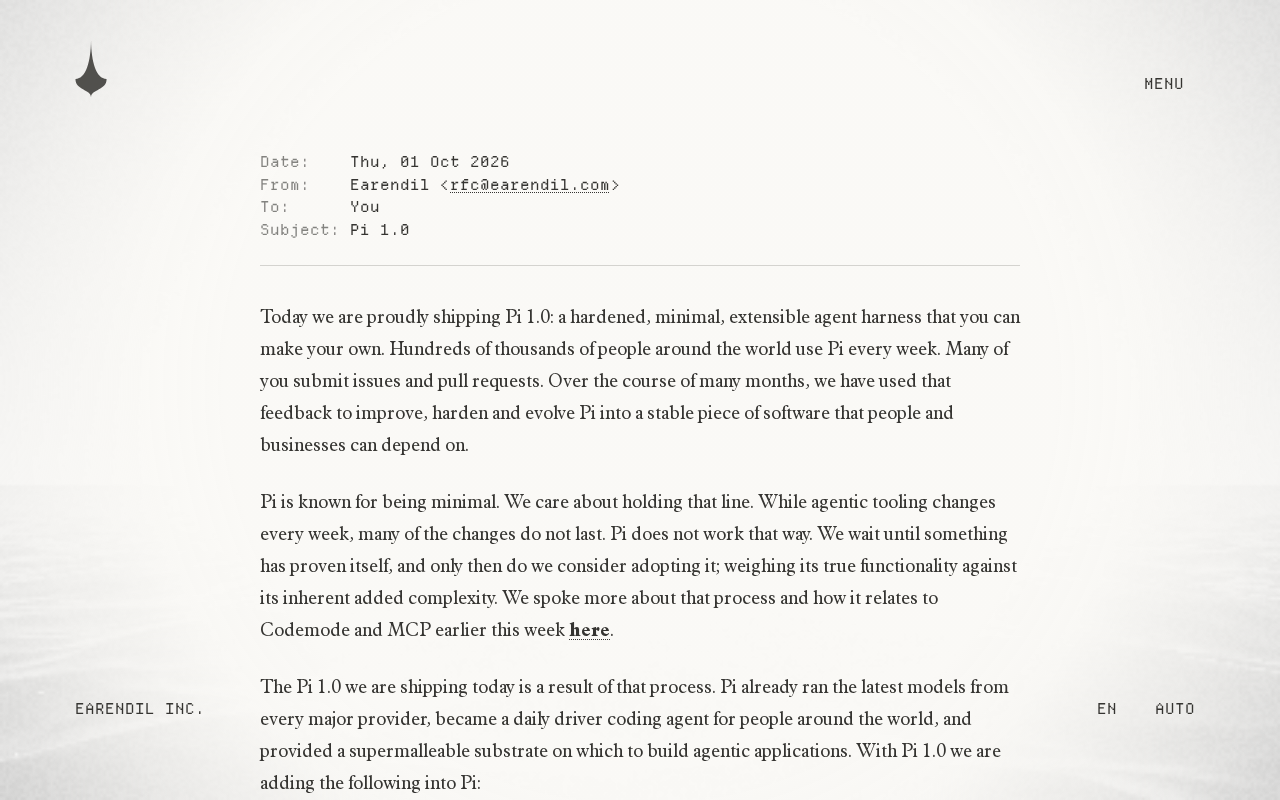
Unfortunately, the available source material is limited to the project link (earendil.com/posts/pi-1-0/) and the Hacker News discussion thread — there's no detailed description of the project's features, tech stack, or positioning. This article therefore offers an objective overview based on publicly available information, along with what can reasonably be inferred from the community response.
What the Community Response Signals
On a community like Hacker News — dominated by technical experts — racking up 327 upvotes in a short timeframe is no small feat. Generally, only two types of projects reach this threshold: practical tools that solve widespread engineering problems, and exploratory works that are genuinely inspiring in their concept or implementation.
The 120-comment discussion count is equally notable. High comment volume often comes with substantive technical debate — arguments about design trade-offs, questions about applicable use cases, and so on. That kind of discourse is itself a useful reference for developers trying to assess a project's maturity.
How to Evaluate Whether a 1.0 Release Is Worth Trying
When a project is labeled 1.0, it typically signals that the author believes it has reached a level of stability suitable for production use or broader promotion. For projects at this "first official release" milestone, there are a few dimensions worth examining:
- Documentation completeness: Are there clear instructions for installation, usage, and configuration?
- Maintenance activity: How quickly are issues addressed, and how frequent are commits?
- Dependencies and compatibility: Is the tech stack mainstream? How costly is integration?
- Real-world validation: Are there known production deployments?
Hacker News (HN) is a tech community run by Y Combinator, known for its high content standards. Its ranking algorithm factors in vote counts, time decay, and comment engagement — making it difficult to game with artificial inflation. A post that stays on the front page and accumulates 300+ upvotes can generally be taken as organic community recognition rather than the result of a marketing campaign. HN's user base skews heavily toward engineers, founders, and technical researchers who tend to be skeptical of overhyped projects — which makes high-upvote posts a relatively reliable signal.
Semantic Versioning (SemVer) defines version numbers in the format "MAJOR.MINOR.PATCH." By convention, a major version of 0 (e.g., 0.x.x) indicates early-stage or experimental development where the API may change at any time. Bumping to 1.0.0 signals that the author is committing to a reasonably stable public interface and considers the software production-ready at a basic level. That said, this is convention, not law — some projects release 1.0 prematurely, while others remain at 0.x long after reaching maturity. Treat "1.0" primarily as a confidence signal from the author, and verify it against actual code quality and documentation.
Recommendations for Getting Accurate Information
Given the limited source material available for this article, readers interested in the project are encouraged to visit the original project page directly for first-hand information. The author's site (earendil.com) typically contains the design rationale, feature list, and usage examples that matter most.
The Hacker News discussion thread is also an excellent complement for understanding a project's strengths and weaknesses. These threads often surface real-world feedback from other developers, side-by-side comparisons with similar tools, and the author's own responses to criticism — all of which tend to be more representative of the actual user experience than a project's promotional homepage.
Summary
Pi 1.0's strong showing in the technical community suggests it's worth paying attention to. However, without more detailed technical information, this article cannot offer a deep assessment of its features or applicable use cases. Readers are encouraged to consult both the project's original page and the community discussion to determine whether it fits their own needs. As more information becomes available, a more complete evaluation will be possible.
Related articles

Chain of Thought Isn't Just for AI: How Humans Can Use CoT to Improve Thinking Quality
Chain of Thought isn't just a prompt trick for large models. Starting from a Hacker News discussion, this article analyzes why CoT works for human thinking too, breaks down actionable ways to transfer it, and highlights the key differences between human CoT and machine CoT.
Cloudflare Teams Up with OpenAI: Closi…
Cloudflare Teams Up with OpenAI: Closing the Loop from Vulnerability Discovery to Defense with AI
Cloudflare uses OpenAI Daybreak to investigate security vulnerabilities and generate reviewable remediation plans, while developers use Codex to boost coding efficiency and quality.

Orca Multi-Agent Orchestration in Practice: A Guide to Parallel Collaboration with Claude and Codex
Orca is Stable AI's free open-source agent workbench supporting 34 agents like Claude Code and Codex in parallel. Learn its Git worktree isolation, multi-model orchestration, and mobile management.