pi: A One-Stop AI Agent Toolkit — Architecture Breakdown Behind 46k GitHub Stars
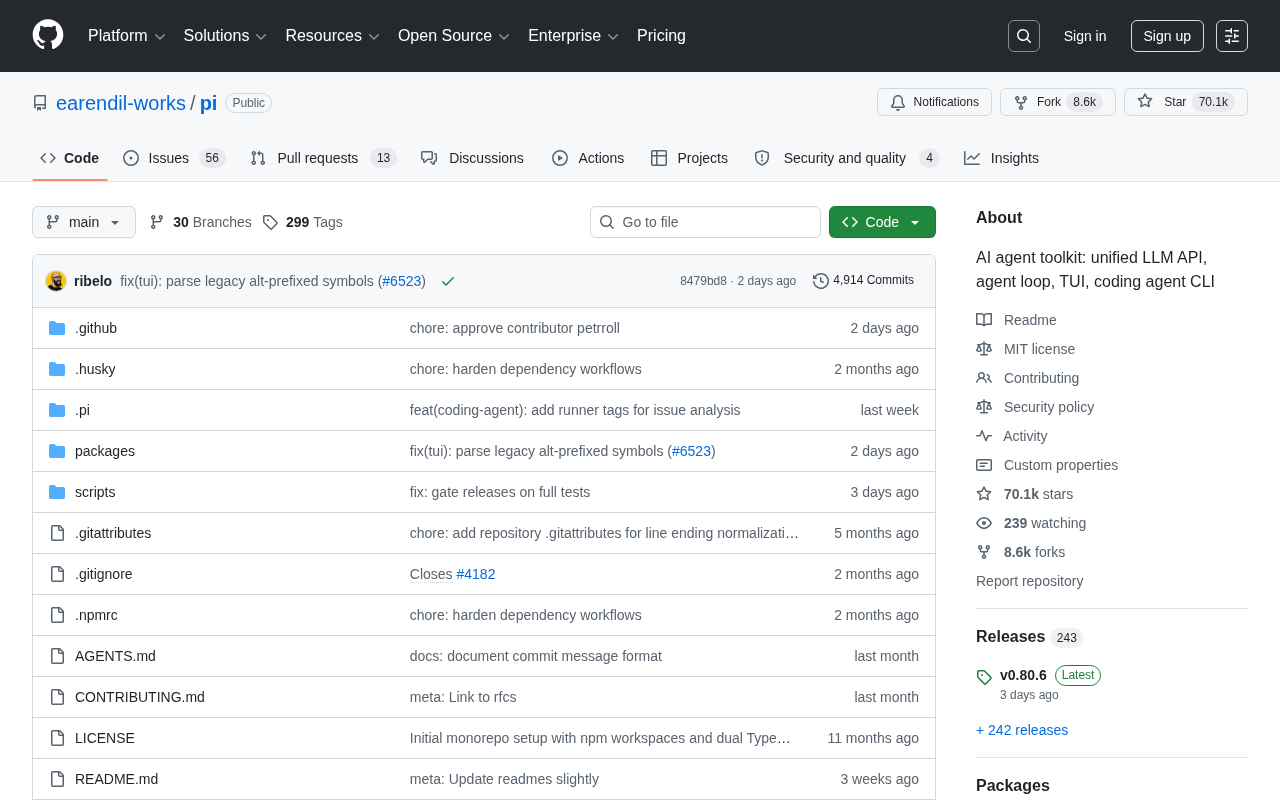
pi is a TypeScript-based all-in-one AI Agent toolkit unifying LLM APIs, CLI, TUI/Web UI, Slack, and vLLM inference.
pi is an open-source AI Agent infrastructure project by the earendil-works team, designed to consolidate the scattered challenges of Agent development — vendor LLM API integration, UI building, team tool connectivity, and inference compute management — into a single toolkit. Its five modules cover a unified LLM API layer, a coding agent CLI, dual TUI/Web UI libraries, a Slack bot integration, and vLLM inference pods. Written in TypeScript for shared type definitions across frontend and backend, the project has surpassed 46,000 GitHub Stars, reflecting strong community demand for a standardized Agent foundation.
The open-source community's demand for AI Agent toolchains is exploding. The pi project by the earendil-works team consolidates everything from a command-line coding assistant to multi-channel interaction interfaces into a single unified toolkit. It has quickly amassed over 46,000 Stars and 5,480 Forks on GitHub, establishing itself as a notable Agent infrastructure project within the TypeScript ecosystem.
What Problem Does pi Actually Solve?
Building a production-ready AI Agent typically forces developers to repeatedly wrestle with the same challenges: integrating LLM APIs from different vendors, building interaction interfaces, connecting Agents to team collaboration tools, and managing inference compute. pi's positioning is to consolidate these scattered pieces into a single toolkit, so developers don't have to assemble everything from scratch.
According to the project description, pi covers five major modules: a coding agent CLI, a unified LLM API layer, TUI & web UI libraries, Slack bot integration, and vLLM-based inference pods. This "all-in-one" combination signals its ambition to become a one-stop foundation for Agent development — not just a single-purpose tool.
Unified LLM API: Abstracting Away Vendor Differences
With multi-model usage becoming the norm, a unified API layer is one of the core value propositions of any Agent toolchain. Different vendors' interfaces vary significantly in parameter naming, streaming responses, and function calling formats. Integrating them directly pollutes business logic with adaptation code.
pi's unified LLM API aims to smooth over these differences, letting the Agent logic above it face only a single abstract interface. Developers can switch underlying models without changing business code — which is especially valuable in production environments where you need to flexibly balance cost, performance, and availability.
Take function calling as an example: OpenAI, Anthropic, and Google Gemini each define different tool description formats and response structures. OpenAI uses a tools array with a tool_choice parameter; Anthropic uses tools with a separate tool_use content block; Google uses functionDeclarations. Directly integrating multiple APIs requires writing separate serialization and parsing logic for each vendor. A unified API layer defines a canonical internal data model above these heterogeneous interfaces, with an adapter layer handling bidirectional conversion. Business code only needs to be written once against this internal model and can then seamlessly switch between underlying providers. This pattern is conceptually similar to LiteLLM (Python) and LangChain's model abstraction layer — pi brings this approach to the TypeScript/Node.js ecosystem.
Coding Agent and Dual-Mode UI Libraries
The fact that the project ships its coding Agent as a standalone CLI indicates the team views "code tasks" as a core use case. The command-line format integrates naturally into developers' daily workflows and CI/CD pipelines, and aligns with how most programming Agents are interacted with today.
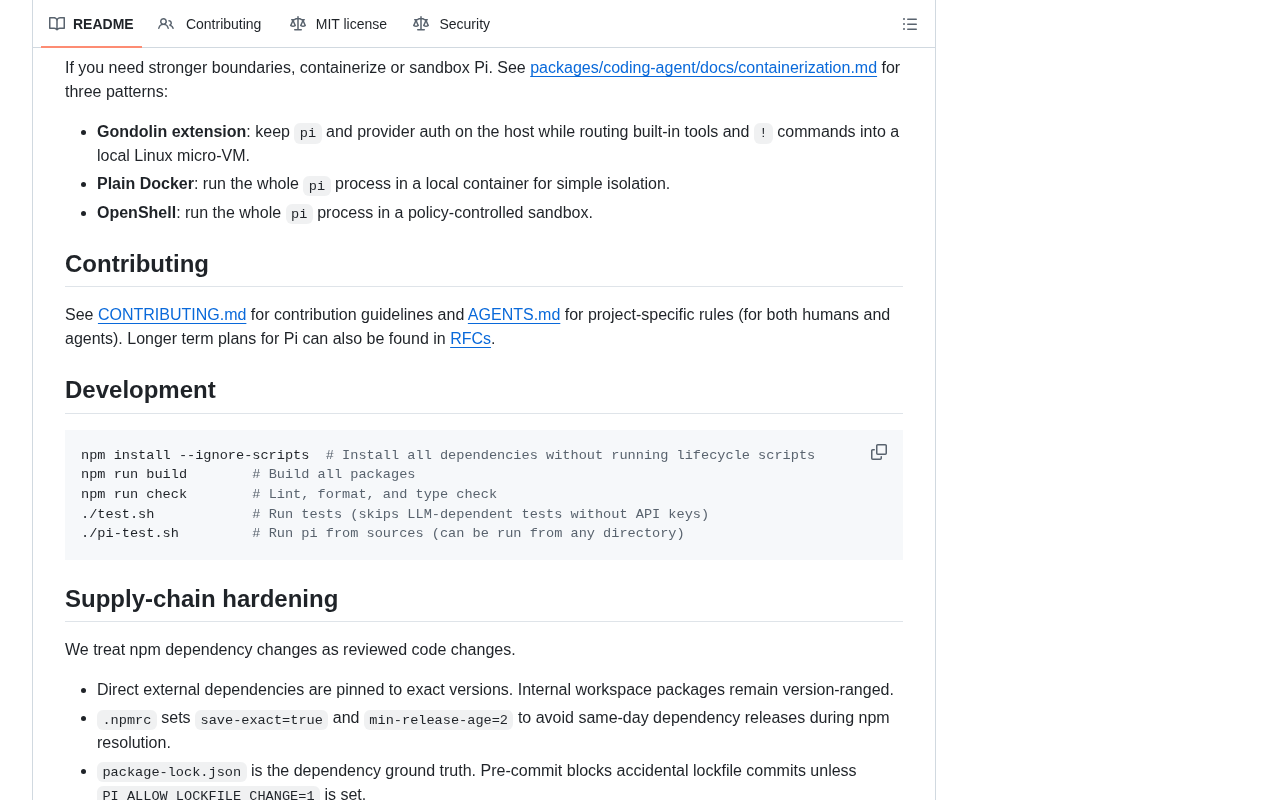
More interesting is the simultaneous provision of both a TUI (terminal interface) and a web UI library. TUI targets power terminal users who prioritize lightweight, instant responsiveness; the web UI makes it easier to build polished, product-facing interfaces for broader audiences. Maintaining both means the same Agent capabilities can be surfaced flexibly depending on the target user group, reducing redundant frontend development.
A TUI (Terminal User Interface) is a text-based graphical interface rendered within a command-line terminal — distinct from plain CLI output, it can render panels, lists, progress bars, scrollable views, and other interactive components. In the Node.js ecosystem, Ink (React-based) and Blessed are common TUI libraries. For AI Agent use cases, TUI's advantage is delivering structured real-time feedback — such as streaming tokens, tool call status, and multi-turn conversation history — without launching a browser. This makes it ideal for local debugging or remote SSH access. By maintaining both TUI and Web UI libraries, pi allows the same Agent's core state and logic to be reused, with only the rendering layer swapped based on the target platform. This is a natural architectural choice under TypeScript's unified type system.
Slack Integration and vLLM Inference Pods
The Slack bot module targets team collaboration scenarios — embedding an Agent directly into everyday communication tools is one of the most practical ways to bring AI capabilities into actual workflows. For internal tools or team assistant applications, this out-of-the-box integration can save significant engineering effort.
The vLLM pods component rounds out the self-hosted inference side. vLLM is one of the leading solutions for high-throughput LLM inference today. By wrapping it into deployable inference units, pi enables teams to run open-source models on their own compute without relying on external APIs. This is a critical capability for data-sensitive environments or teams with cost-control requirements, and it closes the loop by extending the entire toolchain from "calling an API" all the way to "running your own inference."
vLLM is a high-performance LLM inference engine open-sourced by the UC Berkeley team. Its core innovation is PagedAttention — borrowing the paged memory management concept from operating systems to manage the KV Cache, dramatically reducing memory fragmentation and significantly boosting concurrent throughput. Under equivalent hardware conditions, vLLM typically delivers several to over ten times higher throughput than native HuggingFace Transformers inference, making it the go-to choice for production-grade self-hosted open-source models (such as LLaMA, Qwen, Mistral, etc.). By packaging vLLM as deployable "pods," pi provides lifecycle management, resource scheduling, or containerized deployment abstractions on top of vLLM's raw inference capabilities — allowing teams to incorporate open-source models into their entire Agent toolchain without configuring an inference service from scratch.
Technology Choices and Ecosystem Positioning
pi is written in TypeScript, a choice consistent with its positioning within the web and Node.js ecosystem. TypeScript's type system offers tangible benefits for building complex Agent state management and API abstractions, and allows frontend UI libraries and backend logic to share type definitions — reducing coordination overhead.
With over 46,000 Stars, community interest in this kind of integrated Agent toolkit is clearly significant. It reflects a broader trend: Agent development is moving away from "everyone building their own wheels" toward "standardized foundations," and developers increasingly want a set of battle-tested components they can assemble into their own applications.
Conclusion
pi's value lies in threading a complete Agent development chain through a single toolkit — from model invocation and interaction interfaces to team integration and compute deployment. For teams looking to build AI Agents quickly, it offers a path that reduces repetitive engineering work. That said, an all-in-one approach also means carefully evaluating the maturity and coupling of each module. Whether it fits your specific architecture is something best validated in a real project. Interested developers can head directly to its GitHub repository to explore the documentation and examples.
Related articles
StarCraft Returns: Blizzard Reboots the Franchise as an Open-World Shooter
Blizzard is rebooting StarCraft as an open-world shooter, led by Far Cry veteran Dan Hay — revisiting the dream that StarCraft: Ghost never fulfilled.
CadQuery vs. OpenSCAD: Which Is Better for AI Agentic CAD Work?
CadQuery vs. OpenSCAD for AI agentic CAD: comparing Python ecosystem, error feedback, and geometric expressiveness to find the best tool for AI-driven 3D modeling.
Void Linux Maintainer Orphans ~100 Packages Over AI Policy Dispute
A Void Linux maintainer orphaned ~100 packages over an AI policy dispute, highlighting open source governance challenges around AI contributions, licensing, and community values.