Pi Agent Minimal Core Explained: MCP, Skills, and the Philosophy of Extension Design

Pi Agent rose to fame with a minimal core plus on-demand extensions, diverging from feature-stacking tools.
The article draws on a Bilibili creator's analysis to break down the design logic behind Pi Agent's sustained GitHub star growth. Its rise stems from a contrarian path — a minimal core with capabilities delivered through extensions — rather than more features than Codex or Claude Code. Feature stacking raises context overhead and slows requests, while many developers only need a reliable core that can call models, read/write files, and execute commands. Minimal does not mean weak; complex capabilities are moved to external mechanisms at the cost of a higher learning curve. The extension path starts with model configuration, connects external tools via MCP, encapsulates reusable capabilities in Skills, addresses long-term context with project memory, and fills in personalized workflows through custom plugins. It suits developers who want control over their toolchain, and its long-term success depends on the extension ecosystem's activity.
Pi Agent Minimal Core Explained: MCP, Skills, and the Philosophy of Extension Design
As AI coding tools increasingly resemble all-in-one suites, a new project has gained significant developer attention by doing less. Pi Agent's performance on GitHub star trends illustrates the appeal of this contrarian approach. Drawing on an analysis from a Bilibili creator, this article breaks down Pi Agent's design logic, extension mechanisms, and its fundamental differences from tools like Codex and Claude Code.
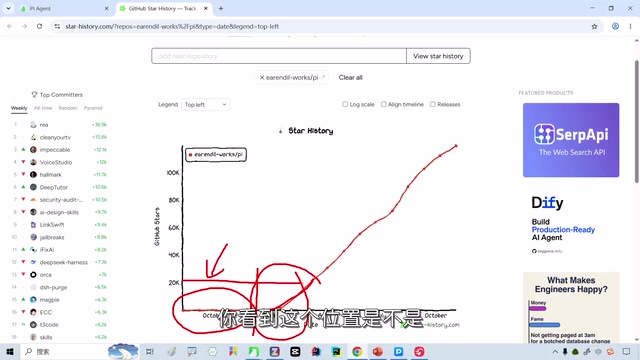
Reading Pi Agent's Rise Through Its Star Curve
On the GitHub Stars History site, Pi Agent's growth curve shows distinct phases. According to the chart presented by the Bilibili creator, the project accumulated few stars slowly in its early stage. It then entered a growth phase, climbing from a few thousand to around 20,000 stars, indicating growing developer interest. Growth continued, at one point approaching 70,000 stars, and it is currently accelerating further.
This is not a single viral spike but a sustained rise. The creator concludes that more and more developers are paying attention to Pi Agent. He also cautions that if you have never heard of this project before, it may indicate you are lagging in keeping up with new AI technologies — blunt, but it points to a reality: AI coding tools are iterating so fast that a new name appears every few months.
Why Pi Agent When Codex Already Exists?
This is the key question for understanding Pi Agent. The creator's answer is counterintuitive: Pi Agent gained attention not because it has more features than Codex or Claude Code, but precisely the opposite — it chose a completely different design path: a minimal core with capabilities delivered through extensions.
The Cost of "Feature-Rich"
Competition among AI coding tools is fierce, with Codex, Claude Code, Cursor, and others vying against each other, easily falling into feature stacking where "if you have it, I must have it too." Tool calling, MCP, Skills, main agent, task planning, context management, sandboxing… these capabilities are certainly useful, but integrating them all makes context grow larger and requests slower.
For many developers, the real need is not that heavy. Sometimes you just need an agent that can call an LLM, read files, modify code, and execute commands — a lightweight, reliable, stable core is enough. Pi Agent's approach is to provide this sufficiently simple core first, with other capabilities extended on demand.
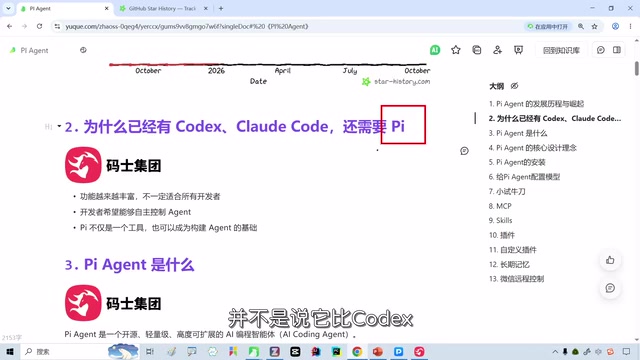
Autonomous Control
Another difference lies in control. When using mature tools like Codex, developers must follow the product's preset rules, extension methods, and interaction patterns, or things may not work well. Pi Agent emphasizes developers' autonomous ownership of the agent: you can write plugins, customize tools, and even use custom commands to handle events or workflows, without relying on the product's preset capabilities.
The creator thus offers a positioning judgment: Pi Agent is not just a tool but can also serve as a foundation for building agents. Give you a reliable core first, then extend outward as needed.
MCP (Model Context Protocol) is a protocol standard proposed and open-sourced by Anthropic in late 2024, designed to let LLM applications connect to external tools and data sources in a unified way. It decouples "tool providers" from "model callers": file systems, databases, search services, and the like only need to implement one MCP Server, and any agent supporting the protocol can connect directly without writing separate adapter code for each tool. For a minimal-core project like Pi Agent, the significance of MCP is externalizing "connectivity" — the core does not need to build in tool-calling logic for every kind of tool; it only needs to implement the protocol client to mount any MCP Server on demand, which is key to rapidly expanding capability boundaries on a small core.
Skills refer to agent capability units encapsulated as reusable modules, typically containing instruction descriptions, accompanying scripts, or tool definitions, enabling the agent to execute preset workflows in specific task scenarios. Unlike MCP, which focuses on "connecting external resources," Skills focus on "encapsulating how to do things": for example, a code review Skill codifies the checklist, which tools to call, and the output format. The value of this design is that capabilities are composable, versionable, and community-shareable — the core only handles scheduling, while specific skills are loaded on demand as files or directories, avoiding core bloat and allowing developers to accumulate project-specific workflows.
A Minimal Core Does Not Mean Weak Functionality
A common misconception needs clarification here. The creator emphasizes that minimal does not mean weak; rather, complex capabilities are moved from the core to external extension mechanisms. The core retains only what everyone needs, avoiding building all features in; extension capabilities are added through mechanisms such as plugins.
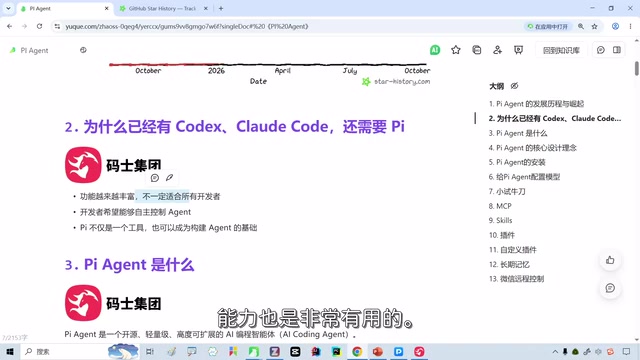
This design trade-off has two consequences. The benefit is a stable, lightweight core with a short request path; the cost is that developers must configure and combine capabilities themselves, so the learning curve is not necessarily low. For users accustomed to out-of-the-box experiences, this may instead be a burden.
Sandbox is an isolated execution environment that lets agent-generated code or commands run in a restricted space, limiting access to the file system, network, and system resources. In AI coding tools, sandboxes mainly address security: having the model automatically execute commands risks accidental file deletion, privilege escalation, or even execution of malicious instructions, and sandboxes contain the impact within acceptable bounds through permission boundaries and resource quotas. For minimal-core projects like Pi Agent, sandboxing is typically not built into the core but connected as an optional extension — configured by those who need strong isolation, while those prioritizing lightness and speed can omit this overhead.
From Model Configuration to MCP and Skills: How the Extension Path Works
Although the original sharing focuses on design philosophy, the recurring keywords outline Pi Agent's extension path: model configuration is the starting point, MCP handles connecting external tools and data sources, Skills carry reusable capability encapsulation, project memory addresses long-term context, and custom plugins fill in personalized workflows. These capabilities are not built into the core but connected on demand.
This mechanism naturally aligns with directions such as "multi-agent" and "long-term memory": the core handles stable execution, while external modules expand boundaries. Developers can decide which capabilities to connect based on actual project needs, rather than being constrained by a product's preset feature set.
Project memory refers to mechanisms by which an agent retains and retrieves context across sessions and tasks. Common implementations include writing key information to memory files within the project, maintaining vector indexes for semantic retrieval, or organizing rule documents by directory hierarchy. Its difference from an ordinary conversation context window lies in persistence: the context window becomes invalid when the session ends or the length is exceeded, whereas project memory preserves "this repository's conventions, historical decisions, and common commands" and loads them on demand at the next startup. This is a typical example of a minimal core outsourcing "long-term context" to external modules — the core does not carry this burden, and the granularity and storage of memory are decided by developers on a per-project basis.
Who Is Pi Agent For?
From its design philosophy, Pi Agent is better suited to developers willing to control their own toolchain — those who need a lightweight agent, are willing to write plugins, are sensitive to context overhead, and want to customize workflows per project. If you want out-of-the-box, fully featured, low-configuration tools, mature commercial products may be less hassle.
This also explains its growth curve: it wins not through a feature list but through a positioning that "returns control to developers," attracting users who identify with the minimalist philosophy. Whether this path can hold long-term depends on whether the extension ecosystem is active enough — the simpler the core, the more critical the richness of external capabilities.
One-line Summary
Pi Agent gained popularity through a contrarian design of a minimal core plus on-demand extensions, diverging from feature-stacking tools.
Paragraph Summary
The article, drawing on a Bilibili creator's analysis, breaks down the design logic behind Pi Agent's sustained GitHub star growth. Its rise is not because it has more features than Codex or Claude Code, but because it chose a contrarian path of a minimal core with capabilities delivered through extensions: feature stacking raises context overhead and slows requests, while many developers only need a reliable core that can call models, read and write files, and execute commands. Minimal does not mean weak; complex capabilities are moved to external mechanisms, at the cost of a higher learning curve. The extension path starts with model configuration, connects external tools via MCP, encapsulates reusable capabilities in Skills, addresses long-term context with project memory, and fills in personalized workflows through custom plugins. The article argues it is better suited to developers willing to control their own toolchain, and its long-term success depends on the activity of the extension ecosystem.
Related articles
The Apple I Didn't Exist Yet—So How Did Woz Write BASIC?
How did Wozniak write the BASIC interpreter before the Apple I existed? Retrocomputing and Hacker News discussions reveal: hardware specs first, then code—paper, pencil, and segmented verification replaced a machine that didn't exist.

Open-Source Humanoid Hand at the $100 Level Achieves Real-Time Teleoperation
The open-source Amazing Hand project enables real-time teleoperation of a $100-level humanoid robotic hand and supports integration with the SO101 arm for full-body control.

DKIM2: Making Every System That Handles an Email Sign for What It Did
DKIM2 proposes that every system handling an email sign for its own operations, extending email authentication from the sender to the entire delivery chain. This article examines its core claims, its relationship with existing DKIM, and the practical problems that must be faced in deployment.