Pi Durable: A Persistence Solution That Lets AI Agents Auto-Resume After Crashes

Pi Durable checkpoints agent state to disk for automatic crash recovery.
Pi Durable is a TypeScript library that solves AI agent state loss after process crashes, which normally requires manually sending continue to restart. It checkpoints every task and tool call to SQLite or JSONL before and after execution. After a server restart, the agent reads the database, finds the last successful checkpoint, and auto-resumes—recovery is a system behavior, not a user action. It targets always-on agents on Slack, email, and Telegram rather than CLI coding tools. The article also flags two deployment risks: checkpointing I/O and storage overhead, and tool call idempotency.
Pi Durable: A Persistence Solution That Lets AI Agents Auto-Resume After Crashes
Imagine this scenario: your AI Agent is sending five emails in a row, and the process crashes on the fourth, leaving an unfinished tool call behind. Traditional coding agents recover in a very primitive way—restart the service, restart the agent, manually send continue, and then pray it can figure out on its own how far the task got.
Pi Durable (pronounced "PyDurable" in the video) solves exactly this pain point. It is not yet another coding agent, but a TypeScript library: every task and every tool call is checkpointed into persistent storage such as SQLite or JSONL. After the server restarts, the agent reads its state directly from the database and continues from the breakpoint—no human intervention required.

Why Crash Recovery for Traditional Agents Hurts So Much
A normal coding agent's runtime state usually lives only in memory. Once the process dies, the context, completed steps, and in-progress tool calls are all lost. Recovery typically relies on manual work: restart the service, reinitialize the agent, and feed "continue" to it as a new instruction.
The problem is that the agent doesn't truly know how far it got before the crash. It can only guess based on the remnants of the conversation history. Guess wrong and you get duplicate emails, missing emails, or completed tasks being redone. For one-off tasks this uncertainty is tolerable; for long-running online agents, it's a disaster.

The Checkpoint Mechanism: State Lives on Disk, Not in Memory
The core design of Pi Durable can be summed up in one sentence: persist every step of the agent. Specifically, each task and each tool call generates a checkpoint before and after execution, written to a SQLite or JSONL file. The choice of storage media is pragmatic—SQLite suits scenarios needing queries and transactions, while JSONL wins on human readability and simple append writes.
When the server restarts and the process is brought back up, the first thing the agent does is not re-plan, but read the database, verify state, locate the last successful checkpoint, and continue from there. The key point emphasized in the video: you don't need to send continue. Recovery is a system behavior, not a user behavior.
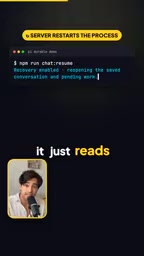
The direct benefit of this mechanism is predictability. A crash no longer means a black-box reset of task state, but merely a pause in the execution flow. For scenarios requiring auditing, the checkpoint records in JSONL are themselves a complete execution log.
Checkpoint is a classic concept in distributed systems and fault-tolerant computing: at a specific moment in program execution, serialize key in-memory state (variables, progress, context) and write it to reliable storage, forming a snapshot that can be rolled back to. When a process crashes or a machine fails, the system can recover from the most recent valid checkpoint instead of recomputing from scratch. The cost of checkpointing lies in the trade-off between write frequency and performance—the more frequently you write, the less work is lost on recovery, but the greater the I/O overhead. Pi Durable brings this idea down to the agent layer, with checkpoint granularity at the level of individual tasks and single tool calls, effectively slicing the agent's execution flow into discrete, independently recoverable segments.
SQLite is an embedded relational database where the entire database is a single file, requiring no separate server process, and supporting ACID transactions and SQL queries. JSONL (JSON Lines), by contrast, is a text format with one independent JSON object per line; its advantages are extremely simple append writes, direct human readability, and easy troubleshooting with tools like grep. The two play different roles in Pi Durable: SQLite suits scenarios needing conditional state queries and atomic write guarantees; JSONL suits log-style appends, post-hoc auditing, and quick manual inspection. Choosing between them is essentially a trade-off among query capability, transactional guarantees, and operational simplicity.
Built for Always-On Agents, Not CLI Tools
Pi Durable's positioning needs to be clear: it is not a command-line coding assistant, nor a replacement for coding agents like Pi. It is a TypeScript library that you import into your own application and build your own always-on agent on top of.
The target scenarios are always-on agents reachable via Slack, email, or Telegram. These agents are characterized by long lifecycles, scattered trigger sources, and sensitivity to reliability. Users won't sit at a terminal manually recovering an agent because it crashed—they may not even know a crash happened. That is exactly the experience persistent checkpointing is meant to guarantee.
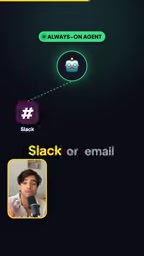
The video's author also demos a small locally running model version: setting up a fully local always-on agent on your own machine. The point of this demo is to lower the verification barrier—without cloud services or large-model APIs, you can observe how the checkpoint mechanism actually performs during crash recovery.
Always-on Agent differs fundamentally from one-off CLI tools in lifecycle and trigger pattern: it stays resident for the long term, is woken asynchronously by external events (messages, emails, scheduled tasks), and often serves multiple channels and users simultaneously. Such systems have availability requirements close to traditional backend services, and crash recovery must be automated. By contrast, coding agents typically run interactively in a developer's terminal, and a human can simply restart them after a crash. Pi Durable provides persistence as a library precisely so developers building their own always-on services can reuse this recovery semantics, rather than being forced to accept the runtime constraints of some finished agent.
A Design Trade-off Worth Noting
Writing every tool call to persistent storage comes at the cost of extra I/O overhead and storage growth. For high-frequency agents, JSONL files will balloon quickly, and SQLite will also face write pressure. The video does not discuss checkpoint cleanup strategies or compaction mechanisms, which is something you'll need to evaluate yourself for real-world deployment.
Another implicit constraint is tool call idempotency. Whether a checkpoint records "call issued" or "call completed" determines whether side effects will be replayed on recovery. Operations like sending email are inherently non-idempotent, so Pi Durable's state machine must precisely distinguish between these two cases—otherwise crash recovery could actually cause duplicate sends. The original author doesn't go deep into this layer in the demo, but from an engineering perspective, it's a core problem that persistent agents cannot avoid.
Idempotency means that executing the same operation once versus multiple times produces the same final effect on the system. Query and read operations are naturally idempotent; operations like sending email, transferring money, or placing orders have side effects, and repeated execution causes real harm. In the context of crash recovery, the key question is whether the checkpoint records the "intent" or the "result": if the checkpoint is written before the call is issued, recovery may replay a call whose side effects already occurred; if written after completion, calls within the crash window may be permanently lost. Common engineering solutions include assigning a unique ID to each operation and deduplicating downstream, or using "two-phase" recording (first record pending, then record done) so recovery logic can identify and handle the intermediate state.
Summary
Pi Durable brings the long-mature checkpoint concept from distributed systems down to the AI agent layer: don't trust memory with state, only trust disk. For developers building always-on, multi-channel, unattended agents, this approach provides a far more reliable foundation than "manually send continue after a crash." It is a library rather than a product, which means both flexibility and integration cost—whether to use it depends on whether your agent truly needs to "survive" crashes.
One-line Summary
Pi Durable checkpoints agent state to disk, enabling automatic resume from breakpoints after crashes.
Paragraph Summary
Pi Durable is a TypeScript library that solves the pain of AI agent task-state loss after process crashes, which would otherwise require manually sending continue to restart. Its core mechanism is checkpointing: every task and every tool call is written to SQLite or JSONL persistent storage before and after execution. After a server restart, the agent reads the database directly, locates the last successful checkpoint, and auto-resumes—recovery is a system behavior, not a user behavior. The library targets always-on agent scenarios like Slack, email, and Telegram rather than CLI coding tools, and the author also demos a local small-model version to lower the verification barrier. The article also points out two deployment risks: the I/O and storage overhead of checkpointing, and tool call idempotency—you must precisely distinguish "call issued" from "call completed," or crash recovery may replay side-effecting operations like sending emails.
Related articles

Chain of Thought Isn't Just for AI: How Humans Can Use CoT to Improve Thinking Quality
Chain of Thought isn't just a prompt trick for large models. Starting from a Hacker News discussion, this article analyzes why CoT works for human thinking too, breaks down actionable ways to transfer it, and highlights the key differences between human CoT and machine CoT.
Cloudflare Teams Up with OpenAI: Closi…
Cloudflare Teams Up with OpenAI: Closing the Loop from Vulnerability Discovery to Defense with AI
Cloudflare uses OpenAI Daybreak to investigate security vulnerabilities and generate reviewable remediation plans, while developers use Codex to boost coding efficiency and quality.

Orca Multi-Agent Orchestration in Practice: A Guide to Parallel Collaboration with Claude and Codex
Orca is Stable AI's free open-source agent workbench supporting 34 agents like Claude Code and Codex in parallel. Learn its Git worktree isolation, multi-model orchestration, and mobile management.