pi-plugin-cc: Connect Claude Code to Any LLM in One Second

pi-plugin-cc lets Claude Code connect to any LLM via Pi for flexible switching and cost optimization.
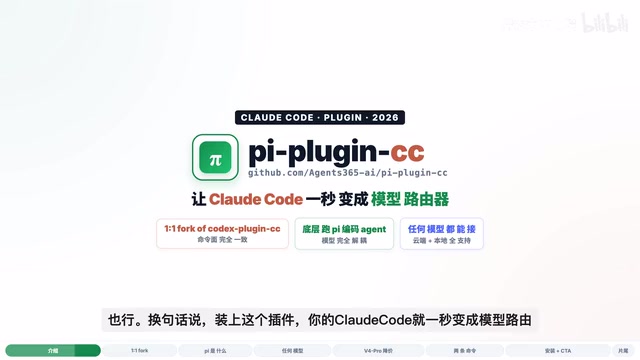
pi-plugin-cc is a Claude Code plugin directly copied 1:1 from OpenAI's codex-plugin-cc, with only the underlying engine replaced by Pi, an open-source coding Agent. Since Pi supports complete model decoupling, it can connect to cloud APIs like DeepSeek, OpenAI, Anthropic, and Google, as well as local models via Ollama and LM Studio, turning Claude Code into a model router that enables multi-model collaboration, cost optimization, and reduced vendor lock-in. Licensed under Apache 2.0 for free commercial use.
Project Overview
A new Claude Code plugin recently launched on GitHub — pi-plugin-cc, available at github.com/agents365ai/pi-plugin-cc. Its core functionality can be summed up in one sentence: it adds a set of commands to Claude Code that delegate code review and task handoff directly to Pi, an open-source coding Agent.
Claude Code is Anthropic's command-line AI programming assistant, and its plugin system allows developers to extend its capabilities through standardized interfaces. Plugins are essentially a set of predefined slash commands injected into Claude Code's working context via CLAUDE.md configuration files or dedicated plugin directories. This design lets third-party developers add new workflow capabilities without modifying Claude Code's core code — such as invoking external Agents, integrating CI/CD systems, or connecting to other AI services.
The key point is that Pi can connect to any LLM on its end — cloud-based services like DeepSeek, OpenAI, Anthropic, and Google all work, as do local solutions like Ollama and LM Studio. Once you install this plugin, your Claude Code becomes a model router — connect whatever you want, make it as cheap as you need.
Design Origin: A 1:1 Copy of CodexPluginCC
The origin of this project is key to understanding it. pi-plugin-cc is a direct 1:1 copy of OpenAI's official plugin codex-plugin-cc — identical command surface, identical interaction logic, all functionality fully preserved. The only change is swapping the underlying engine from Codex to Pi.
OpenAI's Codex CLI is their officially open-sourced command-line programming Agent, which quickly gained developer attention after its release in early 2025. codex-plugin-cc is a bridge plugin developed specifically by the Codex CLI team for the Claude Code ecosystem, allowing Claude Code users to delegate specific tasks to Codex CLI without leaving their current working environment. This "Agent calling Agent" design pattern represents a new trend in the AI programming tool ecosystem: different tools are no longer in competition but can form collaborative networks through standard interfaces.
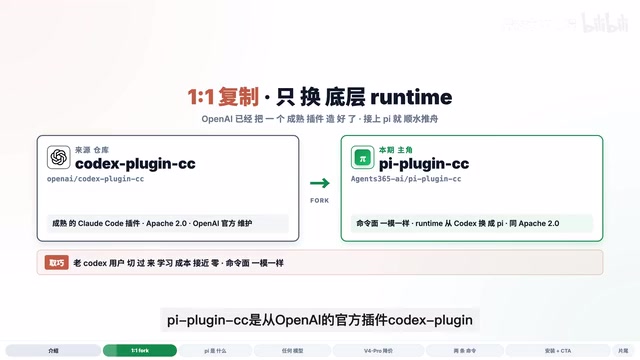
This is a clever and strategic design approach:
- OpenAI already built the wheel: codex-plugin-cc is a fairly mature Claude Code plugin with well-tested interface design and command system
- Pi naturally supports model decoupling: As an open-source coding Agent, Pi is inherently not bound to any model vendor
- Combining both is a natural fit: Pairing a mature plugin shell with a flexible Agent engine requires minimal engineering effort but delivers significant value
The license follows Apache 2.0. Apache 2.0 is one of the most permissive licenses in open-source software, allowing free use, modification, and distribution in commercial products — the only requirement is retaining the original copyright notice and license text. Unlike GPL-family licenses, Apache 2.0 doesn't require derivative works to be open-sourced (no "copyleft" obligation), making it the preferred license for enterprise toolchain integration. Development teams can integrate pi-plugin-cc into internal tool platforms, SaaS products, or commercial IDE plugins without worrying about legal compliance issues.
What Is Pi? Why It's the Core
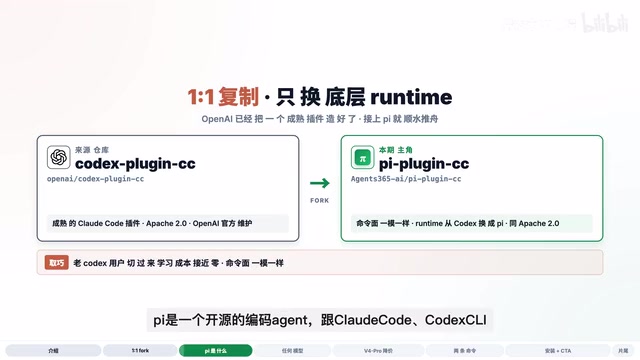
Pi is an open-source coding Agent in the same category as Claude Code and Codex CLI. Its defining feature is complete model decoupling — Pi itself is not bound to any LLM provider. Whatever API Key you configure, that's the model it uses to do the work.
"Model decoupling" is an important architectural principle in current AI engineering, referring to the isolation between application-layer logic and underlying LLM providers through abstract interfaces, so that switching models doesn't require modifying business code. LLM Routers are a concrete implementation of this concept, with representative open-source projects including LiteLLM and RouteLLM, which provide unified OpenAI-compatible APIs that dynamically route to different model providers on the backend. Pi, as a router at the coding Agent level, brings this capability directly into the code-writing workflow rather than staying at the API call layer.
Pi's Supported Model Ecosystem
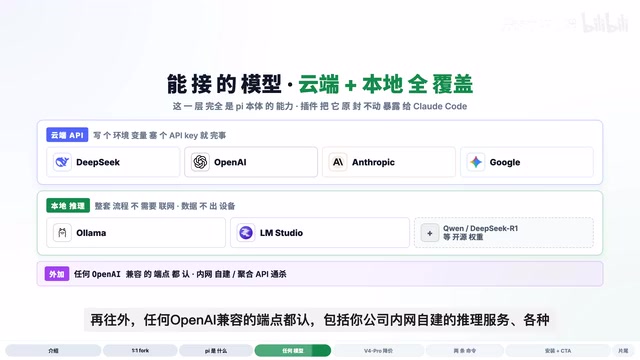
| Type | Supported Services |
|---|---|
| Cloud APIs | DeepSeek, OpenAI, Anthropic, Google |
| Local Deployment | Ollama, LM Studio |
Ollama and LM Studio are currently the most mainstream local LLM runtime frameworks. Ollama focuses on command-line and API services, supporting dozens of open-source models like Llama, Mistral, and Qwen — a single command handles model download and startup. LM Studio provides a graphical interface, making it more suitable for non-technical users. For code development scenarios involving trade secrets, user privacy, or regulated data, local models are the only compliant choice — code snippets never leave the local network, completely eliminating the data leakage risks of cloud APIs. Pi's native support for local models gives pi-plugin-cc practical value even in enterprise intranet environments.
So the true core dependency of pi-plugin-cc is the Pi Agent, not any specific model vendor. This means:
- When a model provider drops prices, switch instantly
- When a new model launches, try it immediately
- Use DeepSeek for routine tasks to save money, use Claude/GPT for critical code when quality matters — allocate flexibly
Practical Value and Use Cases
Cost Optimization: Spend Where It Counts
Between 2024 and 2025, the LLM market experienced intense price competition. The release of DeepSeek R1 drove high-performance reasoning model API prices down to a fraction of previous levels, followed by price cuts from OpenAI, Anthropic, and Google. In this context, "model arbitrage" has become a new skill for savvy developers — routing tasks of different complexity to the most cost-effective model can dramatically reduce API costs without sacrificing overall quality.
Claude Code itself uses Anthropic's models, and token consumption isn't cheap. Through pi-plugin-cc, you can delegate less critical tasks (such as simple code reviews, formatting suggestions, documentation generation) to lower-cost models, saving your Claude quota for scenarios that truly require high-quality reasoning.
Multi-Model Collaboration: Each Model in Its Role
Within the same workflow, you can assign different models to different roles:
- Use DeepSeek for initial code generation (cheap and high-volume)
- Use Claude for architecture design and complex reasoning (quality-first)
- Use local models for sensitive code (data never leaves your machine)
Reducing Vendor Lock-in Risk
The LLM market changes extremely fast — today's optimal choice might not be tomorrow's. Through Pi's model decoupling feature, pi-plugin-cc ensures your workflow is never hard-bound to a single vendor, maintaining maximum flexibility. This aligns with the classic enterprise software architecture principle of "avoiding vendor lock-in" — when a provider raises prices, experiences service outages, or gets surpassed by competitors, your switching cost approaches zero.
Summary
The design philosophy of pi-plugin-cc is simple: don't reinvent the wheel, but cleverly combine existing mature components. It leverages the mature interface design of OpenAI's open-source plugin, adds Pi's model-agnostic characteristics, and achieves free model switching for Claude Code with minimal engineering effort.
For developers who use Claude Code daily, this plugin offers a new option for low-cost experimentation and flexible model resource allocation. Especially in the current climate of escalating price wars among model providers, the ability to switch to the most cost-effective model at any time is itself a competitive advantage.
Key Takeaways
- pi-plugin-cc is a 1:1 copy of OpenAI's codex-plugin-cc, with only the underlying engine swapped from Codex to Pi
- Pi is a fully model-decoupled open-source coding Agent supporting DeepSeek, OpenAI, Anthropic, Google, and local models
- After installation, Claude Code becomes a model router enabling flexible multi-model switching and cost optimization
- Licensed under Apache 2.0, fully legal and compliant for commercial use
Related articles
 Product Reviews
The Programmer's Desk Setup Guide: Building a Workspace That Feels Like Home
Discover how programmers build productive, comfortable workspaces. From multi-monitor setups to ergonomic design, explore the desk philosophy that drives focus and flow.
 Product Reviews
Qoder vs Cursor Real-World Comparison: Which $20/Month AI IDE Is Better?
Hands-on comparison of Qoder vs Cursor AI IDEs: Agent autonomy, human interaction count, and architecture decisions. Qoder needed only 2 interactions vs Cursor's 8.
 Product Reviews
Cursor Cloud Agent Demo: Eliminating Bottlenecks Across the Entire Software Development Lifecycle
Deep analysis of Cursor's Cloud Agent demo showing how cloud VMs, automated test artifacts, and a full-chain control plane systematically eliminate human bottlenecks across the software development lifecycle.