Pico CSS Is No Longer Maintained: Farewell to a Lightweight CSS Framework

Minimalist CSS framework Pico CSS is no longer maintained, sparking discussion about alternatives and open-source sustainability.
Pico CSS is a minimalist CSS framework known for semantic styling and extremely small size, advocating clean HTML with beautiful default styles. The author has confirmed it is no longer maintained, meaning no new features, bug fixes, or security updates. Existing projects can run short-term but face long-term compatibility risks. The article covers Pico's design philosophy, compares it with Bootstrap and Tailwind, and suggests migrating to native CSS, Water.css, MVP.css, or Tailwind CSS. It also reflects on open-source sustainability and backup planning.
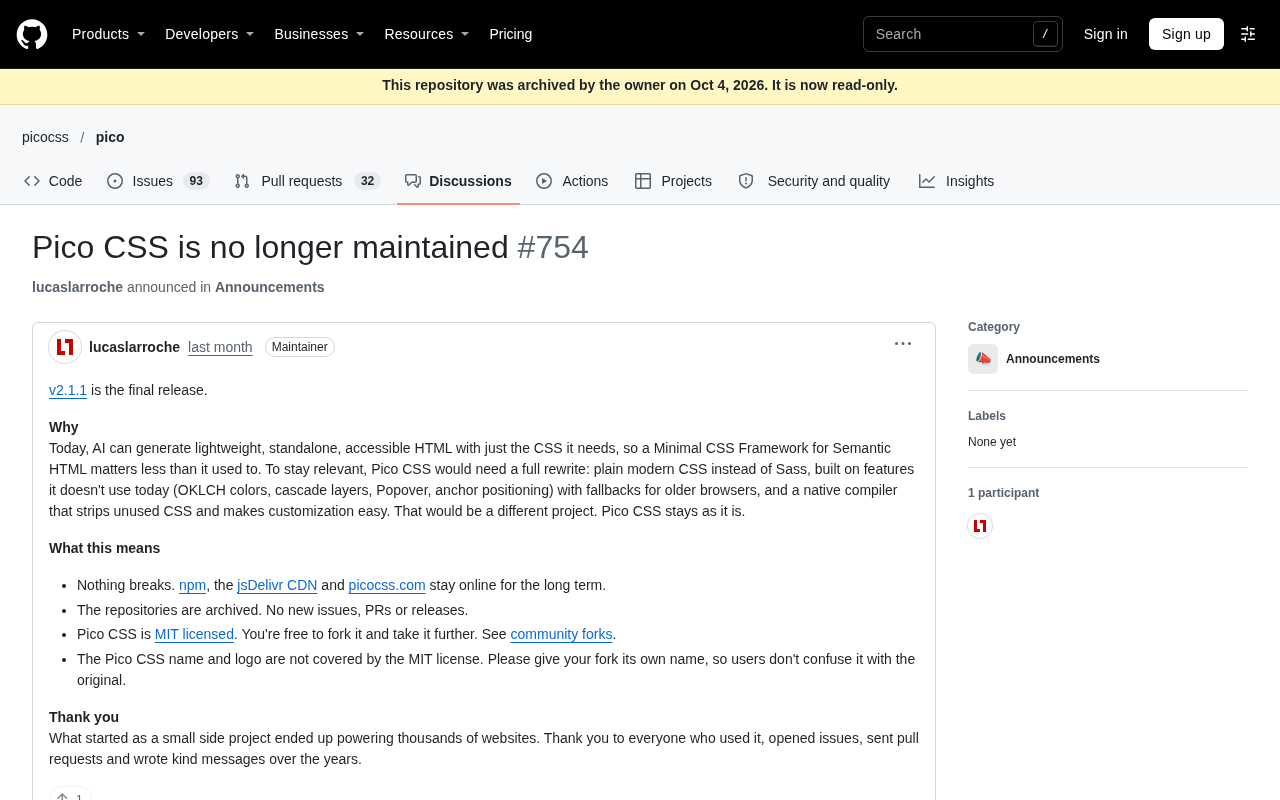
Recently, a discussion on Hacker News titled "Pico CSS is no longer maintained" drew attention in the developer community. This CSS framework, once known for being "minimal and semantic," has officially entered a state of being unmaintained. For many front-end projects pursuing a minimalist style, this is undoubtedly a signal worth noting.
What Is Pico CSS?
Pico CSS is a minimalist CSS framework that focuses on "out-of-the-box" semantic styling. Its core philosophy is: you only need to write clean HTML, and Pico automatically gives native elements beautiful default styles without requiring a large number of class names. This design made it popular for rapid prototyping, static sites, and lightweight applications.
Compared with mainstream frameworks such as Bootstrap and Tailwind CSS, Pico is extremely small, and its learning curve is nearly zero. It does not force you to use a specific class name system; instead, it directly beautifies HTML tags through selectors, which to some extent returns to the "document" nature of the Web.
Semantic HTML refers to using HTML tags with clear meaning to organize content, for example using <header>, <nav>, <main>, <article>, and <footer> instead of large numbers of meaningless <div> elements, and using <button> rather than a <div> with a click event. Semantics not only improves accessibility (assistive technologies such as screen readers can correctly parse the structure), but also benefits SEO and code maintainability. Pico CSS is built around this idea: it assumes that developers write HTML with clear structure and correct semantic tags, and then directly assigns default styles to these tags through element selectors, thereby avoiding piling up class names in HTML.
Utility-first CSS is represented by Tailwind CSS. Its core idea is to provide a large number of fine-grained atomic classes (such as flex, p-4, text-center), and developers build styles by combining these classes in HTML rather than writing separate CSS files. This approach brings a high degree of flexibility and customizability, but it also makes HTML verbose. In contrast, Pico CSS takes a "semantics-first" route: HTML stays clean, and styles are provided uniformly by the framework. The two form a sharp philosophical contrast: the former gives style control to developers, while the latter provides beautiful out-of-the-box defaults. Understanding this difference helps when deciding during migration which model better fits team habits.
What Does It Mean to Stop Maintaining It?
According to the discussion on Hacker News, the author of Pico CSS has clearly stated that the project will no longer be maintained. This means there will be no new features, bug fixes, or security updates in the future. For existing projects that depend on the framework, problems may not appear immediately in the short term, but in the long run, as browser features evolve and Web standards are updated, potential compatibility risks will gradually accumulate.
The community reaction has been relatively calm, though there are also voices of regret. Some comments pointed out that Pico CSS's design approach influenced a number of later projects, and its "semantics-first" philosophy can still be seen in some modern CSS solutions. Some developers also believe that although the maintenance cost of such micro-frameworks is not high, once the author loses interest, it is difficult for the project to continue, which exposes the sustainability problem commonly faced by open-source projects.
Alternatives and Migration Advice
If you are using Pico CSS, or plan to adopt a similar lightweight solution, you can consider the following directions:
- Native CSS: Modern CSS already supports features such as nesting, container queries, and
:has(). Many scenarios that previously required framework assistance can now be implemented in pure CSS. - Other micro-frameworks: Such as Water.css and MVP.css, which also focus on semantic styling and can serve as alternatives.
- Utility-first frameworks: If project complexity increases, utility-first solutions such as Tailwind CSS may be more suitable.
When migrating, note that Pico CSS's styles apply globally to HTML elements. When replacing it with another solution, you may need to re-examine the scope of default style overrides to avoid visual inconsistencies.
Container Queries are an important advance in modern CSS in recent years. They allow components to adjust styles according to the size of their parent container rather than the viewport, making them very suitable for building truly responsive components. Native CSS Nesting allows developers to write nested rules in CSS much like using Sass/SCSS, reducing dependence on preprocessors or build tools. The :has() selector provides "parent selector" capability, allowing a parent element to be styled based on the state of its child elements, for example form:has(input:invalid). The maturity of these native features means that effects that previously required frameworks or preprocessors can now be achieved directly with standard CSS. This is also an important background for the article's suggestion to consider native CSS as a replacement for lightweight frameworks.
Reflections on the Sustainability of Open-Source Maintenance
The discontinuation of Pico CSS is not an isolated case. Many personally maintained open-source projects face the same fate after the author's energy shifts elsewhere. For enterprise users, when choosing a technology stack, in addition to evaluating functionality and size, the project's maintenance activity, community size, and long-term support plans are equally important.
From a positive perspective, Pico CSS has already fulfilled its mission: it proved that "less is more" is still viable in the CSS framework space, and it provided a reference for later minimalist solutions. Even if it is no longer updated, the code and ideas it left behind will still influence some developers.
For individual developers, this may also be a reminder: while enjoying the convenience of open source, you should also prepare backup options for critical dependencies.
Key Points
- Pico CSS is no longer maintained and will no longer receive updates or fixes.
- The framework is known for its semantic approach and extremely small size, making it suitable for rapid prototyping and static sites.
- Existing projects can continue to run in the short term, but compatibility risks need attention in the long term.
- Alternatives such as native CSS, Water.css, or Tailwind CSS can be considered.
- The event has once again sparked discussion about the sustainability of open-source projects.
The sustainability of open-source projects generally refers to a project's ability to remain actively maintained over the long term, promptly fix defects and security issues, and adapt to technological evolution. Many personally maintained projects face the problem of a low "Bus Factor"—that is, once the key maintainer leaves, the project stagnates. Common response mechanisms include: bringing in multiple co-maintainers, establishing foundations or commercial sponsorship models (such as Open Collective and GitHub Sponsors), and adopting clear governance and handover processes. For enterprise users, when evaluating dependencies, in addition to features, they should also pay attention to commit frequency, issue response speed, release cadence, and whether there is a backup maintenance plan, so as to reduce the long-term risk brought by "dependency abandonment."
One-line Summary
Minimalist CSS framework Pico CSS is no longer maintained, sparking discussion about alternatives and open-source sustainability.
Paragraph Summary
Pico CSS is a minimalist CSS framework known for its semantic approach and extremely small size. It advocates that writing clean HTML is enough to get beautiful default styles. Recently, the author confirmed that it is no longer maintained. This means there will be no new features, bug fixes, or security updates in the future. Existing projects can run in the short term, but in the long term they face compatibility risks brought by browser evolution. The article introduces Pico's design philosophy, compares it with mainstream frameworks such as Bootstrap and Tailwind, and offers migration advice: you can move to native CSS, micro-frameworks such as Water.css and MVP.css, or adopt Tailwind CSS when complexity increases. The event also prompts reflection on the sustainability of personally maintained open-source projects, evaluation of maintenance activity, and preparation of backup plans.
Related articles

GitHub Daily · October 30: Skills Ecosystem Explodes, Agents Start Provisioning Their Own Computers
GitHub Daily Oct 30: Skills ecosystem hits three layers (official, personal, vertical), agents get their own computers, and cross-session memory becomes essential.
AWS AgentCore Gateway: Connecting AI A…
AWS AgentCore Gateway: Connecting AI Agents to Enterprise Backends with MCP
How AWS AgentCore Gateway acts as a primary MCP server to aggregate REST APIs, Lambda, and existing MCP services? Analyzing its AST real-time mapping, zero cold start, semantic search for tool overload, session isolation, and key injection security design, plus the architectural approach to decoupling enterprise AI agents from backends.

One Link Gives Figma AI a New Skill: Hands-On with MCP Connectors
Paste one MCP server link and the AI Agent in Figma gains new tool capabilities. We break down the setup flow, 20+ one-click apps, read/write permissions and execution policies, and the public HTTPS requirement.