Pilot5 Legal: A Legal Assistant Where Five AI Models Challenge Each Other

Pilot5 Legal pits five AI models against each other to fight hallucination in legal research.
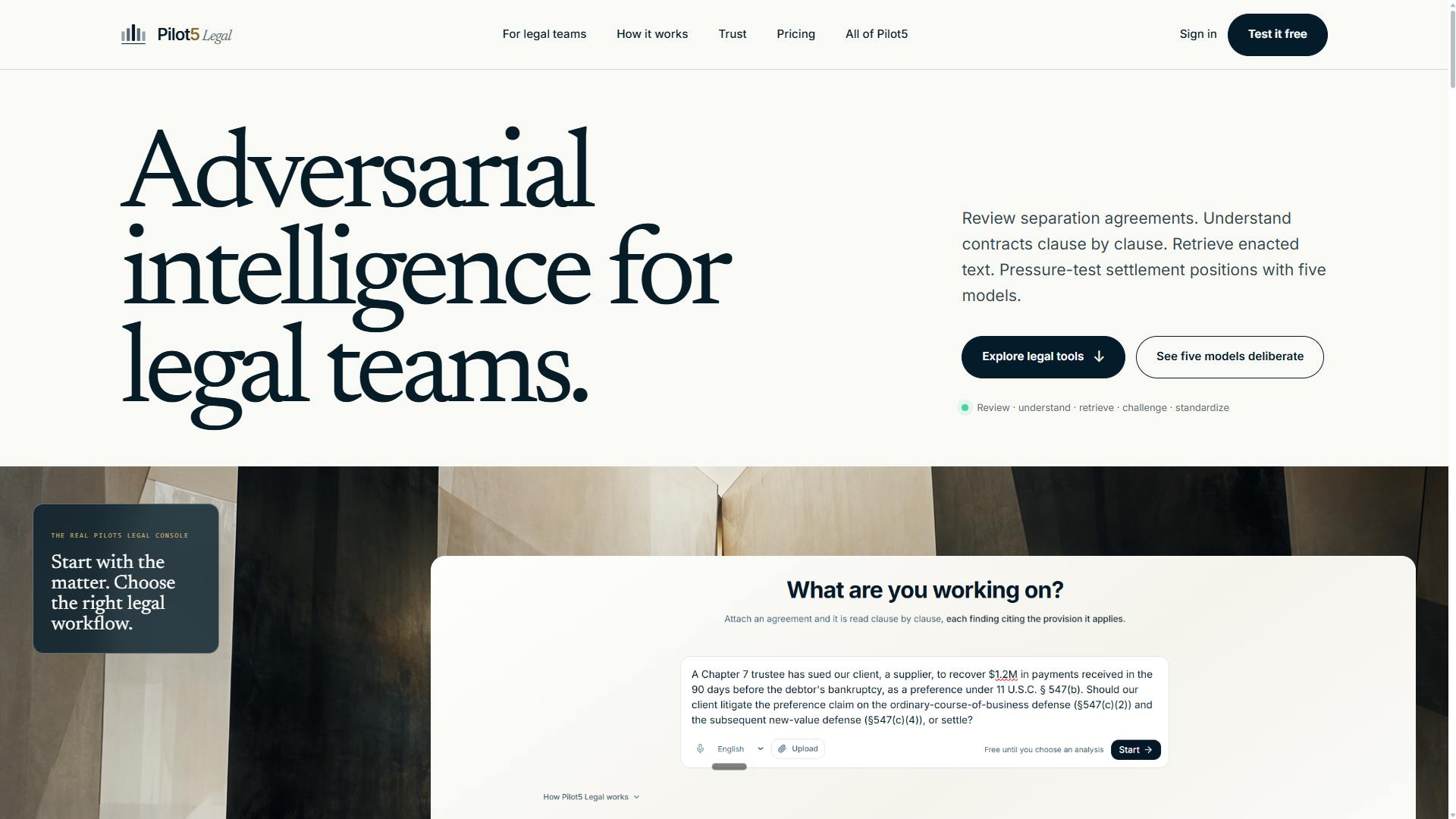
Pilot5 Legal is an AI tool for legal professionals whose core innovation is having five frontier AI models independently analyze the same legal question and challenge each other's reasoning, converging on a recommendation while preserving the strongest dissent. This "multi-model adversarial" design targets legal AI's biggest weakness: hallucination and overconfidence. Key features include primary source research, citation verification, contract analysis, and transparent reasoning — directly addressing incidents like ChatGPT fabricating case citations. The product emphasizes auditability and fits the compliance reality that lawyers bear ultimate responsibility for AI-generated content. However, the architecture carries cost and latency tradeoffs, and model homogeneity bias could undermine the adversarial effect. With 73 ProductHunt upvotes, the product remains early-stage.
A Legal Tool That Makes AI Models Question Each Other
On ProductHunt, a product called Pilot5 Legal has been turning heads in the legal tech community. Its tagline is refreshingly direct: "Five AI models challenge every legal answer." At the time of writing, the product had received 73 upvotes and 6 comments, ranking 16th on the daily leaderboard under three categories: Productivity, Legal, and Artificial Intelligence.
Unlike most legal AI tools built on a single large model, Pilot5's core approach is "multi-model adversarial reasoning": five frontier AI models independently analyze the same legal matter, challenge each other's reasoning, and converge on a recommended conclusion — while still preserving the strongest dissenting opinion. This design targets the biggest pain point of AI in professional settings: hallucination and overconfidence.
Why Make Multiple Models "Fight It Out"?
When a single large model delivers a legal opinion, it typically outputs conclusions in a fluent, confident tone — even when the content is wrong. For lawyers, this "seemingly credible" quality is precisely what makes it dangerous. A misquoted case citation or a misread contractual clause can carry real professional and legal consequences.
Pilot5's cross-model verification mechanism attempts to address this problem. Five models reason independently and challenge one another, effectively staging an internal "mock debate." When multiple models agree on a conclusion, the confidence level naturally rises. When they diverge, the system doesn't paper over the contradiction — it surfaces the strongest opposing view for the user.
This "preserve the dissent" design philosophy deserves recognition. One of the core tasks of legal work is weighing competing arguments. A tool that only provides a single answer can actually mislead judgment, while showing disagreement more closely mirrors how lawyers actually think.
AI hallucination refers to large language models generating content that is factually nonexistent or incorrect with high apparent confidence. This problem is particularly damaging in legal contexts. In the 2023 U.S. federal case Mata v. Avianca, lawyers used ChatGPT to draft case summaries, and the AI fabricated multiple nonexistent precedents — resulting in court-imposed sanctions and public apologies. This incident became a landmark warning for the legal community about AI tools. The multi-model cross-verification approach fundamentally borrows from the design philosophy of academic peer review and the adversarial legal system: no single authority, and conclusions must withstand independent scrutiny and rebuttal before they can be trusted.
Four Capabilities Purpose-Built for Legal Work
Beyond the multi-model framework, Pilot5 Legal adds four key features tailored to legal workflows:
Primary Source Research
Directly retrieves authoritative original legal sources rather than relying on secondhand information baked into training data, reducing the risk of outdated or decontextualized content.
Citation Verification
Verifies the case citations and statutory references that AI produces. This is the lifeline of any legal AI — AI "fabricating citations" has caused numerous public failures, and citation verification capability directly determines whether professionals can trust the tool.
Citation accuracy carries a "veto" effect in professional legal practice. Filing a document with fabricated precedents doesn't just damage the case — the attorney may also face disciplinary action. Current mainstream large models have training data cutoff dates, and major legal databases (such as Westlaw and LexisNexis) are not fully accessible for crawling, making models prone to conflating real precedents with invented ones. A truly functional citation verification feature requires real-time connections to authoritative legal databases at runtime — not just relying on the model's own "memory." This is why the implementation difficulty far exceeds standard RAG (Retrieval-Augmented Generation).
Contract Analysis
Clause-level review and analysis of contract documents — a high-frequency and time-intensive part of a lawyer's daily work, with clear automation value.
Transparent Reasoning
The entire reasoning process is visible to the user, designed to let lawyers "inspect, challenge, and verify" AI outputs. This stands in sharp contrast to the "black box gives you an answer" model.
Transparency and Verifiability: The Right Direction for Legal AI
Pilot5 Legal's product philosophy can be summed up in one sentence: don't let lawyers blindly trust AI — give them auditable tools.
This aligns closely with emerging regulatory consensus and industry norms around legal AI. In many jurisdictions, lawyers bear ultimate responsibility for anything they submit, and any AI-generated opinion must undergo human verification. A tool that emphasizes "transparent reasoning + citation verification + preserved dissent" therefore has stronger compliance footing than products that simply chase "one-click answer generation."
From a positioning perspective, Pilot5 isn't a brand-new company — it's "relaunching for legal work." This suggests the team already has accumulated technical depth in multi-model orchestration and is now focusing that capability on a vertical where accuracy requirements are exceptionally high.
A Few Sober Observations
The multi-model architecture improves credibility, but it also introduces real costs in terms of latency and compute. Running five frontier models simultaneously carries non-trivial inference overhead, which may be reflected in pricing.
Second, the effectiveness of "models challenging each other" depends heavily on the quality of the orchestration logic. If the five models share similar training biases, the so-called "adversarial" dynamic may simply be an echo chamber — unable to surface real errors. Whether genuine diversity is achieved in practice is the key factor determining the product's true quality.
Additionally, 73 upvotes and 6 comments on ProductHunt represents a moderate level of traction. The product is still in early stages, and core metrics like citation accuracy and contract analysis quality need longer-term validation from real users.
For legal professionals looking for AI tools, Pilot5 Legal offers a compelling perspective: rather than chasing an all-knowing AI, build an AI collaboration system that dares to question itself and can be audited.
Model homogeneity bias is a deep challenge for multi-model architectures. Today's leading frontier models (GPT-4, Claude, Gemini, etc.) have significant overlap in training data and RLHF alignment approaches, which can cause them to produce systematically consistent errors on certain questions rather than genuinely independent reasoning. Some researchers call this the "AI echo chamber" — multiple models appear to reach consensus when in fact they're all reinforcing the same mistaken direction due to shared training biases. Truly effective multi-model adversarial reasoning requires deliberately introducing architectural diversity in model selection (e.g., mixing base models from different lineages) and diversity in reasoning strategies, plus designing orchestration-layer mechanisms capable of identifying "false consensus" — a demanding requirement for the system's architects.
Related articles

Workbuddy for Absolute Beginners: How a Desktop AI Agent Fits Into Real Workflows
A beginner's guide to the Workbuddy desktop AI agent: installation, claiming credits, file management, and building automated workflows—compared with CodeX for fit and cost, helping professionals shift from AI question-askers to AI managers.

OpenAI's New Agent Stack: Computer Use, Decisions API, and Ultra-Fast Workflows
OpenAI Dev Day unveiled a new agent stack: Computer Use outperforms humans, Decisions API delivers ultra-low-latency classification via Luna, Agents API opens the same Computer Use capabilities, and GPT-6.1 Sol costs only one-seventh of Astra. Core updates, benchmark data, and developer insights.

Liang Wenfeng Open-Sources DeepInfo Inference Framework, Takes On U.S. Ban
DeepSeek open-sources its DeepInfo inference framework after its models, featuring GPU/CPU cross-pipelining, small-model prediction with large-model verification, and full Huawei Ascend and NVIDIA chip support—facing the U.S. federal ban head-on. This article analyzes its significance for AI deployment and open-source strategy.