Pinku: A Private AI Chat Tool That Runs Offline on iPhone and Mac

Pinku runs open-source large models locally on iPhone and Mac via Apple's MLX framework, enabling truly private offline AI chat with a serverless architecture.
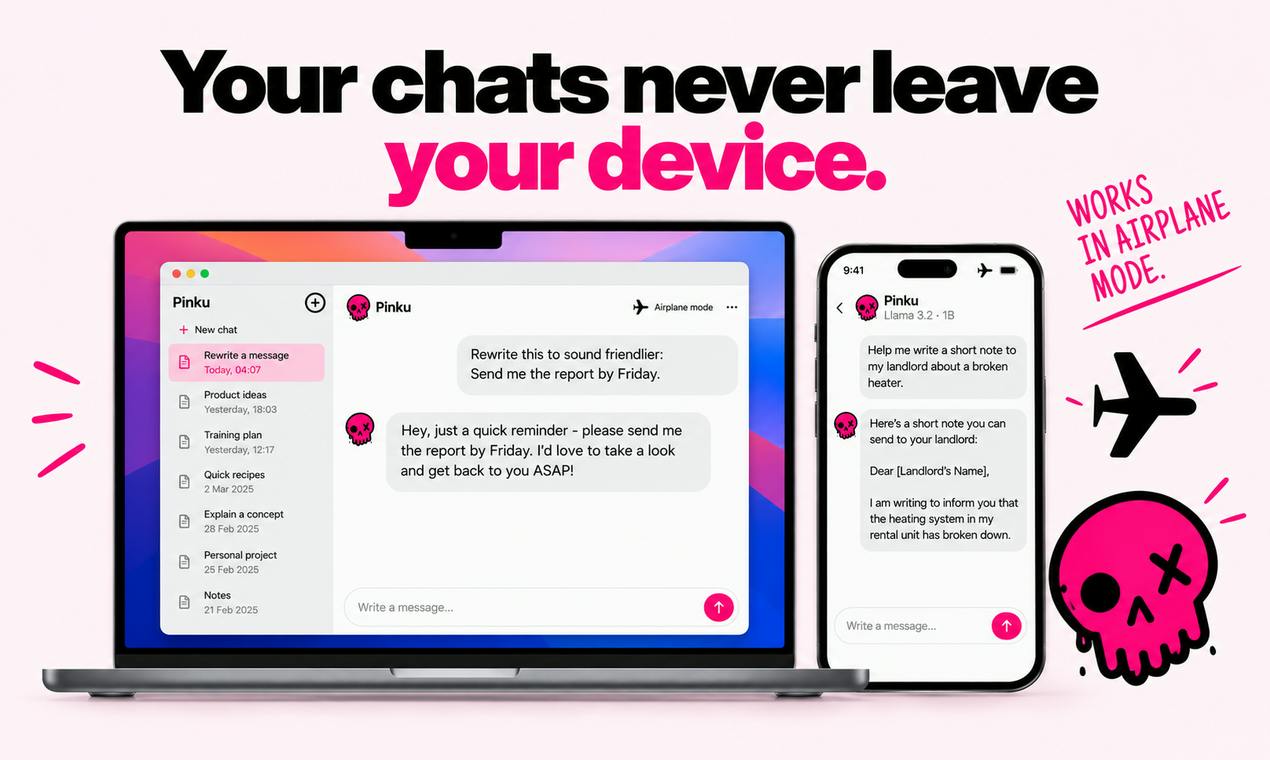
Pinku is a privacy-first AI chat tool ranked #20 on Product Hunt, with its core selling point being fully offline operation. It uses Apple's MLX framework to run open-source models like Llama, Qwen, and Gemma locally on iPhone, iPad, and Mac. After downloading once, users can chat even in airplane mode. With no accounts and no servers, chat data never leaves the device, and privacy is guaranteed by architecture rather than policy. The trade-offs are that model size is constrained by device compute, answer quality falls short of cloud flagship models, and cross-device sync is lacking. Its free-to-start model targets privacy-sensitive professionals, offline workers, and tech enthusiasts, representing an important trend of bringing edge AI from the cloud back to local devices.
When AI Chatting No Longer Needs the Cloud
Most AI chat tools work in a simple way: your question is sent to a remote server, a large model on that server generates an answer, and the result is sent back to your screen. During this process, your conversation content travels over the network and remains on someone else's server. For users handling sensitive information, trade secrets, or who simply care about privacy, this chain itself is worth being wary of.
Pinku takes a completely different path. This product, ranked #20 on Product Hunt, has a core proposition captured in one sentence: private AI chat, running offline on your iPhone and Mac.
How Local Inference Enables "Chatting Even in Airplane Mode"
Pinku's technical foundation is Apple's MLX framework—a machine learning array computation framework Apple provides for its own chips (M series and A series). With MLX, Pinku can run open-source models directly on iPhone, iPad, and Mac, including the Llama, Qwen, and Gemma families.
The usage flow is not complicated: download a model once, and afterward you can chat completely offline. The original text explicitly states that even with airplane mode enabled, the chat function remains available. This means the inference process happens entirely locally on the device, without relying on any network connection.
The trade-offs behind this are also clear. Running locally means model size is limited by the device's memory and compute power, and it's impossible to call giant models with hundreds of billions of parameters like in the cloud. The Llama, Qwen, and Gemma models Pinku supports all belong to relatively lightweight open-source model families that can run on edge devices, but there will be a gap in answer quality and complex reasoning capability compared with cloud-based flagship models. This is a reality all edge AI solutions face together.
What makes MLX unique is its Unified Memory Architecture. The CPU and GPU of Apple's M series and A series chips share the same physical memory, so data doesn't need to be copied between them, which greatly reduces inference latency and power consumption. MLX is designed specifically for this architecture, using lazy computation graphs and functional array operations to automatically optimize memory usage. In addition, MLX supports model quantization—compressing model weights from 16-bit floating point to 4-bit or 8-bit integers, shrinking model size several times over with almost no loss in accuracy. This is the key technology that lets 7B-parameter models run on an iPhone.
The Llama, Qwen, and Gemma mentioned in the text are three different open-source model families. Llama, released by Meta, is one of the most active open-source model series in the ecosystem today; Qwen comes from Alibaba and performs outstandingly on multilingual and Chinese tasks; Gemma is a lightweight open-source model launched by Google based on Gemini technology. These models are usually released at parameter scales from 7B (7 billion) to 70B (70 billion), but edge deployment typically uses small versions of 1B-8B, compressed with 4-bit quantization, so they can run within the limits of phone memory (usually 8-12GB).
Privacy Is Not a Feature, It's Architecture
Pinku's privacy promise is not guaranteed by a policy clause, but by the architecture itself. The original material states: there is no account system, no server, and chat records never leave your device.
This design stands in sharp contrast to most AI products on the market. Even if cloud AI services claim not to use data for training and to delete it regularly, the data still has to pass through the provider's pipeline. Pinku's approach physically eliminates this pipeline—there is no server to transmit to, so data naturally cannot leak.
The cost is the lack of synchronization and cross-device experience. Because there is no account, your conversations on iPhone won't automatically appear on Mac (unless the product has another local sync mechanism, which the original text does not mention). For users who put privacy first, this trade is worth it; for users accustomed to seamless switching across multiple devices, they will need to adapt.
"Serverless" architecture is fundamentally different from traditional end-to-end encryption. Although end-to-end encryption can prevent eavesdropping during transmission, data still needs to be decrypted and processed after reaching the server, and the provider can theoretically still access the plaintext. Pinku's solution is to completely eliminate the server—inference is done entirely locally, and no data leaves the device. This is an extreme practice of the "data minimization" principle: no collection, no transmission, no storage. From a compliance perspective, this architecture naturally meets GDPR's "data protection by design" requirements and also avoids the legal risks of cross-border data transfer.
Free to Start, and Who It's Aimed At
Pinku adopts a free-to-start model, indicating that the product has designed some kind of paid upgrade path, but the original text does not disclose specific pricing or feature tiers.
In terms of positioning, Pinku targets three types of people: first, data-sensitive professional users such as lawyers, journalists, and doctors, whose conversation content is not suitable for uploading to third-party servers; second, people working in unstable network environments or completely offline; third, tech enthusiasts who simply want to experience local large models. Apple ecosystem users on Mac and iPhone are its natural audience, because the MLX framework itself is optimized for Apple chips.
On Product Hunt, 66 votes, 3 comments, and a #20 ranking show that it has attracted some attention, but it is far from being a breakout hit. This also matches the current general situation of edge AI tools: the concept is attractive, the actual experience is limited by hardware performance, and the audience is relatively niche.
One Small Step for Edge AI, One Giant Leap for Privacy Computing
Pinku itself is not a disruptive product, but it represents a direction worth watching: pulling AI capabilities from the cloud back to local devices. As Apple chips' neural engines grow stronger year by year and open-source models continue to improve in quantization and compression, the models that can run on edge devices will become increasingly powerful. Today Pinku can run Llama and Qwen offline; tomorrow edge models' answer quality may approach that of mid-range cloud models.
For ordinary users, Pinku is currently more of a privacy-first backup option; for the entire industry, it is a pathfinder—proving that AI chat that does not rely on servers and does not collect account information is feasible on consumer-grade hardware.
One-line Summary
Pinku runs open-source large models locally on iPhone and Mac based on Apple's MLX framework, achieving truly private offline AI chat through a serverless architecture.
Paragraph Summary
Pinku is a privacy-first AI chat tool ranked #20 on Product Hunt, with its core selling point being completely offline operation. It uses Apple's MLX framework to perform local inference of open-source models such as Llama, Qwen, and Gemma on iPhone, iPad, and Mac. After downloading once, users can chat even in airplane mode. The product has no accounts and no servers, and chat data never leaves the device; privacy is guaranteed by architecture rather than policy. The trade-offs are that model size is limited by device compute power, answer quality falls short of cloud flagship models, and there is no cross-device synchronization. Its free-to-start model targets data-sensitive professional users, people working in offline environments, and tech enthusiasts, representing an important trend of pulling edge AI back from the cloud to local devices.
Related articles
 Tech Frontiers
Gemini Omni 1.2 Flash: AI Video Moves Toward Draft-Style Editing
Google's Gemini Omni 1.2 Flash update enables conversational, draft-style editing of the same video—swap scenes while keeping products, adjust lighting while keeping characters. Clips up to 15s, 720p costs 30% less than the previous Flash—ideal for e-commerce ads, previs, and short-asset production.

Codex Tutorial: One-Command Install and Run Your First Task
Codex tutorial: one-command install and run your first task. Covers the four Codex forms, sandbox and approval guardrails, AGENTS.md and MCP configs, cloud network policy, and the iron rule of human review—everything you need to get started with this autonomous coding agent.
 Tech Frontiers
Localix: An Open-Source Agentic Development Environment with Multi-Model and Local AI Integration
Localix is an MIT open-source Agentic Development Environment (ADE) supporting seamless Claude Code plugin loading, multi-model cloud and local execution, Mini Apps extensions, and agent context management—an open AI collaboration workbench for developers.