Pinterest Tests Restyle: A New AI Feature That Redesigns Your Room
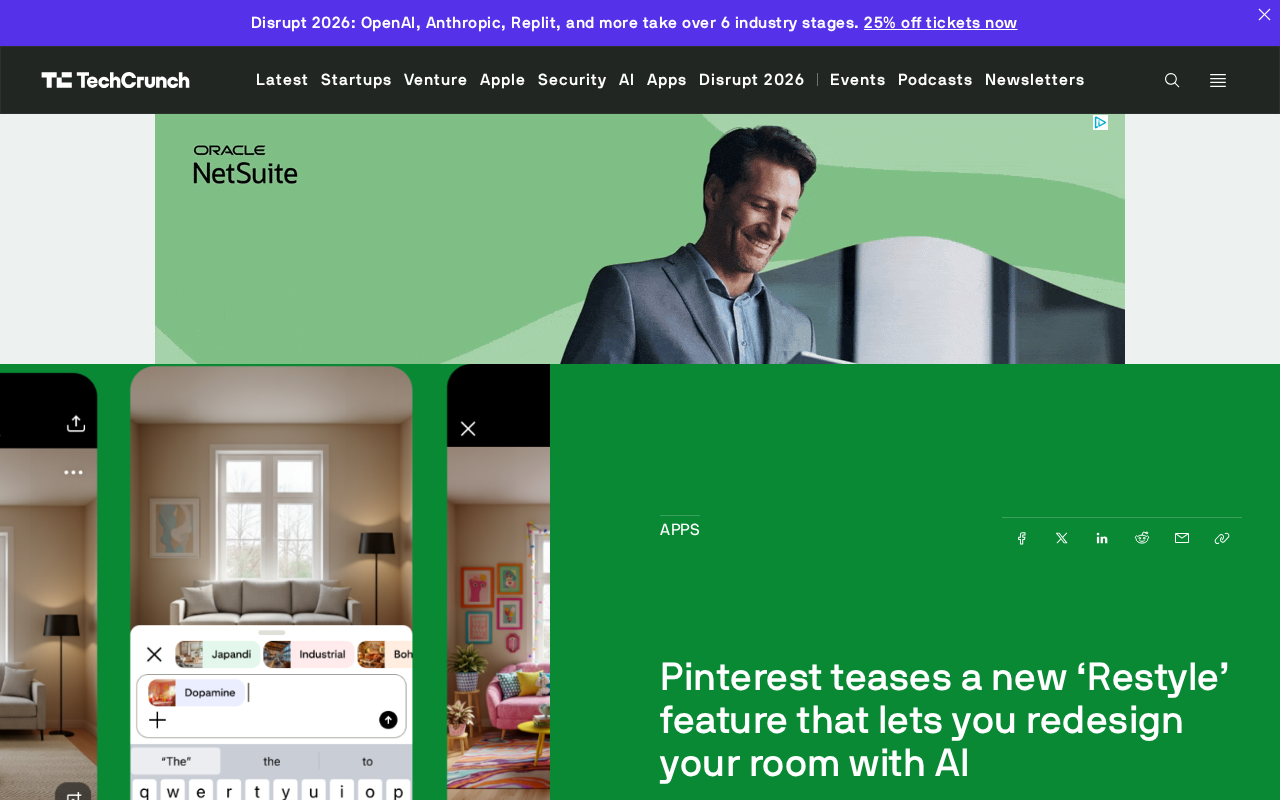
Pinterest's new AI feature Restyle lets users preview home décor changes in their own room photos before buying.
Pinterest is testing an AI-powered home visualization feature called Restyle, which lets users upload photos of their own rooms and see furniture, décor, and lighting overlaid in context. The tool targets a longstanding pain point: users save countless inspiration images on Pinterest but rarely convert them into actual purchases. By lowering the imagination barrier and shortening the decision-making process, Restyle aims to turn passive inspiration browsing into e-commerce transactions — reinforcing Pinterest's identity as a "visual discovery + shopping" platform. The feature is still in testing, with full details yet to be announced.
Pinterest is testing a new AI feature called Restyle that lets users visualize how furniture, décor, lighting, and other design elements would look directly inside photos of their own rooms. The feature aims to bridge the gap between saved inspiration and actual purchases.
What Is Restyle?
Restyle is an AI-powered room transformation tool. Users simply upload a photo of their own room, and the system overlays different furniture, soft furnishings, and lighting elements onto the image — giving users a realistic preview of what a redesign could look like.
This aligns closely with Pinterest's long-standing product identity. As a platform built around visual inspiration, Pinterest hosts an enormous volume of home design and interior décor content. Users have always been able to save (Pin) countless home images they love — but there's historically been a significant gap between "saving inspiration" and "actually making it happen." Restyle is designed to close that gap.
A Critical Link Between Inspiration and Purchase
For Pinterest, Restyle isn't just a product experience upgrade — it's a strategic move in its monetization roadmap.
While the platform is packed with home inspiration imagery, users often struggle to judge whether a particular piece of furniture or decorating style will actually work in their own space. By using AI to overlay virtual design elements onto a user's real room, Restyle dramatically lowers both the mental effort required and the barrier to making a decision.
When a user can clearly see what "that lamp would look like in my living room," the conversion path from browsing to checkout becomes far shorter. This gives Pinterest a meaningful opportunity to translate pure inspiration browsing into e-commerce purchases — strengthening its commercial value as a "visual discovery + shopping" platform.
A Competitive Arena for AI Home Design
The launch of Restyle also reflects the accelerating adoption of AI in interior design and home retail. In recent years, a growing number of companies have leveraged generative AI and image compositing technology to help consumers preview furniture placement, wall color schemes, and overall style combinations.
The core value of these tools lies in "what you see is what you get" — giving users near-realistic visual feedback before they buy. For high-ticket, high-return-rate categories like furniture and home décor, this kind of preview capability is especially valuable: it builds buyer confidence while helping reduce return costs.
With its vast visual dataset and users who come with clear purchase intent, Pinterest holds a natural advantage in this space. If Restyle successfully rolls out at scale, it could become a key gateway connecting home content with e-commerce transactions.
Several notable competitors are already active in this arena. IKEA launched its AR app "IKEA Place" back in 2017, allowing users to virtually place furniture in their real rooms — though its adoption remained limited due to the friction of AR interaction. Startup Houzz introduced a "View in My Room 3D" feature, and Amazon offers similar AR-powered shopping previews. More recently, as generative image models like Stable Diffusion and DALL-E have matured, a new wave of AI-driven interior design tools has emerged — including dedicated products like Reimagine Home and REimagineHome. Compared to these players, Pinterest's differentiating advantage is that it already serves as users' "mood board" for storing inspiration. Users have already expressed their preferences on the platform; Restyle simply needs to complete the final step of "from inspiration to reality" — with minimal friction for the user.
Still in Testing
It's worth noting that Restyle is still in a testing phase and has not yet launched broadly. The specific availability, supported product categories, and the level of detail in AI-generated results have yet to be fully disclosed by Pinterest.
For those tracking real-world AI applications, Restyle is a case worth following closely: it demonstrates the practical potential of generative AI in consumer scenarios, while also representing one platform's exploration of extending from content discovery toward a fully closed commerce loop.
Related articles

Waymo Restarts San Antonio Operations: Back on the Road Five Months After Flood Incident
Waymo resumes San Antonio Robotaxi service ~5 months after a vehicle was swept away in flooding. A look at what happened, why it took so long, and what it means for AV safety in extreme weather.
What Is AIOps? How AI Is Reshaping IT Operations
AIOps applies AI and machine learning to IT operations for anomaly detection, alert noise reduction, and root cause analysis — shifting teams from reactive to proactive.
CCC Sends Its Invitation: 40C3 Hacker Congress Themed "Model Citizens"
CCC announces its 40th Chaos Communication Congress (40C3) under the theme "Model Citizens," inviting hackers worldwide to examine surveillance and algorithmic governance.