Pirate-Style Rescue: Saving Open-Source LLM Models from Deletion

Open-source LLM weights risk permanent deletion, sparking pirate-style community archiving amid copyright gray zones.
A Hacker News post about "pirate-style" rescues of soon-to-be-deleted LLM models highlights a growing crisis in open-source AI: model weights hosted on platforms like Hugging Face can vanish permanently due to copyright disputes, license changes, or publisher cleanups. Since retraining equivalent models costs millions, communities have begun mirroring and redistributing weights before takedowns — echoing the Internet Archive's ethos but operating in legally murky territory. The article urges developers to maintain local backups, scrutinize license terms, and explore decentralized archiving solutions like IPFS to reduce dependence on single-platform hosting.
A Discussion About the Survival of Open-Source Models
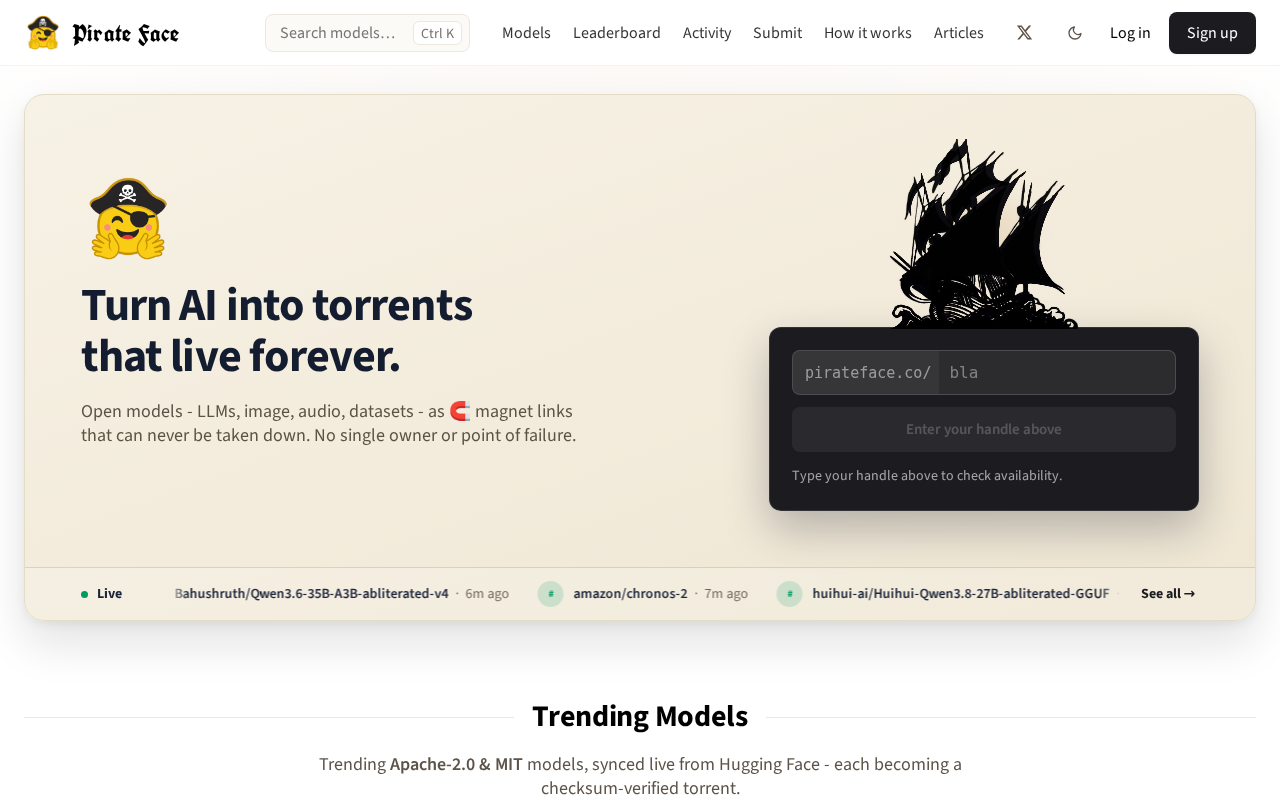
A compelling topic recently surfaced on Hacker News — "Pirate Face Rescues LLM Models from Deletion." Despite modest engagement (9 upvotes and 1 comment), it touches on an increasingly important issue in the open-source AI community: When models hosted on platforms face takedowns or deletion, how do we preserve these public knowledge assets?
Open-source large language models (LLMs) have grown explosively in recent years, with platforms like Hugging Face becoming the primary hubs for model distribution. But models aren't permanent — publishers may delete released weight files due to compliance concerns, copyright disputes, licensing conflicts, or simply the cost of storage. Once deleted, researchers, developers, and downstream applications that depend on these models can find themselves in a difficult position.
Why Models Get Deleted
Open-source models get taken down for a variety of reasons. Some are removed due to copyright disputes over training data; others can no longer be publicly distributed because of licensing changes; and still others disappear when publishers proactively clean up old versions or shut down their accounts entirely.
For the community, this creates a real problem: Models that have been widely cited, fine-tuned, and deployed are nearly impossible to reproduce once they disappear. Training a large model is extraordinarily expensive — the average user simply cannot retrain equivalent weights from scratch. This makes timely mirroring and archiving critically important.
From a technical standpoint, a model's "weights" are the core artifact of its training, typically stored as binary files ranging from tens to hundreds of gigabytes. LLaMA 2 (70B parameters), for example, weighs in at roughly 130GB; multimodal models like Stable Diffusion similarly run into multiple gigabytes. Hugging Face, the dominant model hosting platform, offers free storage to publishers — but as the number of models explodes, storage cost pressures mount. For individual publishers or small teams with no ongoing maintenance intent, deleting an account or cleaning up a repository is completely routine. Unlike code repositories, model weights can't simply be "recompiled" from source — training a comparable replacement model can require millions of dollars in compute. This makes "deletion = permanent loss" far more serious in the AI space than in traditional software.
What "Pirate-Style Rescue" Actually Means
The "Pirate Face" in the post title carries a playful edge, referring to self-organized community behavior resembling a digital preservation movement — downloading, mirroring, and redistributing model weights to alternative storage channels before they're officially deleted.
In spirit, this aligns closely with the Internet Archive and various data preservation projects: When public digital assets face permanent disappearance, the community chooses to intervene with backups. In the LLM context, however, such rescues often operate in a legal gray zone around licenses and copyright — hence the "pirate" label.
What makes this worth discussing is what it reflects about the open-source community's deep commitment to "knowledge accessibility." When a model has become a reproducibility benchmark in academic papers or a foundational component in commercial products, its sudden disappearance creates cascading consequences.
The Tension Between Archiving and Copyright
The real complexity here lies in the conflict between preservation and compliance. On one hand, rescuing a model on the verge of disappearing has clear justification from a digital preservation standpoint — the logic is similar to a library preserving out-of-print books. On the other hand, if a model was deleted for copyright or compliance reasons, redistributing it may constitute an end-run around those original restrictions.
For the open-source community, this raises several questions that deserve long-term consideration:
- Who should be responsible for maintaining the long-term availability of open-source models?
- Is distributed, decentralized model storage a viable solution?
- How can we build a legitimate model archiving mechanism that respects licensing terms?
The current model licensing landscape deepens this tension. Meta's LLaMA series uses a custom community license that explicitly prohibits unauthorized redistribution; models like Mistral and Falcon use permissive licenses such as Apache 2.0 or MIT, which allow modification and redistribution. Yet even under permissive licenses, whether a model's weights constitute a "derivative work" when the training data includes copyrighted content remains an open legal question. U.S. copyright law has no clear precedent here, and the EU AI Act does not directly regulate model archiving. The Internet Archive has faced multiple copyright lawsuits over preserving web content — a cautionary tale that makes LLM archiving projects more legally cautious. Some community projects (such as TheBloke's large-scale model mirroring work on Hugging Face) mitigate risk by only hosting models whose licenses explicitly permit redistribution, but this approach can't cover every model facing a deletion threat.
Practical Takeaways for Developers
For teams that depend on open-source models, this discussion offers several practical reminders:
Don't assume online models will always be available. For model weights that are critical dependencies in production environments, establish local backups or private mirrors to prevent service disruptions from upstream deletions.
Pay attention to license terms. Before using or redistributing a model, clarify its licensing scope — avoid introducing legal risk in the course of "rescuing" it.
Support exploration of decentralized storage. As the number of models grows, centralized hosting on a single platform introduces single-point-of-failure risks. Community-level distributed archiving solutions are worth watching.
On the decentralized storage front, several technical approaches are already in practice. IPFS (InterPlanetary File System) uses content addressing and distributed nodes to store files, theoretically enabling decentralized hosting of model weights; Filecoin builds on IPFS by introducing economic incentives to encourage nodes to preserve data long-term. Dedicated AI model archiving projects have also emerged — platforms like eye.ai, for instance, attempt to establish persistent model archives. However, these solutions have yet to go mainstream, limited by large-file transfer speeds, the sustainability of node incentives, and the absence of content moderation. For enterprise users, a more pragmatic approach is to build private mirror repositories using object storage services (such as AWS S3 or Cloudflare R2) and record model hash values (e.g., SHA-256) for future integrity verification.
Conclusion
While the Hacker News post itself generated limited discussion, it reflects a real and increasingly urgent problem in the open-source AI ecosystem: In a world of rapidly iterating models, how do we ensure that valuable public assets don't quietly disappear? "Pirate-style rescue" may be a stopgap measure, but it reminds us that building a more robust, compliant, and decentralized model preservation infrastructure has become an unavoidable challenge for the open-source community.
Related articles

Chain of Thought Isn't Just for AI: How Humans Can Use CoT to Improve Thinking Quality
Chain of Thought isn't just a prompt trick for large models. Starting from a Hacker News discussion, this article analyzes why CoT works for human thinking too, breaks down actionable ways to transfer it, and highlights the key differences between human CoT and machine CoT.
Cloudflare Teams Up with OpenAI: Closi…
Cloudflare Teams Up with OpenAI: Closing the Loop from Vulnerability Discovery to Defense with AI
Cloudflare uses OpenAI Daybreak to investigate security vulnerabilities and generate reviewable remediation plans, while developers use Codex to boost coding efficiency and quality.

Orca Multi-Agent Orchestration in Practice: A Guide to Parallel Collaboration with Claude and Codex
Orca is Stable AI's free open-source agent workbench supporting 34 agents like Claude Code and Codex in parallel. Learn its Git worktree isolation, multi-model orchestration, and mobile management.