Pistis Multimodal LLM Deep Dive: IDRL and the New Paradigm of Interleaved Distillation and Reinforcement Learning

Pistis builds multimodal LLMs for deep reasoning and long-horizon agentic tasks via IDRL and PAH.
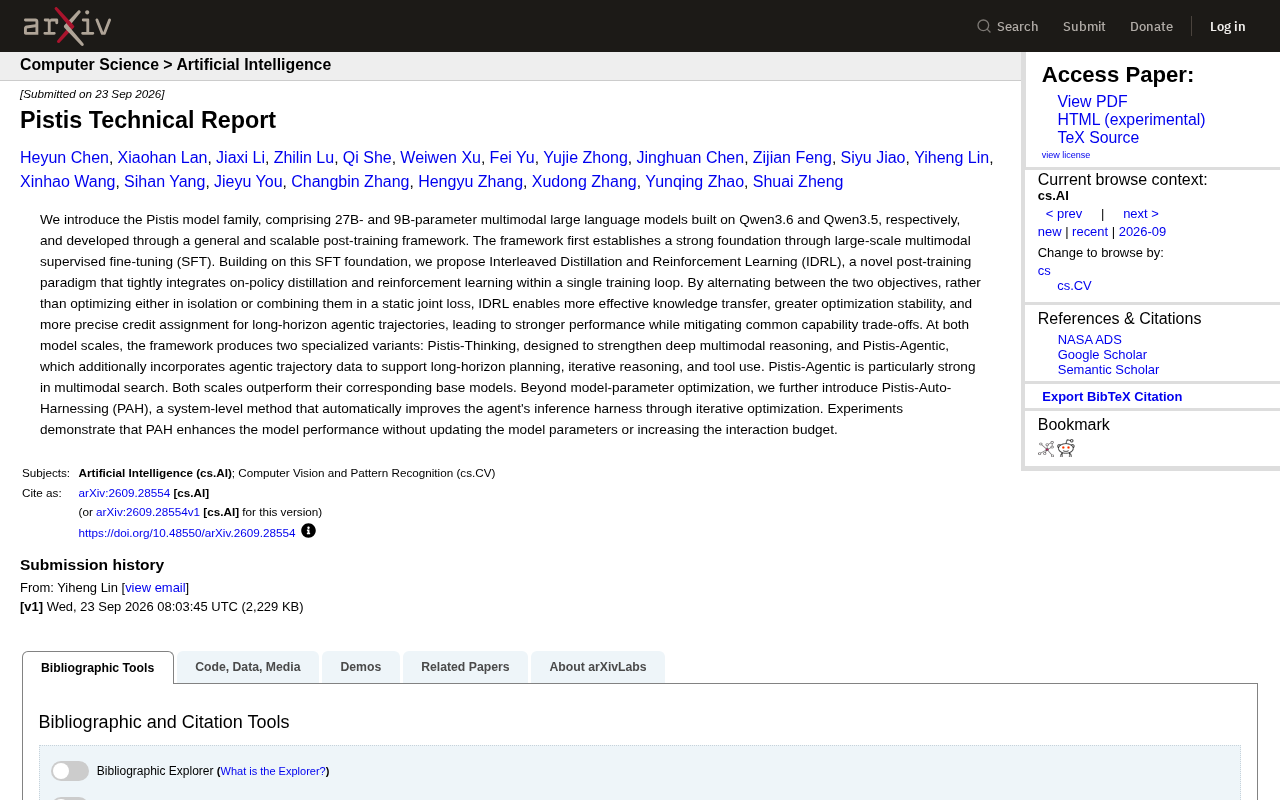
Pistis is a multimodal LLM family built on the Qwen series, offered in 27B and 9B scales. Its core innovation is IDRL (Interleaved Distillation and Reinforcement Learning), a post-training paradigm that dynamically alternates between on-policy distillation and RL within a single training loop to improve knowledge transfer, stability, and credit assignment. The framework yields two specialized variants per scale — Thinking for deep multimodal reasoning and Agentic for long-horizon planning and tool use — with Agentic excelling at multimodal search. PAH further unlocks performance gains at the system level by iteratively optimizing the inference harness without updating model parameters or increasing interaction budget, forming a complete SFT→IDRL→PAH post-training pipeline.
Pistis Model Family: A Complete Technical Roadmap from SFT to Agentic AI
Pistis is a newly released multimodal large language model family available in two parameter scales — 27B and 9B — built on top of Qwen3.6 and Qwen3.5 respectively. What sets this family apart isn't raw parameter count, but the generalizable and scalable post-training framework underpinning it. The research team set out to answer a question that has long challenged the field: how do you improve deep reasoning capabilities without sacrificing performance on long-horizon agentic tasks — avoiding the classic capability trade-off trap?
The training pipeline unfolds in two stages. The first stage establishes a solid foundation through large-scale multimodal supervised fine-tuning (SFT), providing a strong starting point for downstream optimization. The real innovation arrives in the second stage — a post-training paradigm called Interleaved Distillation and Reinforcement Learning (IDRL).
IDRL: Weaving Distillation and Reinforcement Learning Into One
IDRL's core idea deserves a closer look. Conventional approaches typically treat on-policy distillation and reinforcement learning (RL) as separate optimization objectives, or naively combine them using a static joint loss function. The Pistis team argues that both approaches fall short: isolated optimization loses synergistic effects, while a static joint formulation offers poor fine-grained control.
IDRL instead tightly integrates both objectives within a single training loop, optimizing by alternating between them. This alternating mechanism delivers three concrete benefits: more effective knowledge transfer, greater optimization stability, and more precise credit assignment for long-horizon agentic trajectories.
Credit assignment is one of the thorniest problems in long-horizon tasks — when an agent executes a long sequence of actions before receiving final feedback, determining which steps were helpful and which were harmful directly determines training efficiency. IDRL claims to handle this more effectively, simultaneously improving performance while easing the tension between competing capabilities.
On-policy distillation refers to real-time guidance from a teacher model applied to outputs sampled from the student model's current policy — in contrast to offline distillation, which uses statically pre-generated teacher data. Its advantage is that teacher signals closely match the student's current distribution, though used alone it can cause the model to over-rely on the teacher and lack independent exploration. RL takes the opposite approach: reward signals from environmental feedback guide autonomous exploration and encourage the discovery of new strategies, but sparse rewards lead to weak, high-variance training signals that are prone to instability. The natural complementarity of these two approaches is the design principle behind IDRL — distillation provides a stable supervisory anchor while RL provides exploratory drive, and alternating between them allows mutual correction rather than mutual interference.
Two Specialized Variants: Thinking and Agentic
Across both the 27B and 9B scales, the framework produces two specialized model variants targeting distinct application scenarios.
Pistis-Thinking: Deep Multimodal Reasoning
Pistis-Thinking focuses on strengthening deep multimodal reasoning capabilities, suited for tasks requiring complex chains of logic and cross-modal understanding. It represents the model's upper bound on the dimension of "thinking things through."
Pistis-Agentic: Long-Horizon Planning and Tool Use
Pistis-Agentic builds on Thinking by introducing additional agentic trajectory data to support long-horizon planning, iterative reasoning, and tool invocation. The report specifically highlights Pistis-Agentic's strong performance on multimodal search tasks — a practically significant finding, as modern AI applications increasingly depend on models that can proactively retrieve information and call external tools to complete complex tasks, with multimodal search being a critical capability in that mix.
Across both scales, both variants outperform their respective base models, demonstrating that the post-training framework delivers transferable gains rather than scale-specific artifacts.
PAH: A System-Level Method That Improves Performance Without Touching Parameters
If IDRL operates at the level of model parameters, Pistis-Auto-Harnessing (PAH) lifts the perspective to the system level. It is an automated method that improves an agent's inference harness through iterative optimization — encompassing the surrounding mechanisms of how the model runs at inference time, including call logic, prompt structure, and tool orchestration.
PAH's most striking property is that it improves model performance without updating model parameters and without increasing interaction budget. This means that even after model weights are frozen, there remains meaningful performance headroom that can be unlocked purely through inference harness optimization. From a deployment standpoint, this is an eminently practical approach — retraining a model is expensive, while optimizing the inference pipeline is far more flexible and cost-efficient.
Inference harness optimization is a system-level extension of "prompt engineering" and "agentic orchestration," encompassing chain-of-thought format design, tool-calling sequence strategies, context window management, and the granularity of multi-step planning decomposition. In real-world LLM deployments, the same set of weights under different inference harnesses can produce performance gaps of more than ten percentage points. PAH automates the search for better inference configurations through iterative optimization, essentially turning harness tuning itself into an automatable process rather than one dependent on human expertise. This aligns closely with the emerging research directions of prompt optimization and agentic workflows, and underscores that a model's performance ceiling isn't determined solely by its parameters — inference-time orchestration strategies are equally significant bottlenecks.
Technical Significance and Observations
The Pistis technical report outlines a relatively complete construction path for multimodal agentic AI: SFT lays the foundation, IDRL handles core post-training, and PAH rounds things out at the system level. The three stages build on each other progressively, covering everything from foundational capabilities to higher-level orchestration.
From a broader perspective, IDRL reflects a trend in post-training research — researchers are no longer satisfied treating distillation, RL, and similar techniques as isolated modules, and are instead exploring the deeper dynamic synergies between them. PAH, meanwhile, echoes a parallel path that is rapidly gaining traction: squeezing more performance out of a fixed model through systems engineering, without modifying the model itself.
It's worth noting that this report is a technical summary; specific evaluation results, comparison baselines, and ablation study details should be referenced from the full paper. The base model version numbers mentioned in the report, such as Qwen3.6 and Qwen3.5, should also be verified against official releases. Overall, Pistis presents a methodological combination worth watching for multimodal LLM post-training.
Related articles

@ai-sdk/vue 3.0.306 Patch Release Syncs with [email protected] Update
@ai-sdk/vue 3.0.306 released, synced with [email protected]. A routine patch release for the Vercel AI SDK ecosystem with no public API changes; the Vue adapter layer stays version-aligned with the core package.

Gemini 4 Argon API Launches: The Era of Million-Token Output Begins
Google launches Gemini 4 Argon with sparse MoE architecture, up to 1M output tokens, and a 68.90% Vals Index score, available across API, AI Studio, and the Gemini app.

DukaanAI: Turning Product Photos into Inventory Lists with Open-Source AI
DukaanAI is an AI inventory tool for small retailers that turns product photos into inventory entries using the open-source Gemma 3 model, with local inference, editable fields, and CSV export.