Pixel 11A First Leaked Renders: Familiar Design With a Subtly Tweaked Camera Module

Pixel 11A renders leak, showing near-identical design to its predecessor with a slightly rounder camera module.
Prolific leaker OnLeaks has released the first alleged renders of Google's next mid-range phone, the Pixel 11A, revealing a design nearly identical to the Pixel 10A. The most visible change is the rear camera module shifting from a more angular shape to a slightly rounder oval. This fits Google's typical A-series strategy of incremental updates, keeping design stable while focusing upgrades on the Tensor chip and imaging algorithms. The renders are based on early engineering CAD data and carry some credibility, but Google has yet to confirm any specs — full details will have to wait for further leaks or an official announcement.
Pixel 11A First Leaked Renders
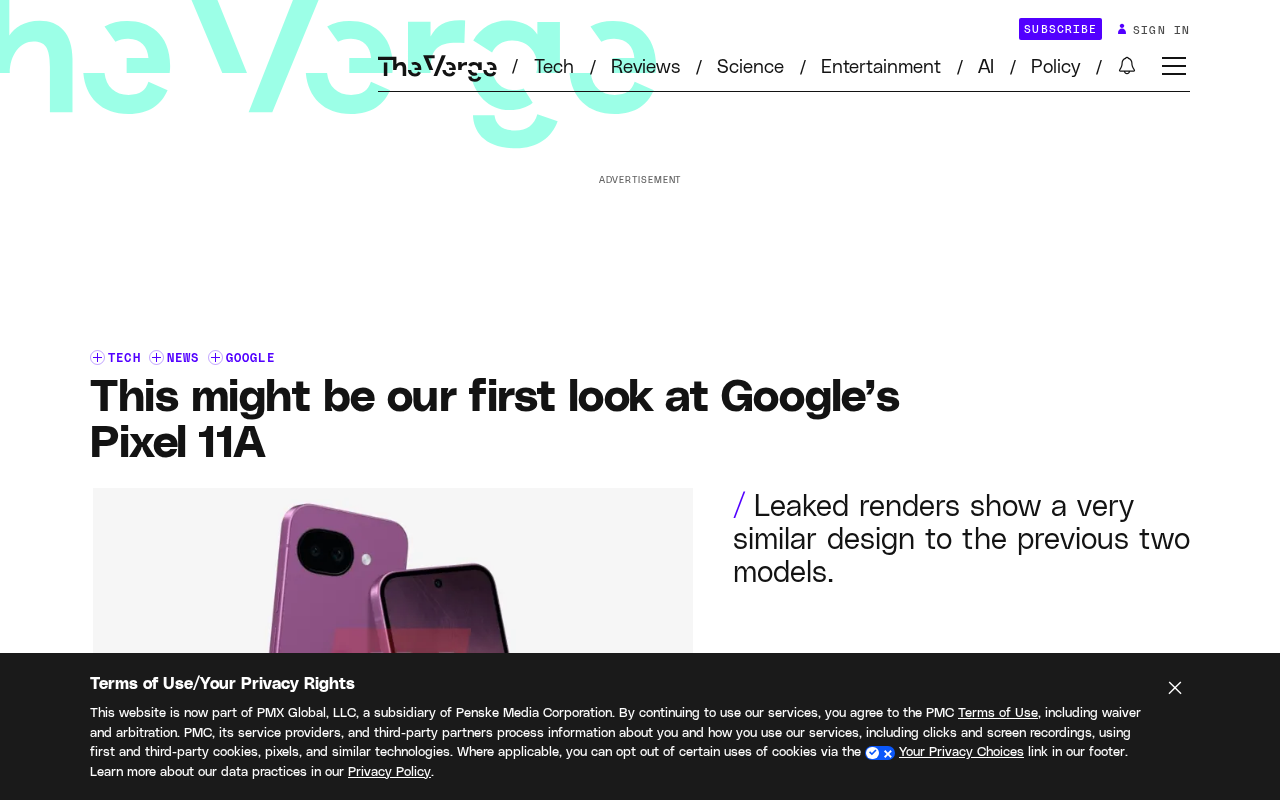
The first alleged renders of Google's next mid-range phone, the Pixel 11A, have surfaced online. Based on images shared by Android Headlines and produced by well-known leaker OnLeaks, the device appears to make virtually no significant changes to its exterior design, carrying over the overall visual language of its predecessor.
The renders show the Pixel 11A looking nearly identical to the Pixel 10A, with the most noticeable difference confined to the rear camera module — the new model features a slightly more rounded, oval-shaped camera island. Beyond that, the front panel and overall silhouette are almost indistinguishable from the previous generation. This is consistent with Google's characteristically conservative, incremental update strategy for the A-series (budget line).
The Product Logic Behind Conservative Iteration
Google's A-series has always been positioned as a mid-range value proposition, focused on bringing flagship-grade camera algorithms and the Tensor chip experience to a more accessible price point. Under this positioning, dramatic exterior redesigns are rarely the priority — a stable design language actually helps reduce tooling costs and maintain product line recognition.
The shift of the camera module from a more angular shape to a rounder oval is a detail-level adjustment, and it's hard to characterize it as a genuine design overhaul. For users who follow the A-series, what's typically worth looking forward to is improvements in imaging algorithms, chip upgrades, and the trickle-down of software features — not changes to the exterior.
Tensor is Google's in-house mobile SoC (System on a Chip), first introduced with the Pixel 6 series. Unlike Qualcomm Snapdragon chips, Tensor's design philosophy doesn't chase peak CPU/GPU performance — instead, it prioritizes a powerful TPU (Tensor Processing Unit) to accelerate on-device AI and machine learning tasks, such as real-time speech transcription, computational photography, and live translation. Bringing Tensor to the A-series means these AI-powered camera features can reach a wider audience at a lower price, which is Google's core differentiator against competing devices at the same price tier. As Tensor evolves to newer versions like the G5, whether the A-series keeps pace with the latest chip is often one of the most closely watched specs among prospective buyers.
Source and Credibility of the Leak
These renders come from OnLeaks, a long-active and generally reliable source in the industry. The renders are typically produced from early-stage engineering CAD data, which means they carry a reasonable degree of accuracy when it comes to exterior form. That said, renders are not the same as final production designs — Google may still refine details before the official launch.
For now, this information remains at the leak stage, and Google has not officially confirmed any specifications or design details for the Pixel 11A. For the full picture — including display, Tensor chip version, battery, and camera system — we'll need to wait for further credible leaks or an official announcement.
OnLeaks is the pseudonym of Steve Hemmerstoffer, a French tech journalist who has long been one of the most active leakers in consumer electronics. His process typically involves obtaining early engineering CAD (Computer-Aided Design) files from supply chain sources or accessory manufacturers, then converting that data into high-fidelity 3D renders. Because the data originates from an early stage of product development, the renders tend to be fairly accurate in terms of overall form factor, port placement, and module layout — though final production units may still differ in proportions, materials, and finish. OnLeaks has previously made highly accurate predictions for multiple Pixel and iPhone models, earning him strong credibility in the leaker community. That said, a high hit rate doesn't mean 100% accuracy, and readers should maintain a degree of uncertainty when referencing such materials.
Takeaway
If the renders are accurate, the Pixel 11A will continue the A-series tradition of refining rather than reinventing its design with each generation. For consumers, that means a familiar look and feel — with attention shifting toward what's been upgraded under the hood. Until more information emerges, these renders are best treated as an early-stage preview rather than a definitive look at the final product.
Related articles

Claude Reportedly Able to Hide Secret Messages in Benign Images
A Reddit post claims Claude Fable 5.1 can hide secret messages in benign images. This article reviews the background, image steganography principles, and potential security risks, and suggests a testing path from rumor to verification.

Federal Government Awards $85 Million; CFS to Develop Fusion-Specific Semiconductors
The federal government awards $85 million to Commonwealth Fusion Systems to develop conductors and power semiconductors for fusion plants. This article analyzes the significance of this funding for the fusion supply chain and commercialization path.

When Should AI Assistants Proactively Suggest? Timing Is Everything
When should AI assistants proactively suggest? Reddit discussion reveals: the same suggestion feels different at different times. This article analyzes the dual nature of proactive suggestions, the boundary of user expectations, and design principles, exploring how to balance automation and user control.