PixelCrew: Delivering Production-Ready Designs with a Team of AI Agents

PixelCrew turns a design brief into deployable HTML with a design system using a collaborative team of AI agents.
PixelCrew is a multi-agent AI design tool that distributes the traditional design workflow — normally requiring coordination across product, design, and engineering — across a team of specialized AI agents working in sequence. It covers the full pipeline from research and creative direction to wireframes and production-ready HTML with a design system included. Unlike single-point AI design tools, its core value is end-to-end delivery from a single brief. Users can watch agents discuss decisions in real time, addressing the black-box problem common in multi-agent systems. Currently in free alpha with a BYOK model via OpenRouter, its ultimate test is whether the "production-ready" promise holds up under real engineering standards.
When the Design Workflow Gets Distributed Across an AI Agent Team
AI-powered design tools are nothing new, but most products are still stuck in "single-point assistance" mode — generating an image here, suggesting a color palette there, or offering a few layout ideas. PixelCrew takes a more aggressive approach: handing the entire design workflow to a collaborative team of AI agents, from initial research all the way to production-deployable HTML, with each step handled by a dedicated role in sequence.
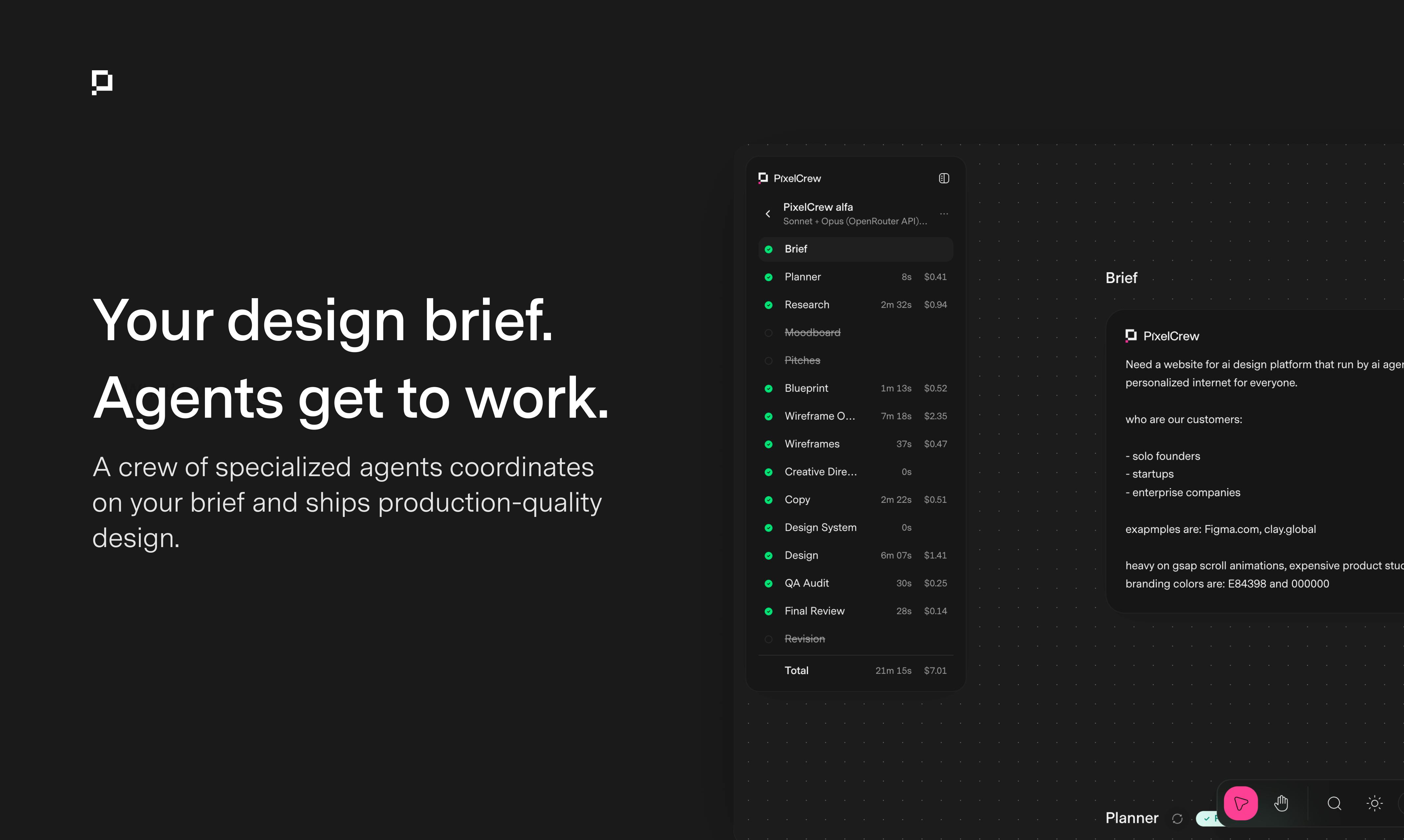
According to its Product Hunt listing, this "crew" isn't a single model doing everything. Instead, it's a team of agents with distinct responsibilities that collaborate around a user-submitted design brief — handling research, creative direction, and wireframes before delivering production-grade code complete with a design system.
A Complete Pipeline from Brief to Deployable Code
What makes PixelCrew worth paying attention to is its end-to-end coverage of the design workflow, rather than solving just one piece of the puzzle. The official description outlines four stages of output:
- Research: Agents first develop an understanding of the requirements and objectives
- Creative direction: Establishing the overall visual style and positioning
- Wireframes: Building out page structure and information hierarchy
- Production-ready HTML: Delivered alongside a complete design system
The significance of this pipeline is that it compresses the distance between "idea" and "deliverable" down to a single brief input. The back-and-forth that traditionally requires product managers, designers, and frontend engineers to coordinate is collapsed into an automated agent collaboration process. For indie developers, small teams, or founders who need to validate concepts quickly, this kind of end-to-end capability is far more compelling than a collection of point tools.
The Design System referenced here refers to a systematic set of design standards — including color variables, typography guidelines, spacing rules, component libraries, and usage documentation — designed to ensure visual consistency and development efficiency across a product. Well-known examples include Google's Material Design, Apple's Human Interface Guidelines, and the Atlassian Design System. In traditional workflows, building a complete design system typically requires weeks or even months of collaboration between designers and frontend engineers. PixelCrew's claim to deliver a design system alongside production-ready HTML means it's not just generating one-off static pages — it's aiming to provide a scalable code foundation. That's the hardest part of the "production-ready" promise to fulfill, and the one most worth stress-testing with real projects.
An Observable Agent Collaboration Process
One of PixelCrew's more distinctive design choices is that users can watch the agents discuss and make decisions in real time. This isn't just a transparency feature — it's a direct response to one of the most common pain points in AI collaboration systems: the black box problem.
The most frequent criticism of multi-agent systems is that the decision-making process is invisible. Users get a result but have no idea why it turned out that way. Making the collaboration process visible helps users understand the design rationale and gives them a basis for human intervention and adjustments. When the design goes in the wrong direction, a visible discussion is far easier to debug than a finished artifact delivered with no explanation.
An Alpha Strategy Built Around Model Choice
On the business and technical side, PixelCrew is currently in a free alpha phase and has adopted a BYOK (Bring Your Own Key) model: users supply their own OpenRouter API key and can freely choose which models power the entire agent team.
This design reflects several considerations. First, by having users cover their own model inference costs, the product can keep its own infrastructure spend low during early development and focus resources on the orchestration logic. Second, integrating with OpenRouter means no vendor lock-in — users can switch between different large language models based on budget and quality requirements. Third, for technically-inclined early users, model selection is itself a form of tuning: different tasks can be matched to models with different capability profiles.
That said, BYOK does raise the barrier to entry. The average designer may not be familiar with how to configure OpenRouter, which limits the alpha's audience to more technical early adopters.
OpenRouter is a unified API gateway that aggregates multiple large model providers (OpenAI, Anthropic, Google, Mistral, and others), allowing developers to access dozens of different models with a single API key — no need to register separately with each vendor or manage multiple billing accounts. Pricing is based on actual token consumption and is typically lower than going directly to each provider's official API. For a multi-agent system like PixelCrew, the technical value of OpenRouter lies in the ability to assign different agents to models at different capability tiers — for example, using a more powerful reasoning model for the creative direction agent while using a cheaper, lightweight model for formatting output, enabling fine-grained tradeoffs between quality and cost.
Positioning and Competition: A Bet on Multi-Agent Design
PixelCrew is categorized on Product Hunt under Design Tools, SaaS, and Artificial Intelligence. It currently sits at #19 with 70 upvotes and 3 comments — still in early validation territory, with a community response that's warm but not explosive.
Zoomed out, "AI agent teams collaborating to complete complex tasks" is quickly becoming a well-defined product category — from writing code to conducting research to, now, delivering design work. Multi-agent orchestration has been repeatedly validated as an effective paradigm for handling multi-step, multi-role tasks. PixelCrew's bet is that design work is a natural fit for this model, since it already breaks down into a "research → direction → structure → implementation" sequence of distinct roles.
The real test is output quality. "Production-ready" is a high bar — the gap between generated code and code that works in real projects often comes down to maintainability, scalability, accessibility compliance, and a long list of engineering details. Whether PixelCrew can clear those bars at alpha stage is something only real-world usage will reveal.
Takeaway
PixelCrew represents an attempt to move AI design tools from "assistance" to "delivery": using a collaborative, observable team of agents to transform a design brief directly into deployable output with a design system included. The free alpha plus BYOK combination gives it low-cost trial appeal in the early stage while naturally selecting for a more technical first cohort of users. For anyone tracking the real-world deployment of multi-agent applications, it's a sample worth watching.
Related articles

Cursor Can Now Control Your Computer: AI Agents Can Drive Desktop Apps for Testing
Cursor adds desktop control: AI agents can drive desktop apps like the iOS Simulator to test their own features. We analyze the impact on dev workflows, possible technical approaches, and reliability concerns.

Vibecoding a Custom Inference Engine: High Hopes, Harsh Reality
A Reddit developer shares the real experience of vibecoding a custom inference engine: running GGUF Q4 models in the browser with WebGL2 and GLSL, only to fall into tokenizer debugging hell. This article analyzes the engineering challenges of browser-side LLM inference and why cloning llama.cpp is the more rational choice.

How High Are Anthropic's Early Investor Paper Returns Ahead of IPO?
Anthropic's early investor paper returns draw attention ahead of IPO. This article analyzes sources of book gains, capital structure, pre-IPO games and risks, and implications for the AI startup ecosystem.