PixVerse R2: A Real-Time World Model You Can Explore and Change

PixVerse R2 upgrades video generation into a real-time, interactive world model with multimodal input and session memory.
PixVerse R2 is a generative AI product positioned as a "real-time world model," breaking the static one-prompt-one-output logic of traditional text-to-video generation. It supports real-time multimodal input — text, images, audio, and actions — and features session memory that carries user-made changes forward into subsequent generation, maintaining a coherent, intervenable dynamic world. Official use cases include interactive stories, generative characters, and playable worlds, with a Developer Tools classification signaling a platform rather than pure consumer product. It topped Product Hunt on launch day, though key metrics like latency and long-session consistency still await real-world validation.
From Video Generation to an "Interactive World"
Generative AI progress in the video space has largely centered on one thing: generating a fixed clip. You write a prompt, the model outputs a few seconds of video, and that's it. PixVerse R2 is trying to break that one-shot generation logic. It positions itself as a real-time world model — not producing static video clips, but generating a continuously evolving audiovisual world.
The product topped Product Hunt's daily chart (#1), earning 216 upvotes and 42 comments. It was listed across multiple categories — Developer Tools, Artificial Intelligence, Games, and Vercel Day — reflecting its cross-cutting positioning at the intersection of dev tools, AI, and gaming.
What R2 Actually Does Differently
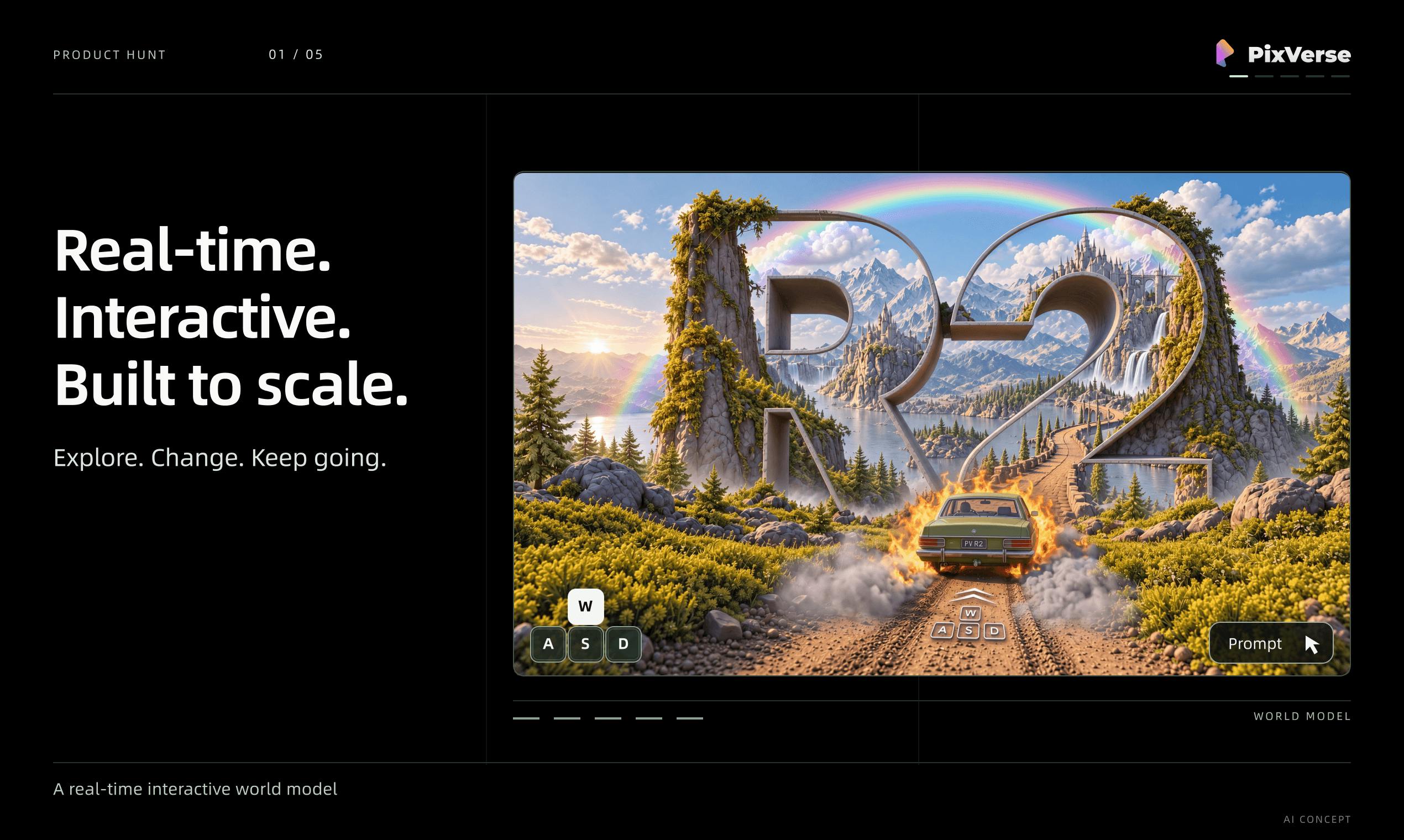
According to the official description, R2's core differentiation comes down to three things: multimodal input, conversational memory, and real-time continuity.
It accepts text, images, audio, and actions as inputs during generation — meaning interaction isn't a one-time prompt, but a continuous stream of instructions woven throughout the entire experience. You can change the world while it's running.
The memory capability is even more significant. R2 "remembers" what happened earlier in a session and carries those changes forward into subsequent generation. This is what fundamentally sets it apart from traditional text-to-video models: those produce independent, stateless outputs every time, while R2 attempts to maintain a coherent, causally consistent world state.
Why "Memory" Is the Critical Threshold
For an explorable world, consistency is the biggest technical challenge. If you move around in a scene, change an object, and then look back, the world should reflect the marks you left — not randomly regenerate. R2's emphasis on "carries those changes forward in real time" is a direct response to the coherence problem that has long plagued generative video.
From an architectural standpoint, maintaining session memory is extremely costly for generative models. Traditional diffusion or autoregressive video models start each generation from noise or a context window — historical state isn't explicitly preserved. To achieve a "leave your mark" effect, the model either needs to encode the entire history of frames into a conditioning vector, or maintain some form of external state representation (such as a scene graph or a world-state vector in latent space). The former grows computationally expensive over time; the latter requires the model to learn how to compress high-dimensional visual information into addressable, updatable structured memory. This is precisely the core problem that academia and industry have yet to fully solve in the "persistent world model" space — and it's the area most in need of real-world testing to understand R2's actual capability boundaries.
Potential Use Cases
Officially, R2's capabilities are aimed at a full spectrum — from interactive stories and characters to playable generative worlds.
What these scenarios share is a need for a dynamic environment that can be intervened on in real time while maintaining internal logical consistency. Interactive narratives need characters that respond to user input; playable worlds are closer to games, requiring the environment to respond to actions and maintain physical and visual coherence.
Its placement in the Developer Tools category also signals that PixVerse wants developers to build on top of it, rather than positioning it purely as a consumer product. This aligns with the broader industry trend of treating "world models" as AI infrastructure.
Positioning and Industry Context
"World model" has become a high-frequency term in the AI field. Rather than generating isolated media content, world models attempt to have AI understand and simulate a continuously evolving environmental state — a path that many researchers see as a route toward stronger general capabilities.
PixVerse R2 brings this concept to a real-time, interactive, multimodal product level. Based on its high vote count and top-of-chart performance on Product Hunt, there is clear market interest in this "explorable, changeable" generative paradigm. That said, it's worth noting that the publicly available information is largely based on official product descriptions. Actual generation quality, latency, controllability precision, and consistency stability during long sessions all still need to be verified through broader real-world testing.
The concept of "world models" was systematically introduced in reinforcement learning, where the core idea was to have agents learn an internal representation of their environment — enabling them to plan actions through "imagination" without interacting with the real environment at every step. Yann LeCun and others further extended this into a necessary component for building AGI, arguing that models need to understand the causal structure and physical laws of the world, not just fit the distribution of perceptual data. In recent years, Google DeepMind's Genie, OpenAI's framing of video models as "world simulators," and multiple game companies exploring neural networks as replacements for traditional game engines have all pushed this academic concept toward productization. PixVerse R2 is one of the earlier products in this trend to explicitly position "real-time interactivity" as its core value proposition for developers.
Summary
PixVerse R2 represents a clear attempt to evolve generative video into "generative worlds": multimodal input, conversational memory, and real-time continuity all point toward a coherent, intervenable dynamic world. For developers focused on interactive content, generative gaming, and AI infrastructure, this is a direction worth tracking closely. Whether it can deliver on the promise of an "explorable, changeable world" will ultimately depend on how it performs in real-world use.
Related articles

Chain of Thought Isn't Just for AI: How Humans Can Use CoT to Improve Thinking Quality
Chain of Thought isn't just a prompt trick for large models. Starting from a Hacker News discussion, this article analyzes why CoT works for human thinking too, breaks down actionable ways to transfer it, and highlights the key differences between human CoT and machine CoT.
Cloudflare Teams Up with OpenAI: Closi…
Cloudflare Teams Up with OpenAI: Closing the Loop from Vulnerability Discovery to Defense with AI
Cloudflare uses OpenAI Daybreak to investigate security vulnerabilities and generate reviewable remediation plans, while developers use Codex to boost coding efficiency and quality.

Orca Multi-Agent Orchestration in Practice: A Guide to Parallel Collaboration with Claude and Codex
Orca is Stable AI's free open-source agent workbench supporting 34 agents like Claude Code and Codex in parallel. Learn its Git worktree isolation, multi-model orchestration, and mobile management.