Pizza Bot: An Inbox for Background AI Agents
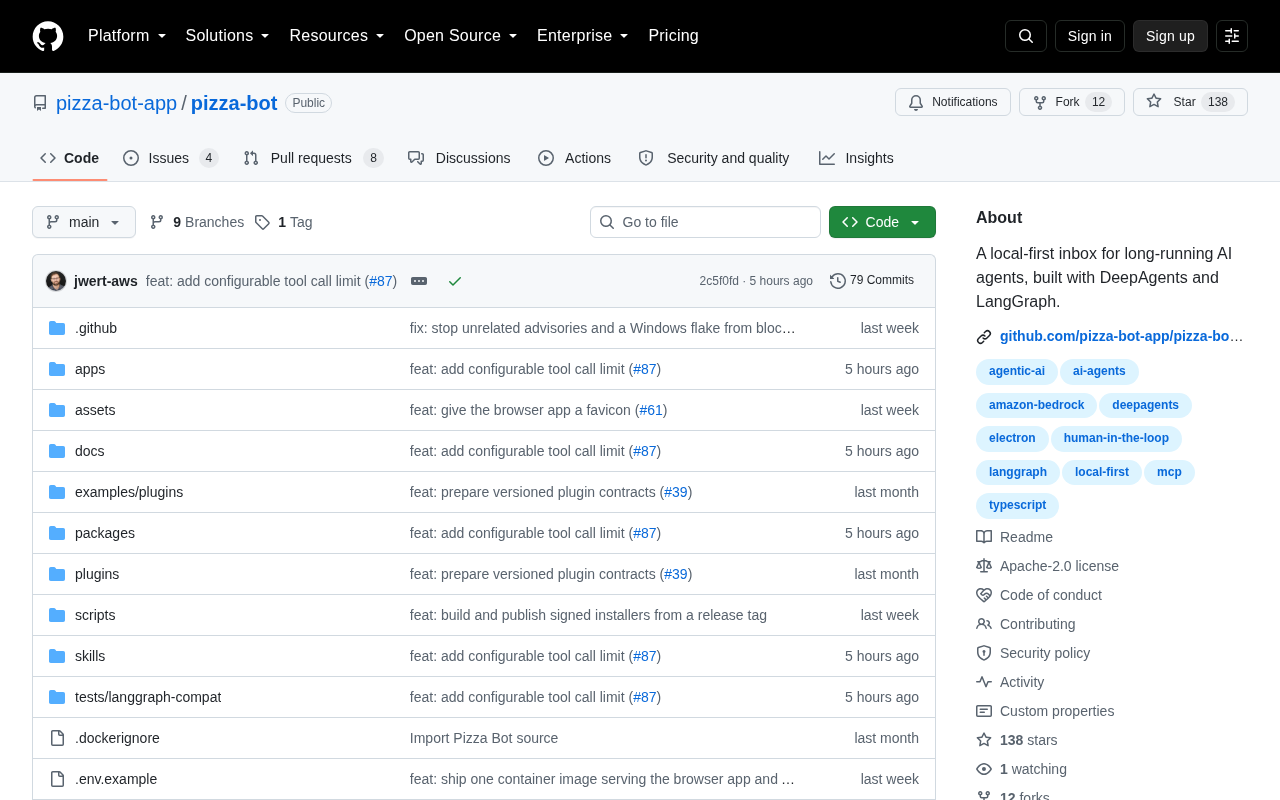
Pizza Bot brings an email-style inbox to background AI agents for async human-agent collaboration.
As AI agents evolve from real-time chat into tools that autonomously execute long-running background tasks, synchronous chat windows can no longer support async collaboration needs. Pizza Bot proposes an "inbox" as a new communication paradigm between background agents and users — applying familiar email/messaging patterns to AI to enable async notifications, multi-agent message aggregation, and unified human intervention checkpoints. The design reduces cognitive load and aligns with Human-in-the-loop architecture trends, though the project faces real challenges around information overload, ecosystem dependency, and competition from major players.
An Overlooked Pain Point: How Should AI Agents Communicate With You?
As AI agents evolve from simple conversational assistants into tools capable of autonomously executing long-running tasks, a new product design challenge has emerged: when AI is quietly working in the background, how should it interact with users?
Pizza Bot, a recent Show HN project on Hacker News, targets exactly this scenario. Its positioning is clear — providing an "inbox" for AI agents running in the background. The concept sounds simple, yet it addresses a critical gap in today's AI application experience.
Worth noting: the project received minimal initial traction on Hacker News (4 upvotes, 0 comments), so this article is more of an analysis of its product positioning rather than a review of a community-validated solution.
Why Background Agents Need an "Inbox"
Traditional chat-based AI interaction is synchronous: you ask, it answers, and you stay glued to the screen the whole time. But truly valuable agents often need to execute time-consuming tasks — crawling data, monitoring website changes, batch processing files, or running automated workflows. These tasks can last anywhere from minutes to hours.
In this asynchronous working model, a synchronous chat window feels clunky. Users can't wait around indefinitely, yet the agent may encounter situations mid-execution that require user confirmation, additional input, or a completion notification.
The "inbox" metaphor neatly solves this problem:
- Async notifications: Get notified when a task completes or fails, just like receiving an email
- Message aggregation: Outputs from multiple background agents are collected in one place, preventing information from getting scattered
- Human-agent collaboration checkpoints: When an agent needs a human decision, it can "leave a message" in the inbox and wait for a reply
This design philosophy aligns closely with the growing trend toward "Human-in-the-loop" agent architectures.
Human-in-the-loop is an AI system design paradigm that preserves human review or intervention at critical decision points within automated workflows. Unlike fully autonomous AI, this architecture acknowledges that current models still need human oversight when handling ambiguity, high-risk operations, or value judgments. Typical implementations include confirmation steps before task execution, human review of intermediate results, and human fallback for edge cases. In agentic scenarios, Human-in-the-loop is especially important — an agent that can autonomously browse the web, call APIs, and modify files can cause far more damage from a single mistake than an ordinary conversational error. The inbox model can be seen as a lightweight implementation of Human-in-the-loop: rather than requiring human confirmation at every step, it allows the agent to proactively "raise its hand" when it deems intervention necessary, balancing efficiency with control.
The Product Value Through an Interaction Paradigm Lens
Pizza Bot's core innovation isn't in the underlying model — it's in rethinking the interaction paradigm. Most AI products on the market today are still stuck in the "real-time chat window" mindset, but as agents become more autonomous, synchronous conversation actually becomes a bottleneck.
Treating AI output as "messages" to be managed is essentially applying the mature email/instant messaging paradigm to AI scenarios. This brings several potential advantages:
Reduced Cognitive Load
Users don't need to stay glued to their screens — they can check on agent progress at their own pace, just like reading emails. This is especially valuable when managing multiple automated tasks simultaneously.
Native Multi-Agent Support
When a person has multiple specialized agents (one for monitoring, one for organizing, one for writing), an inbox can consolidate all their outputs into a single, coherent information stream.
Multi-Agent systems consist of multiple AI agents with different specializations or roles working together to complete complex tasks. Compared to a single all-purpose agent, multi-agent systems offer advantages like parallel execution for greater efficiency, reduced complexity through specialization, and resilience against localized failures. However, they also introduce coordination and observability challenges — it's difficult for users to simultaneously track the state of multiple agents. Current mainstream multi-agent frameworks (such as LangGraph, AutoGen, and CrewAI) primarily address agent-to-agent communication and orchestration, while the design of "how humans monitor and intervene in these agents" remains relatively underdeveloped. The inbox scenario that Pizza Bot targets fills exactly this gap in the human-machine interface layer of multi-agent systems.
Preserving Decision-Making Control
Fully autonomous AI still faces trust issues. The inbox model lets users retain approval and intervention capabilities at critical junctures, striking a balance between automation and controllability.
Challenges and Open Questions
As an early-stage project, Pizza Bot faces some very real challenges.
First, there's the risk of information overload. If multiple agents push messages frequently, the inbox itself could become a new source of noise — requiring careful design around notification prioritization, message aggregation, and filtering.
Second, there's ecosystem dependency. For an "AI agent inbox" to deliver value, a sufficient number of reliable background agents need to already be running. In an era where the agent ecosystem hasn't yet matured, infrastructure-type products like this may face a classic chicken-and-egg problem.
Finally, there's the challenge of differentiated positioning. As OpenAI, Anthropic, and other major players gradually integrate async task and notification mechanisms into their own products, an independent inbox product needs to prove its irreplaceable value.
Conclusion
Pizza Bot is a noteworthy signal: competition in AI products is expanding from "model capability" to "interaction experience." As agents become capable of working independently in the background, elegantly managing asynchronous communication between humans and AI is poised to become the next major battleground in product design.
While this project currently has limited traction and relatively sparse information, the question it raises — how should background AI communicate with people? — is very likely a challenge that future agent applications cannot avoid.
Related articles
Free DeepSeek V4.1 Flash via DSH: Bulk Point Collection & International WorkBuddy Tested
DSH project update tested: WorkBuddy now offers 100 points per claim, rate limits raised beyond 80M tokens with faster resets, and international WorkBuddy supports free Hunyuan 4 and DeepSeek V4.1 Flash.
Capsule: Pack Web Apps and Data into a Single SQLite File
Capsule is a Rust/Tauri 2.0 tool that packs HTML web apps and data into a single SQLite file — privacy-first, local storage, portable sharing, with AI support.
DSH-SUBAGENT-UI Plugin: The Ultimate Sub-Agent Manager for DeepSeek Harness
DSH-SUBAGENT-UI is a DeepSeek Harness browser plugin offering sub-agent overview, search, local categorization, and completion snapshots — install with one command.