Plane: Can This 56K Star Open-Source Project Management Tool Replace Jira?

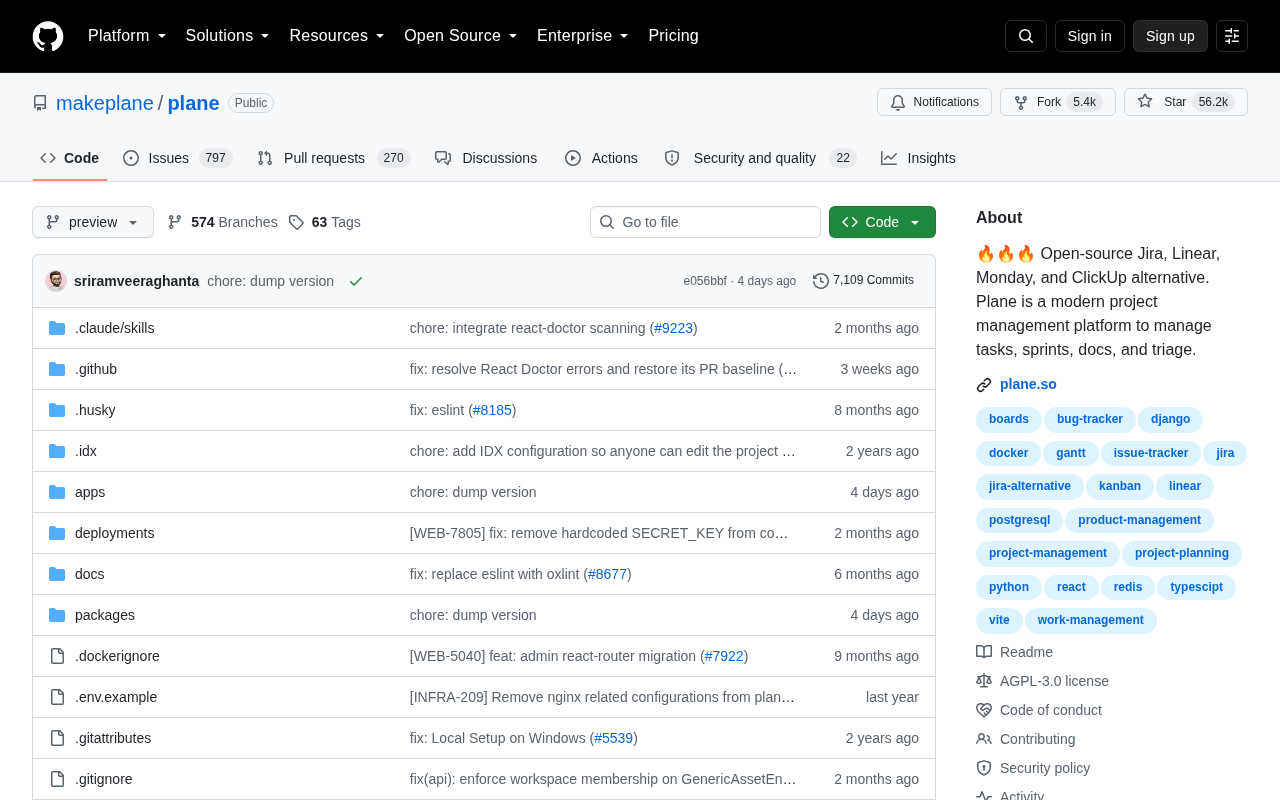
Plane is a 56K-Star open-source project management platform positioned as a self-hosted alternative to Jira and Linear.
Plane is an open-source project management platform with over 56,000 GitHub Stars, built with TypeScript and covering core workflows including task management, Sprint planning, document collaboration, and issue triage. Supporting self-hosted deployment, it offers teams data sovereignty, cost control, and deep customizability as an alternative to Jira, Linear, and ClickUp, though teams should weigh self-hosting operational costs against enterprise feature maturity.
In the enterprise project management space, Jira, Linear, Monday, and ClickUp have long dominated the landscape. However, the high subscription costs, closed data storage, and limited customization capabilities of these commercial tools have always been pain points for many teams. The emergence of the open-source project management platform Plane (makeplane/plane) is shaking up this status quo.
Currently, the project has garnered over 56,000 Stars on GitHub, with 5,377 Forks, and maintains a growth momentum of 54 new Stars per day. These numbers indicate that developer community demand for open-source project management solutions continues to heat up.
What Is Plane: An Open-Source Project Management Platform Rivaling Jira
Plane positions itself as a modern project management platform, aiming to be an open-source alternative to mainstream commercial tools like Jira, Linear, Monday, and ClickUp. Built with TypeScript, it covers core project management workflows: Tasks, Sprints, Docs, and Triage.
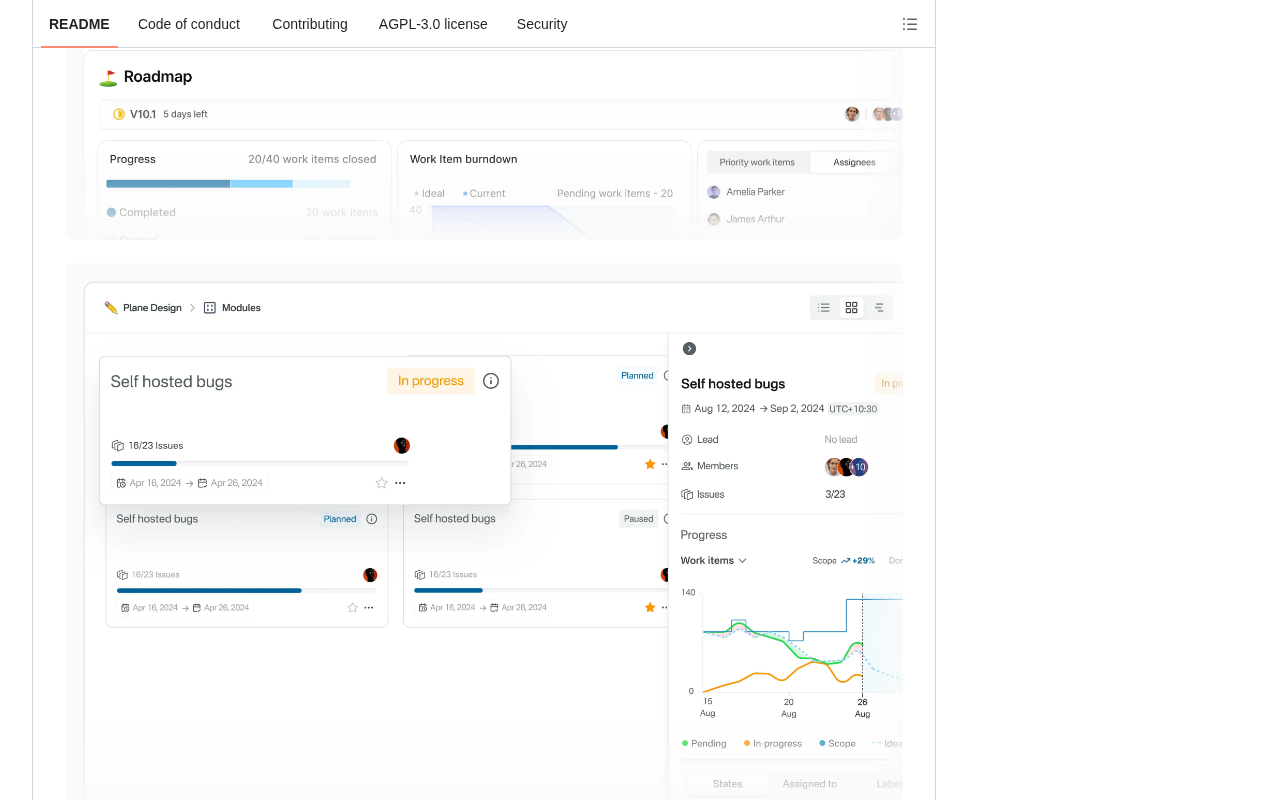
Unlike traditional single-function tools, Plane attempts to integrate the various capabilities needed for agile development into a single platform. Teams can plan roadmaps, track progress, and manage knowledge documentation here, forming a closed-loop collaborative environment. This "all-in-one" design philosophy aligns with the direction championed by current commercial tools (such as ClickUp's "All-in-One" approach), and Plane delivers it in open-source form.
To understand Plane's positioning, it's helpful to review the evolution of agile development and project management tools. Agile Development originated from the Agile Manifesto in 2001, emphasizing iterative delivery, rapid feedback, and team collaboration. As agile methodologies gained popularity, project management tools evolved from early Gantt charts and waterfall management into digital platforms supporting frameworks like Kanban and Scrum. Jira was launched by Atlassian in 2002, initially positioned as a bug tracking tool before evolving into the de facto standard for agile project management; Linear targets modern development teams with minimalist design and smooth user experience; Monday.com and ClickUp lean more toward general-purpose collaboration platforms. The market for these tools exceeds billions of dollars, but their closed ecosystems have continuously spawned open-source alternatives.
Plane Core Features at a Glance
Plane's feature design draws from the strengths of multiple mature products:
- Task and Sprint Management: Drawing from Jira and Linear's agile workflows, it supports Sprint planning and iteration tracking. Sprint is a core concept in the Scrum framework, referring to a fixed-duration (typically 1-4 weeks) development iteration cycle. At the beginning of each Sprint, the team selects the highest-priority User Stories from the Product Backlog, breaks them down into executable tasks, and delivers a working software increment at the Sprint's end. The quality of Sprint planning directly impacts the team's delivery cadence and predictability, and mature project management tools typically provide visualization aids like Burndown Charts and Velocity Charts to help teams assess iteration health and predict future delivery capacity;
- Document Collaboration: Built-in Docs capability keeps project documentation tightly linked with tasks, reducing tool switching;
- Triage: Helps teams efficiently categorize and prioritize incoming tasks—particularly crucial when handling large volumes of Issues.
Why Open-Source Project Management Solutions Deserve Attention
For an increasing number of enterprises that value data sovereignty, the appeal of open-source solutions goes beyond cost.
Data Sovereignty: Self-Hosted Deployment for Full Data Control
SaaS products like Jira and Monday host team data on third-party servers, raising concerns for industries like finance and healthcare that have strict data compliance requirements. Plane supports self-hosted deployment, allowing teams to keep all data within their own infrastructure.
The deeper significance of self-hosting goes far beyond simply "keeping data on your own servers." In an increasingly strict global regulatory environment, regulations like the EU's GDPR (General Data Protection Regulation), China's Data Security Law and Personal Information Protection Law, and the US's HIPAA (Health Insurance Portability and Accountability Act) all impose explicit requirements on data storage locations and access permissions. For teams handling sensitive project information (such as government projects, defense R&D, or financial trading system development), keeping project management data entirely within their own infrastructure is not just a compliance requirement but a core element of security strategy. Self-hosting also means teams can independently determine data backup strategies, encryption standards, and access control mechanisms, avoiding data breaches caused by security incidents at third-party service providers.
Cost Control: Breaking Free from Per-Seat Pricing
Commercial project management tools typically charge per user, with subscription costs rising significantly as teams scale. Take Jira as an example—its standard tier charges monthly per user, and a 100-person team can face annual subscription fees reaching tens of thousands of dollars. Open-source solutions offer clear economic advantages in this regard, making them especially suitable for startups and budget-constrained organizations.
Highly Customizable: Transparent Code Supports Secondary Development
As an open-source project, Plane's code is fully transparent, allowing teams to deeply customize or extend it according to their own workflows without being constrained by a commercial product's predetermined feature framework.
Technical Stack and Community Ecosystem Analysis
Plane uses TypeScript as its primary development language—a choice that provides excellent consistency across frontend interactions and full-stack development while lowering the barrier to entry for community contributors, given TypeScript's vast ecosystem and broad developer base.
TypeScript is a JavaScript superset released by Microsoft in 2012 that significantly improves code maintainability and development efficiency for large projects through its static type system. In full-stack development scenarios, using the same language for both frontend and backend enables type definition sharing, reduces type inconsistency issues during API integration, and lowers the cognitive burden of switching between different tech stacks. TypeScript's popularity on GitHub is second only to Python and JavaScript, with a massive ecosystem (including mainstream frameworks like Next.js and NestJS), meaning Plane's technical choices can attract the widest range of open-source contributors for collaborative development.
From a community data perspective, over 5,000 Forks indicate that a large number of developers are researching, extending, or contributing code based on this project. Sustained Star growth also reflects the project's activity level and market recognition. For open-source projects, a healthy and active community is often a better predictor of long-term viability than a feature list.
It's worth noting that when evaluating an open-source project's long-term viability, Star count is merely a surface-level metric. Deeper health indicators include: Commit frequency (code submission activity), Issue response time (how quickly maintainers respond to community feedback), PR merge rate (the proportion of external contributions accepted), Release cadence (version release frequency), and core contributor diversity (whether there's over-reliance on a single company or individual). Plane is backed by a commercial company (Plane is developed by the company of the same name, which also offers a commercial version). This "open-source core + commercial add-on" model (Open Core Model) has been validated as a sustainable business path in projects like GitLab and Supabase—it ensures long-term maintenance funding while building community trust and developer ecosystem through open source.
Challenges and Limitations Facing Plane
As a relatively young open-source product, Plane still faces considerable challenges when competing with commercial tools like Jira that have been refined over many years. Mature commercial products maintain clear advantages in enterprise-grade features (such as complex permission management, audit logs, and stability for large-scale team collaboration), third-party integration ecosystems, and professional technical support. After over twenty years of iteration, Jira has built a Marketplace ecosystem covering thousands of plugins, and its deep integrations with Confluence, Bitbucket, Slack, GitHub, and other tools have been battle-tested in large-scale production environments.
Additionally, while self-hosting brings data sovereignty, it also means teams must bear the costs of deployment, operations, and upgrades. This includes server resource procurement, database maintenance, security patch updates, version upgrade compatibility testing, and other ongoing tasks. For small teams lacking dedicated operations capabilities, this can actually become a burden. Therefore, Plane typically also offers a cloud-hosted version to accommodate different user needs—another typical practice of the Open Core model.
Summary: Which Teams Is Plane Best Suited For?
Plane's rise represents open-source software mounting a challenge against the enterprise project management space—a domain traditionally dominated by commercial products. With advantages in data sovereignty, cost control, and high customizability, it provides a seriously worth-evaluating option for teams seeking alternatives to Jira, Linear, and similar tools.
For teams that value data sovereignty, want to break free from subscription fee constraints, or need deeply customized workflows, Plane deserves a spot on the technical evaluation shortlist. However, teams should also weigh the operational costs of self-hosting and the gap with mature commercial products in enterprise-grade features when making decisions. As the community continues to grow, Plane's future maturity is worth looking forward to.
Related articles

Chain of Thought Isn't Just for AI: How Humans Can Use CoT to Improve Thinking Quality
Chain of Thought isn't just a prompt trick for large models. Starting from a Hacker News discussion, this article analyzes why CoT works for human thinking too, breaks down actionable ways to transfer it, and highlights the key differences between human CoT and machine CoT.
Cloudflare Teams Up with OpenAI: Closi…
Cloudflare Teams Up with OpenAI: Closing the Loop from Vulnerability Discovery to Defense with AI
Cloudflare uses OpenAI Daybreak to investigate security vulnerabilities and generate reviewable remediation plans, while developers use Codex to boost coding efficiency and quality.

Orca Multi-Agent Orchestration in Practice: A Guide to Parallel Collaboration with Claude and Codex
Orca is Stable AI's free open-source agent workbench supporting 34 agents like Claude Code and Codex in parallel. Learn its Git worktree isolation, multi-model orchestration, and mobile management.