Planet-X: Light a Lamp on a 3D Earth to Honor Departed Loved Ones

Planet-X hosts memorial lamps on a rotatable 3D Earth, blending exploration with emotion.
Planet-X is an individual developer's Product Hunt project with 66 votes that places remembrance inside a free, no-registration rotatable 3D Earth. Users can drag the globe to browse countries, click to hear live radio, and dig into antipodes on the other side of the world. Its core emotional feature lets users leave a lamp at a specific location for a departed friend, family member, pet, or idol, turning abstract longing into geographic coordinates. The article affirms its clear concept and lightweight execution while noting that the two user motivations—exploration and remembrance—overlap little, that live radio may interfere with memorial scenarios, and that the lack of sharing and community features may limit spread and retention.
In an era where digital memorial products keep proliferating, most still remain confined to the framework of creating a homepage, uploading photos, and leaving messages. Planet-X, a new product that recently received 66 votes and ranked 18th on Product Hunt, tries a different approach: placing the act of remembrance inside a 3D Earth that users can freely rotate, listen to, and dig into.
A Playable Earth, Not a Static Map
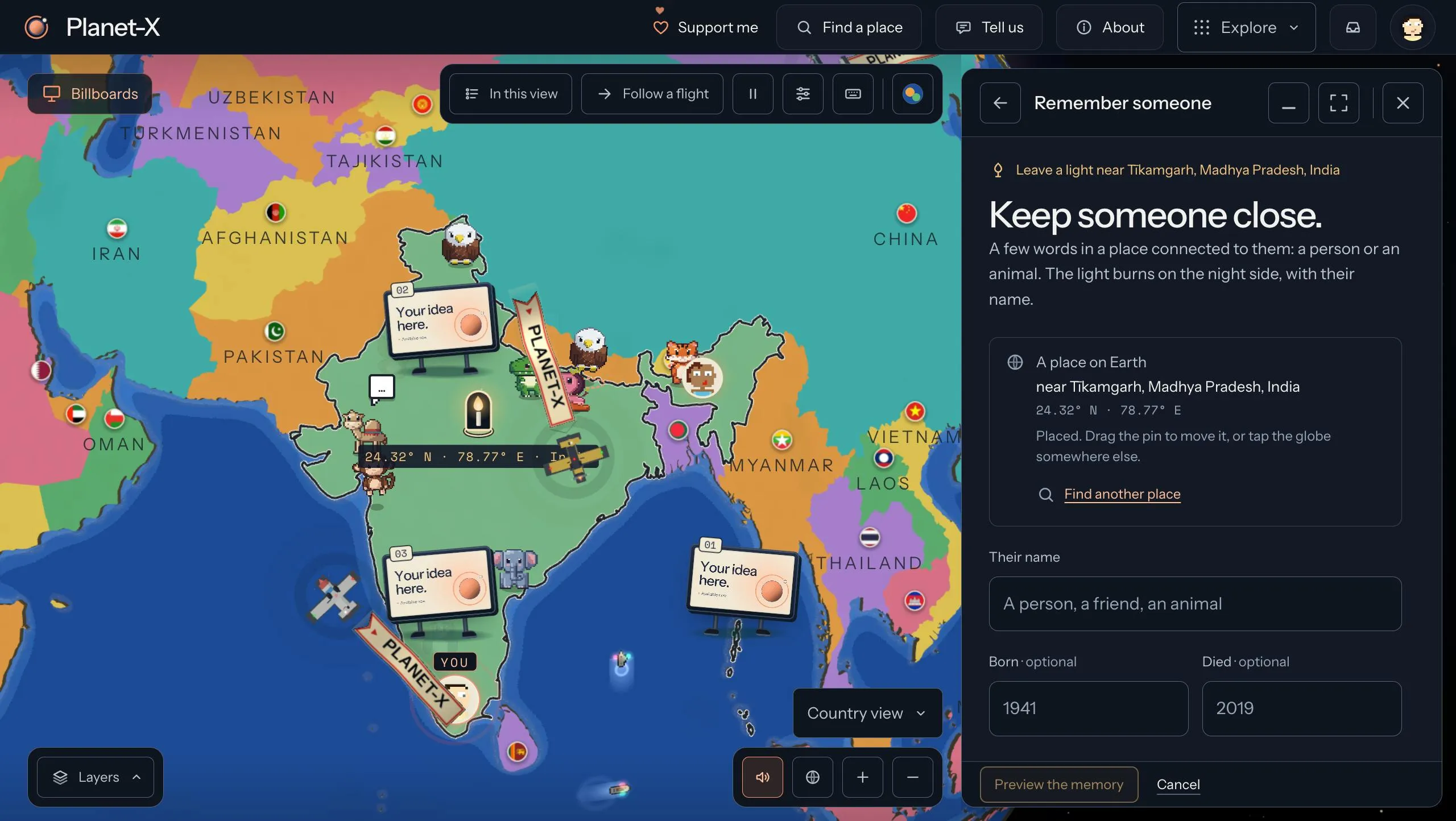
The core interface of Planet-X is a freely rotatable 3D Earth. Users can explore without registering an account: drag the globe to browse different regions, click on a country to listen to its live radio, and "dig" through to the other side of the Earth to see what lies directly opposite.
This design pulls the product away from being a pure memorial tool and toward more everyday exploration. The product tags include Music, Maps, and Radio, suggesting that creator Ashwin C doesn't want users to open it only on special occasions. The acts of rotating, listening, and digging feel game-like, lowering the barrier to entry and making "remembrance" feel less heavy.
An antipode is a geographic concept referring to the point on Earth's surface exactly opposite a given location, connected through the center of the Earth. For example, the antipode of China's eastern coast lies roughly in Argentina, South America. In interactive products, "digging to the other side of the Earth" is typically implemented through raycasting and spherical coordinate inversion: when a user clicks a point on the sphere, the system calculates the position with longitude + 180 degrees and inverted latitude, then moves the camera or marker there. This mechanic is appealing because it turns abstract spherical geometry into an intuitive "piercing" action, letting users perceive the Earth's three-dimensionality and adding exploratory and game-like qualities rather than just static map browsing.
The Memorial Feature: Choosing a Location for a Lamp
Beyond exploration, Planet-X offers an emotionally centered core feature: leaving a lamp for a departed friend, family member, pet, or idol. Users can place this lamp at a specific geographic location, linking memory to place.
The cleverness of this setup lies in translating abstract longing into a coordinate on Earth. Compared to traditional message boards or memorial pages, spatial presentation more readily evokes specific memories—a city, a coastline, a street. The product doesn't reveal whether the lamp appears as a light point, a marker, or another visual element, but given its positioning as a "living globe," it should be part of the Earth's dynamic surface environment.
The Boundary Between Free Exploration and Remembrance
The official description explicitly states that exploration is free and requires no account. This means users can fully experience rotating the Earth, listening to radio, and digging to antipodes before deciding whether to enter the memorial section. For emotional products, this low-pressure trial path makes sense: establish an exploration habit first, then naturally transition to emotional expression.
Anchoring memorial content to geographic coordinates follows a "location-based memory" or "digital place name" approach in product design. Situated cognition in psychology shows that location cues effectively evoke memories associated with specific events. Compared to timelines or message boards on traditional memorial pages, spatial presentation embeds emotional subjects into real-world coordinates, making it easier for users to form specific associations when they see a city or coastline. This type of design is also common in check-ins, tributes, and story markers on digital maps. The key lies in the visibility and revisitability of coordinates—whether the lamp is easy to find again and whether it maintains presence as the map zooms—which directly affects the continuity of the memorial experience.
Can Multisensory Design Support Memorial Scenarios?
Putting live radio and memorial features in the same product is a choice worth discussing. On one hand, sound quickly establishes a sense of place—hearing a country's radio makes that location on Earth feel concrete. On the other hand, memorial scenarios typically require quiet and focus, and continuous radio playback may become a distraction.
Planet-X currently doesn't specify whether radio interacts with memorial lamps—for example, whether a specific sound atmosphere appears after placing a lamp. If the two merely coexist without interfering, the product may feel like stacked features; if they can be connected—say, a lamp corresponding to muted playback or ambient sound from a certain radio—the emotional experience would have more depth.
Live radio features typically rely on network streaming (such as Icecast, Shoutcast, or aggregation APIs) indexing broadcast sources by country or region. Its product value lies in quickly establishing a "sense of being there" through sound: hearing triggers situational associations faster than sight, turning an abstract coordinate on Earth into a place with a sense of life. But sound is also a medium that continuously occupies attention, creating tension with the quiet and focus required for memorial scenarios. A common design compromise is to offer ambient sound modes, fade-in/fade-out volume, or brief playback only on hover, letting sound exist as spatial atmosphere rather than background interference.
Opportunities and Challenges for a Lightweight Product
Judging from Product Hunt data, 66 votes and 3 comments indicate the product has gained some attention, though discussion heat isn't high. Ranking 18th is also mid-tier. As the work of an individual developer (Maker Ashwin C), Planet-X appears well-executed—3D Earth, live radio, and antipode digging are all technically substantial features.
The challenge lies in retention. Exploration map products easily bring novelty on first open, but whether users return repeatedly depends on content updates and emotional connection. The memorial lamp is a hook with long-term value, but it needs social or sharing mechanisms to spread—currently the product mentions no sharing, invitation, or community features, which may limit its reach.
Who Might Use It
Planet-X's potential users fall into two categories. One is curious users interested in geography, radio, and 3D interaction, attracted by the free, no-registration exploration experience; the other is people with clear memorial needs, possibly looking for a more spatial form of expression than traditional memorial pages.
The overlap between these two user types isn't high, meaning the product needs to serve two motivations simultaneously. If Planet-X can, in future versions, create deeper interaction between memorial lamps and geographic exploration—such as recommending local radio or stories based on lamp locations—it could connect the two user groups.
For now, Planet-X is an experimental product with a clear concept and lightweight execution. It doesn't try to solve grand problems but places a simple emotional act—leaving a lamp for someone departed—into a freely explorable 3D world. Whether this combination works still needs validation through more actual use.
Related articles

Medicare Spends $50,000 Treating a Heart Attack but Won't Spend $100 Preventing One: The Mismatch in Healthcare
Medicare pays ~$50,000 to treat a heart attack but won't spend $100 to prevent one. This article unpacks the MedPage Today opinion piece and Hacker News debate on why healthcare payment favors treatment over prevention and the deep causes of incentive misalignment.
Nvidia May Cosign Loan for Nscale's West Virginia AI Data Center
Nvidia is considering cosigning a loan for Nscale's West Virginia AI data center. This article analyzes the signal significance of chip vendors entering data center financing, the risk-sharing logic, and project uncertainties.

Claude Code v2.1.316 Update Analysis: Enterprise Gateway and Multiple Stability Fixes
Claude Code v2.1.316 released: new enterprise gateway pooled group budgets, layered policy mode, subagent effort control, dozens of Shell, network, and session recovery fixes, and Opus 4.8 fast mode deprecated.