Play with Putty: A Collaborative Vibe Coding Tool That Keeps Your Creative Flow Intact

Play with Putty brings real-time collaboration to Vibe Coding, letting teams build with AI seamlessly.
Play with Putty is a new collaborative Vibe Coding tool that combines real-time multi-person collaboration with AI-assisted programming. Designed to be frictionless, it lets multiple users build together on a shared canvas while AI handles implementation details. Positioned across design tools, AI, and Vibe Coding, it differentiates itself from competitors like Cursor and Replit by making collaboration its core feature rather than an add-on.
When AI Programming Meets Real-Time Collaboration
In a world overflowing with AI programming tools, a new product called Play with Putty has caught considerable attention on Product Hunt. Positioned as "Simple, Collaborative Vibe Coding," it earned 107 upvotes and landed at #13 on the daily leaderboard. The product aims to solve a problem that many similar tools have overlooked: how to seamlessly merge real-time multi-person collaboration with AI-assisted programming.
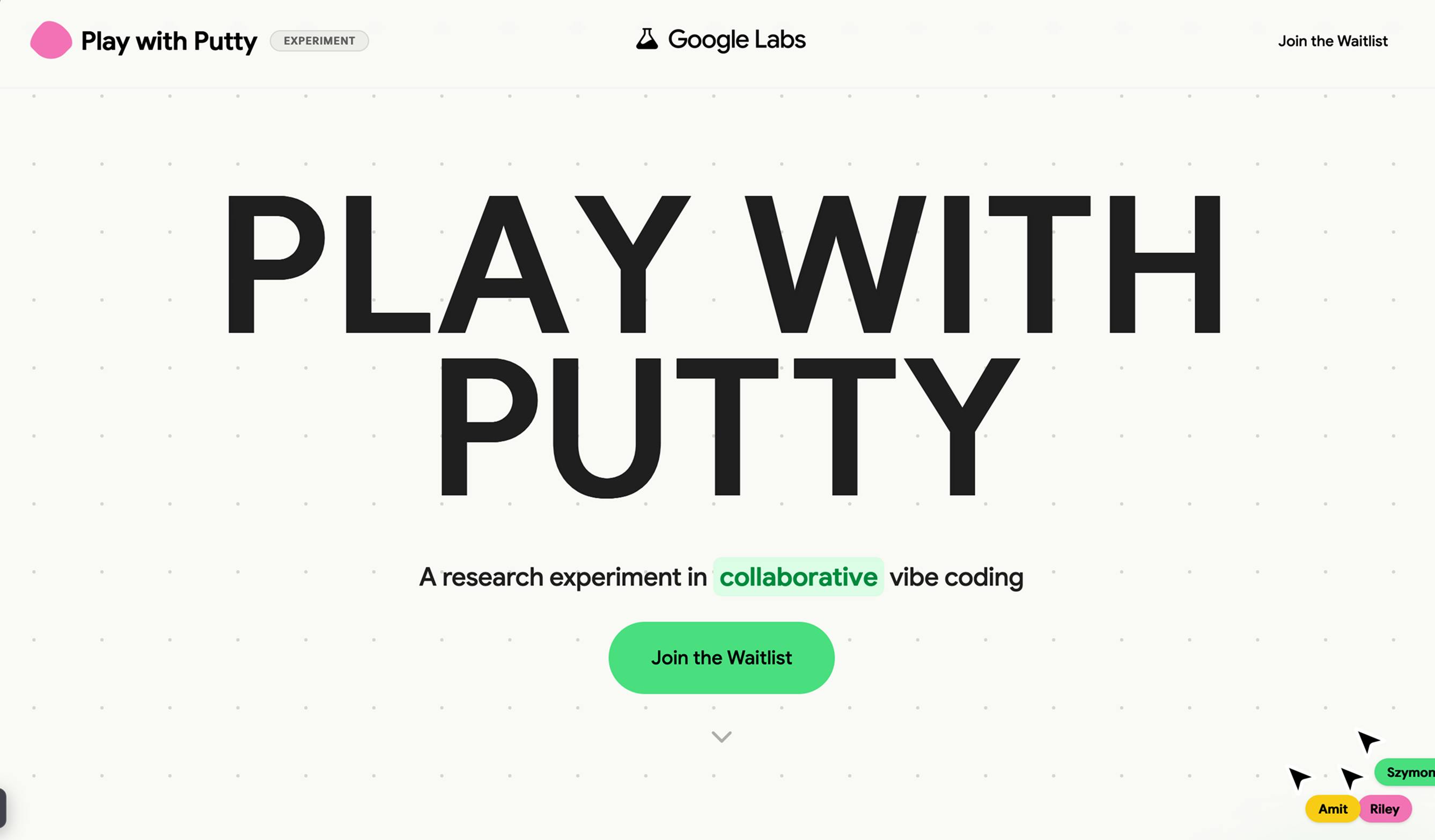
Vibe Coding is an emerging programming paradigm where developers stop writing code line by line and instead converse with AI using natural language, letting AI generate, modify, and iterate on code while the human takes on the role of "director" and "taste arbiter." Play with Putty takes this concept a step further: it doesn't just serve individual developers — it emphasizes real-time multi-person co-creation.
Core Philosophy: Never Break the Creative Flow
Throughout Play with Putty's product description, one keyword appears repeatedly — frictionless. Its design goal is to "let people build through AI without breaking their creative flow."
What Is Creative Flow?
Flow is a psychological concept describing a state of deep immersion where a person is fully focused and loses track of time. For developers, interruptions from tool configuration, environment setup, dependency conflicts, and other tedious tasks are the biggest flow killers. Traditional collaborative programming adds even more friction — code merge conflicts, version synchronization issues, and inconsistent environments can all bring creativity to a screeching halt.
Play with Putty aims to provide an out-of-the-box real-time collaboration environment: multiple people can build together as if working on the same canvas, while AI handles the tedious implementation details behind the scenes. This "what you see is what you get" collaboration model lets participants focus their attention on "what to build" rather than "how to build it."
A Collaborative Playground That Brings People Together
Another standout feature of the product is its social nature. The official description emphasizes "bring people together," which sets it apart from most AI programming tools that focus primarily on individual productivity. It's more like a collaborative playground, suited for team brainstorming, pair programming, teaching demonstrations, or even friends casually building small projects together.
Product Positioning and Competitive Landscape
From the Product Hunt category tags, Play with Putty spans three domains: Design Tools, Artificial Intelligence, and Vibe Coding. This ambitious positioning reflects a current trend in software tools — the boundaries between design, programming, and AI are rapidly dissolving.
The Vibe Coding Competitive Landscape
The Vibe Coding space is already quite crowded. From AI-native code editors like Cursor and Windsurf, to online AI code generation tools like Replit, v0, and Bolt, every player is vying for the "build software with natural language" entry point. Play with Putty's differentiating path is collaboration first:
- Most tools treat collaboration as an add-on feature, while Putty makes real-time collaboration the core design principle;
- It emphasizes lightweight and instant experiences, lowering the barrier to entry so non-professional developers can join in the building process;
- The word "Play" itself signals the product's tone — exploration, experimentation, and fun, rather than serious engineering delivery.
Key Questions Worth Watching About Play with Putty
As an early-stage product that just launched on Product Hunt, publicly available information about Play with Putty is still relatively limited. Based on its product philosophy, there are several areas worth keeping an eye on:
First, balancing collaboration depth with AI code generation quality. Real-time collaboration means multiple people issuing instructions to AI simultaneously. How to coordinate different intentions and avoid overwriting each other is a significant technical challenge. The reliability of AI-generated code will also directly impact the collaboration experience.
Second, the leap from "play" to "production." Both the product name and positioning lean toward the fun side, which helps attract users to try it quickly. But to become a true productivity tool, it still needs to prove it can handle complex, maintainable projects.
Third, clarity on the target audience. Is it aimed at professional development teams, designers and product managers who want to rapidly prototype, or programming education scenarios? Different user groups have very different expectations for "collaboration" and "frictionless."
Conclusion
Play with Putty represents a fascinating direction in the evolution of AI programming tools — moving from individual productivity tools toward collaborative creation platforms. In an era where AI can already handle a significant portion of coding work, human-to-human collaboration and the flow of ideas have become the new value frontier.
Whether it can gain a firm foothold in the fiercely competitive Vibe Coding space remains to be proven through time and more tangible features. But at the very least, it's asking the right question: as writing code becomes increasingly easy, how do we make "building together" feel just as natural and enjoyable?
Related articles

Chain of Thought Isn't Just for AI: How Humans Can Use CoT to Improve Thinking Quality
Chain of Thought isn't just a prompt trick for large models. Starting from a Hacker News discussion, this article analyzes why CoT works for human thinking too, breaks down actionable ways to transfer it, and highlights the key differences between human CoT and machine CoT.
Cloudflare Teams Up with OpenAI: Closi…
Cloudflare Teams Up with OpenAI: Closing the Loop from Vulnerability Discovery to Defense with AI
Cloudflare uses OpenAI Daybreak to investigate security vulnerabilities and generate reviewable remediation plans, while developers use Codex to boost coding efficiency and quality.

Orca Multi-Agent Orchestration in Practice: A Guide to Parallel Collaboration with Claude and Codex
Orca is Stable AI's free open-source agent workbench supporting 34 agents like Claude Code and Codex in parallel. Learn its Git worktree isolation, multi-model orchestration, and mobile management.