Playwright MCP Context Explosion: Why Long-Form Tasks Always Fail Before Submission

Playwright MCP returns the full page tree on every call, bloating context in long tasks; the tool layer needs explicit state management.
Starting from Reddit user feedback, the article argues that Playwright MCP's frequent failures in long-form tasks stem not from insufficient model capability but from flawed context management: every tool call returns the complete page accessibility tree, historical snapshots pile up, and the Agent backtracks through old snapshots to locate elements, blowing up the context before submission. Manually trimming history makes the Agent forget filled content, so simple truncation fails. The community explores three paths: incremental snapshots and diff updates, external snapshot storage accessed via reference IDs, and structured summaries replacing raw trees. The article distills implications for Agent tool design: context is not a trash can, state management should be a first-class citizen of the tool layer, and long tasks need dedicated optimizations such as pagination, incremental updates, and external storage.
When Browser Automation Meets Long Tasks
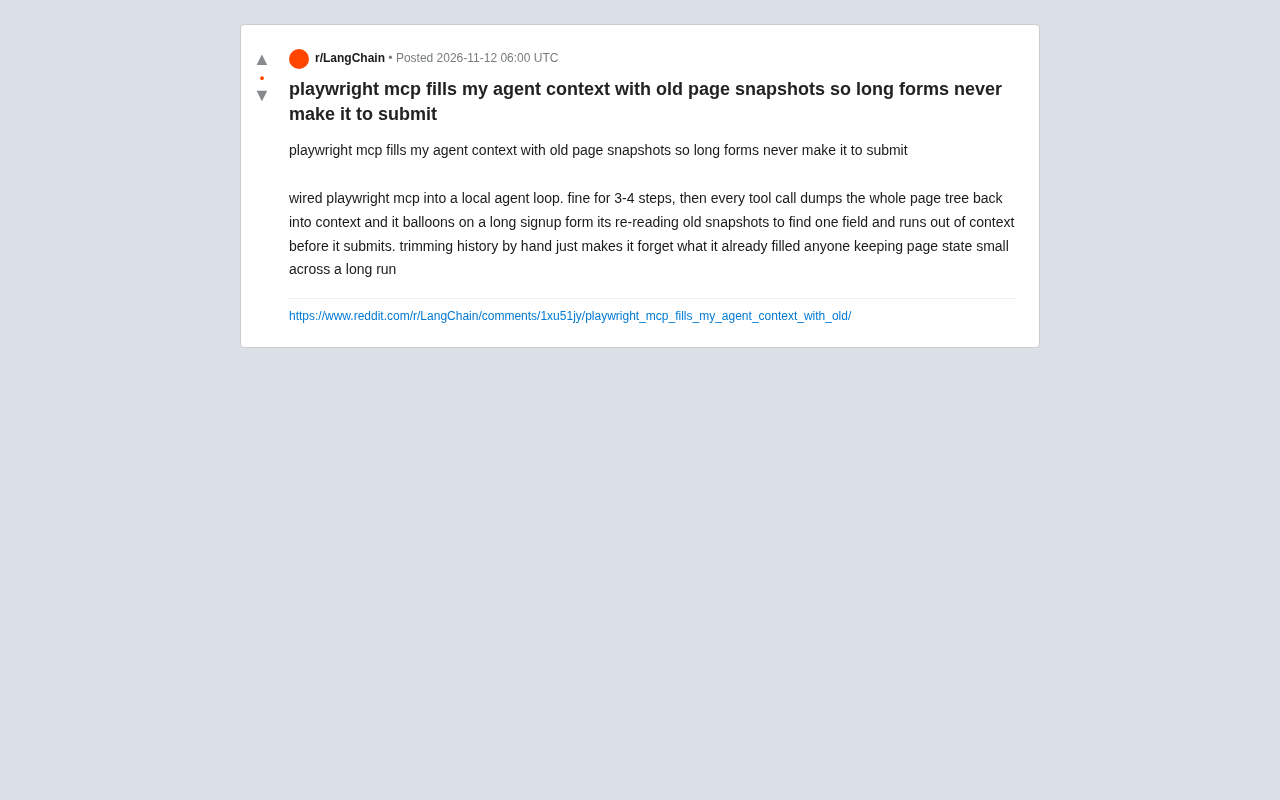
Plugging Playwright MCP into a local Agent loop starts out smoothly enough—form filling and button clicking both work. But once the task gets longer—say, a registration form with multiple fields—the Agent starts failing frequently. According to Reddit users, the problem is that every tool call stuffs the entire page tree back into the context, causing it to blow up before submission.
This isn't a matter of model capability; it's a flaw in the context management strategy.
Breaking Down the Problem: How Old Snapshots Sink Long Tasks
The Mechanism of Context Bloat
After each tool call, Playwright MCP returns the accessibility tree of the current page. For simple pages this may be harmless, but long forms often contain a large number of input fields, labels, and state information—a single return can occupy thousands of tokens. As steps accumulate, historical snapshots pile up, and the context window rapidly fills.
Worse still, when the Agent looks for a particular field, it backtracks through previous snapshots to locate elements. This means old snapshots not only take up space but are also read repeatedly, further intensifying context pressure.
The accessibility tree is a semantic tree that the browser generates from the DOM structure. It strips out purely stylistic and decorative nodes, keeping only elements meaningful to assistive technologies (such as screen readers), including roles (button, textbox, heading, etc.), names, states (checked, disabled), and hierarchical relationships. Playwright can export this tree directly based on Chromium's Accessibility domain, so it is often used as a "page map" for Agents. Compared with raw HTML, it is more compact and semantic, but in long forms every input field, label, and hint text still generates nodes, so the tree remains sizable. The key point: this tree describes a "complete snapshot of the current page," not "the difference from the previous step," so every tool call amounts to re-serializing the entire page—the token cost is proportional to page complexity, not to the amount of change caused by the current operation.
The context window is the upper limit of tokens a model can receive in a single inference, including the system prompt, conversation history, tool return results, and the output to be generated. It is a hard, one-time constraint that does not disappear just because the model gets smarter. In an Agent loop, every round of tool calls and their return values is appended to the conversation history, so context consumption grows monotonically with the number of steps. When approaching the limit, common consequences include: early instructions being squeezed out, the model starting to ignore information from intermediate steps, or requests being truncated with an error. So-called "context bloat" refers to redundant information returned by tools filling the window with far more information than the task actually needs, causing long tasks to exhaust their budget before completion—this is precisely the root cause of long forms failing before submission.
The Side Effects of Manual Cleanup
Some have tried manually trimming the history to keep only the most recent snapshots. But this causes the Agent to forget what it has already filled in, repeating operations or missing fields in subsequent steps. Reddit users pointed out that manually pruning history "just makes it forget what it has already filled in."
This shows that a simple truncation strategy won't work—more refined state management is needed.
Community Exploration: Ideas for Keeping Page State Lean
Incremental Snapshots and Diff Updates
A natural idea is to return only the parts of the page that changed, rather than the entire tree. For example, after the Agent fills in an input field, the MCP returns only that field's state change and any newly added interactive elements. This can significantly reduce token consumption per call while retaining key information.
However, implementing incremental updates requires the MCP server to maintain page state comparisons, which places higher demands on tool design.
In engineering, a diff usually refers to comparing two states and outputting only the changed parts, similar to Git diff or the patch mechanism of a virtual DOM. In the browser automation scenario, there are roughly three implementation paths: first, performing structural comparison based on stable identifiers of accessibility tree nodes and outputting added, removed, and attribute-changed nodes; second, listening to DOM mutation events (MutationObserver) to accumulate a change set and then summarizing it when the tool returns; third, marking snapshots with version numbers, where the Agent carries the version number it last saw and requests "changes since then." The difficulty lies in the stability of node identifiers—an input field gaining focus, dynamic id reordering, and list re-rendering all cause simple comparisons to produce large numbers of spurious differences. Therefore, practical designs often need to match nodes using semantic keys (such as label text + role) rather than pure DOM paths; otherwise, incremental returns may be more verbose than full ones.
External State Storage
Another approach is to store page snapshots outside the context—for example, writing them to files or a database—with the Agent accessing them via reference IDs. This way the context retains only pointers rather than complete snapshots. But it also introduces retrieval overhead: the Agent needs to know when to read which snapshot, increasing decision complexity.
Structured Summaries Instead of Raw Trees
Yet another view holds that rather than returning the raw accessibility tree, the MCP should generate a structured summary containing only the currently interactive elements and a brief description of the fields already filled in. This requires the MCP to have some semantic understanding capability, but it can greatly compress the amount of information.
Implications for Agent Tool Design
Context Is Not a Trash Can
This case exposes a common problem: tool developers tend to return as much information as possible, believing this is friendlier to the Agent. But in reality, redundant information dilutes attention and accelerates context exhaustion. A tool should behave like a human assistant—providing only the information needed for the current step.
State Management Deserves First-Class Treatment
State management in long tasks cannot rely on the Agent's memory; it should be explicitly supported by the tool layer. For example, the MCP could maintain a "form-filling progress" state, and the Agent would only need to query the progress and the next operation rather than backtracking through historical snapshots.
Long Tasks Need Dedicated Optimization
Most MCP tools today are designed for short interactions, with little optimization for long-task scenarios. As Agents handle increasingly complex tasks, tools need built-in mechanisms such as pagination, incremental updates, and external storage—rather than assuming the context is infinitely large.
Conclusion
The context bloat problem of Playwright MCP is not an isolated case; it reflects the shortcomings of the Agent toolchain in supporting long tasks. Solving this problem requires tool designers to rethink their information-return strategy, not just to make the Agent smarter. For developers building local Agent loops, this case is a reminder: context management is a necessary condition for long-task success, not an after-the-fact patch.
One-line Summary
Playwright MCP returns the full page tree on every call, causing context bloat in long tasks; the tool layer needs explicit state management.
Paragraph Summary
Starting from Reddit user feedback, the article points out that the root cause of Playwright MCP's frequent failures in long-form tasks is not insufficient model capability but a flawed context management strategy: every tool call returns the complete page accessibility tree, historical snapshots keep piling up, and the Agent backtracks through old snapshots to locate elements, causing the context to blow up before submission. Manually trimming history makes the Agent forget what it has already filled in, so simple truncation won't work. The community has explored three paths: incremental snapshots and diff updates, storing snapshots in external storage accessed via reference IDs, and replacing the raw tree with structured summaries. The article further distills implications for Agent tool design: context is not a trash can, state management should be a first-class citizen of the tool layer, and long tasks need dedicated optimizations such as pagination, incremental updates, and external storage.
Related articles

Prompt Engineering for Beginners: From Writing Prompts to Engineering Thinking
Starting from the essence and four functions of prompts, this article systematically explains the six-step process, four success criteria, learning value, and practical limitations of prompt engineering to help you build a complete understanding.

Anthropic Launches Nasdaq IPO: AI Giant's Listing and Risk Disclosures
Anthropic officially launches its Nasdaq IPO under ticker ANT, with market valuation expected to potentially exceed SpaceX's record. The prospectus devotes nearly 100 pages to AI risks, while first-half revenue grew over 14x but net losses widened sharply, reigniting the AI bubble debate.

Rust cURL Clone Uses 4,832 unsafe Blocks—Is the Memory Safety Myth Broken?
A Rust cURL clone uses 4,832 unsafe keywords, challenging Rust's memory safety narrative. We analyze what unsafe really means, compare Fil-C, and examine rewrite motives.