Plugins Radar: A Ranking Monitor and Competitor Tracker Built for ChatGPT Plugins

Plugins Radar brings SEO-style rank monitoring to the ChatGPT plugin directory for developers.
With over 5,000 ChatGPT plugins now available, developers face the challenge of standing out in a crowded directory. Plugins Radar applies traditional SEO rank-monitoring concepts to this new arena, tracking plugin visibility across 192 common search terms, surfacing competitor gaps, and sending email alerts when rivals overtake you or update their listings. It uses a freemium model — free topic leaderboards attract early users, while full reports and ongoing monitoring drive conversions. Its emergence reflects a broader trend: AI app ecosystems are replicating the Web-era toolchain, with plugin discoverability becoming the new frontier for optimization.
When the Plugin Ecosystem Gets Competitive, Who Holds the "SEO Ruler"?
With the number of ChatGPT plugins surpassing 5,000, developers are facing a familiar yet thorny problem: in a crowded directory, how exactly do users find your plugin? Questions like where you rank, which keywords cover your plugin, and which potential traffic opportunities you're missing were nearly impossible to quantify — until now. Plugins Radar is an analytics tool built specifically to address this pain point. It takes the battle-tested concept of "rank monitoring" from traditional SEO and brings it to the new battleground of the ChatGPT plugin directory.
The product recently launched on Product Hunt, earning 69 upvotes and placing 20th, with category tags of Analytics, SEO, and Artificial Intelligence. Its positioning is squarely aimed at plugin developers and operators as a vertical audience, rather than general end users.
What It Actually Does
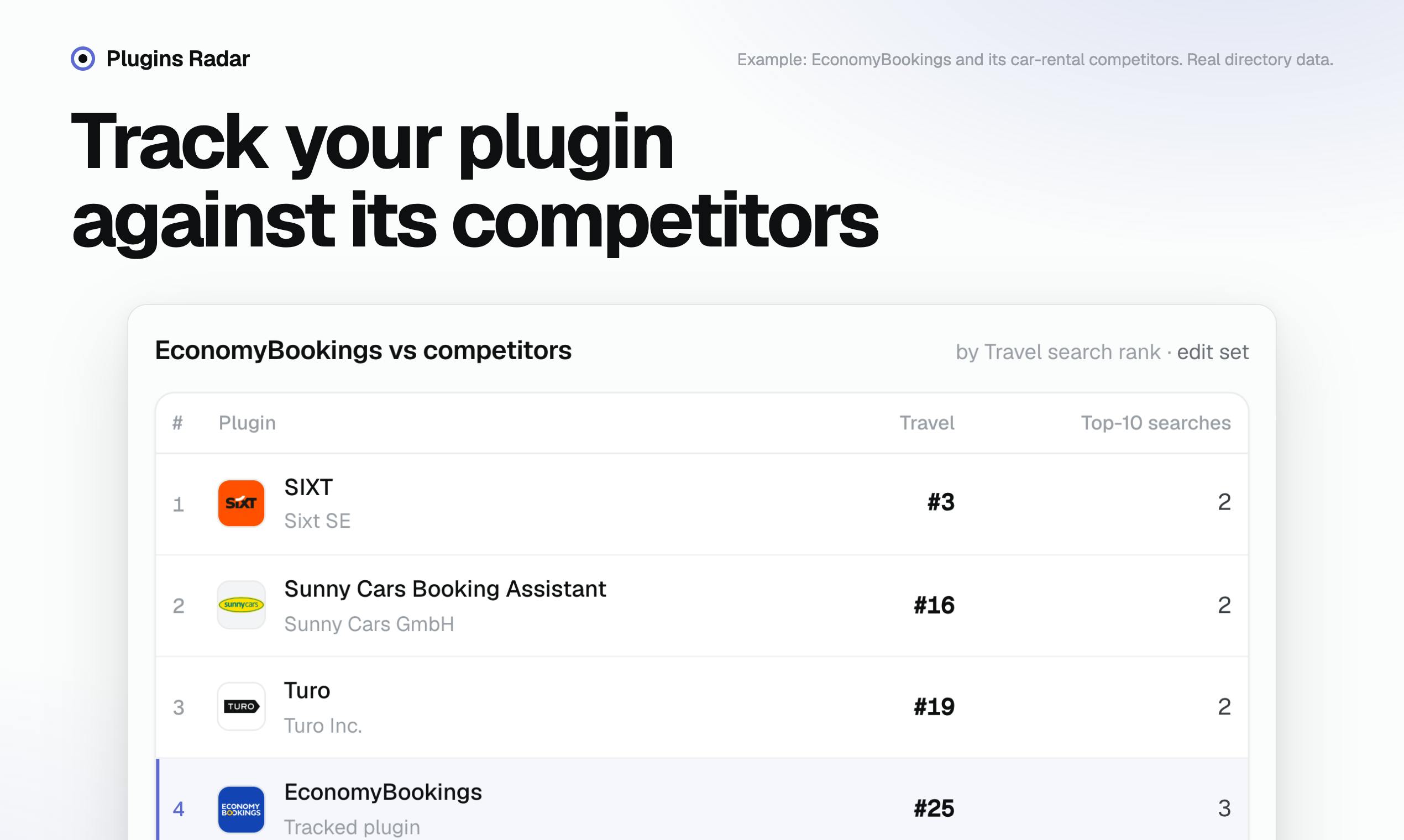
Plugins Radar's core capability is tracking the entire ChatGPT plugin directory. According to the official description, users can query any of the 5,000+ plugins and see where it ranks across 192 common search terms. In other words, it treats the plugin directory like a search engine and attempts to reconstruct the real results page users see under different query scenarios.
Beyond your own rankings, the tool surfaces three key types of information: which plugins are competing with you for the same keywords, how those competitors are distributed, and which search terms your plugin is missing out on. For operators, that last point is especially valuable — it directly points to uncaptured traffic opportunities, rather than just telling you "you're currently ranked X."
Competitor Monitoring and Email Alerts
Another major selling point is dynamic monitoring. Users can add their own plugins and the competitors they want to watch. If a competitor overtakes you in rankings, or modifies its directory listing (such as changing its title or description), the system sends an email notification. This "passive early warning" mechanism transforms a one-time data lookup into an ongoing operational tool — much more aligned with real-world competitor tracking needs.
It's worth noting that the ChatGPT plugin directory isn't a traditional search engine in the conventional sense — it's maintained by OpenAI, and when users express a need inside ChatGPT, the system recommends relevant plugins based on semantic matching. This means "rankings" aren't as transparent as Google search results; they're determined by the model's internal retrieval logic. Plugins Radar's approach is to repeatedly probe the directory using a fixed set of 192 query terms, recording the list of plugins returned each time, and inferring a given plugin's "visibility" under specific queries. This method is fundamentally black-box testing: approximating real rankings through large-scale repeated sampling rather than reading official data directly. This is precisely why the "192 common search terms" figure is so critical — it defines both the breadth of the tool's coverage and its biggest methodological limitation: any query terms not included will be completely invisible.
The Line Between Free and Paid
On the business model side, Plugins Radar takes a common tiered approach. Topic Leaderboards are completely free and open — anyone can register for free and track a plugin to see its full report. Deeper monitoring and alert features most likely form the basis for paid conversion — the free leaderboards drive traffic and build trust, while comprehensive reports and ongoing alerts handle monetization.
This design is quite friendly to early users: developers can map out their plugin's true position in the ecosystem at virtually zero cost before deciding whether to invest further.
A Niche Category on the Rise
The emergence of Plugins Radar fundamentally reflects a broader trend — AI application ecosystems are replicating the toolchain of the Web era. Search engines once gave rise to the SEO industry and monitoring tools like Ahrefs and SEMrush; now the ChatGPT plugin directory has become a new "traffic gateway," and "ASO/plugin SEO" tools built around it have naturally followed.
Of course, this category faces obvious uncertainties. The rules of the plugin directory, its ranking algorithm, and even the overall shape of the plugin ecosystem are still evolving rapidly. The tool's value is heavily dependent on the stability of the underlying platform. If OpenAI adjusts the directory structure or launches its own built-in analytics panel, the survival space for third-party tools will shrink considerably. For developers right now, Plugins Radar's significance lies primarily in providing a previously missing quantitative perspective — making a plugin's "discoverability" measurable and trackable for the first time.
Background note: ASO (App Store Optimization) is a methodology that emerged alongside the iOS App Store and Google Play in the mobile internet era, with the core goal of improving an app's ranking and click-through rate in store search results through keyword optimization, screenshot design, rating management, and more. Ahrefs and SEMrush are the most representative commercial tools in the Web SEO space; both build keyword ranking databases by continuously crawling search engine results pages (SERPs), with subscription prices typically in the hundreds of dollars per month, backed by the long-term tracking of billions of keywords. Plugins Radar is attempting to play a similar role in the ChatGPT plugin ecosystem, but its current coverage of 192 keywords is still at a very early stage compared to those tools. The core significance of this analogy is: once a distribution channel accumulates enough traffic, demand for tools focused on "how to get discovered in that channel" will naturally emerge — this is a universal law of platform ecosystem evolution.
Summary
Plugins Radar transplants mature SEO monitoring concepts into the ChatGPT plugin ecosystem, closing the blind spot developers have around their own rankings. Free leaderboards lower the barrier to entry, while competitor alerts strengthen long-term retention. For teams that are serious about growing their plugins, it's worth trying. And for the broader industry, the emergence of tools like this signals that AI application distribution is entering a new phase of precision operations.
Related articles

Chain of Thought Isn't Just for AI: How Humans Can Use CoT to Improve Thinking Quality
Chain of Thought isn't just a prompt trick for large models. Starting from a Hacker News discussion, this article analyzes why CoT works for human thinking too, breaks down actionable ways to transfer it, and highlights the key differences between human CoT and machine CoT.
Cloudflare Teams Up with OpenAI: Closi…
Cloudflare Teams Up with OpenAI: Closing the Loop from Vulnerability Discovery to Defense with AI
Cloudflare uses OpenAI Daybreak to investigate security vulnerabilities and generate reviewable remediation plans, while developers use Codex to boost coding efficiency and quality.

Orca Multi-Agent Orchestration in Practice: A Guide to Parallel Collaboration with Claude and Codex
Orca is Stable AI's free open-source agent workbench supporting 34 agents like Claude Code and Codex in parallel. Learn its Git worktree isolation, multi-model orchestration, and mobile management.