PluginX AI Agent for Apartment Hunting: Generate Property Reports Instantly, No More Manual App Browsing

PluginX AI agent turns one natural language command into a fully structured rental property report.
This article covers a demo of PluginX, an AI agent tool applied to apartment hunting. Users simply enter a natural language prompt specifying budget, area, and amenity needs, and PluginX automatically fetches and organizes listings into a structured table with rent, floor area, subway distance, nearby amenities, and platform links — with support for in-report filtering and one-click jump to source listings. The article highlights this as a prime example of AI agents landing in vertical consumer services, while noting that the tool's effectiveness depends on data coverage and timeliness, and that human verification on the source platform remains essential.
Using AI Agents to Find Rentals: A Smarter Way to Search
Anyone who's apartment hunting knows the drill — endlessly scrolling through apps, comparing listings one by one, and manually tracking details. Finding the right place often means cross-referencing multiple platforms just to compare prices, and recording details like subway distance and nearby amenities alone can eat up hours. A demo that recently circulated on Bilibili shows an UP host walking through the entire rental search process using the AI agent tool PluginX, compressing what used to be a tedious information-gathering task into a single command.
The core value of tools like this isn't to make decisions for you — it's to automatically aggregate and structure scattered listing data so you can focus on choosing rather than searching.

How PluginX Handles the Rental Search
The workflow demonstrated is remarkably straightforward. The user sent PluginX a single natural language command: "Help me find reliable rental listings in Shuangliu District, Chengdu, with a budget of 1,000 to 1,500 yuan. Organize them in a table, include actual photos, provide detailed information on subway distance, and note nearby transportation and commercial amenities."
After hitting send, PluginX filters matching listings and automatically generates a structured table and report. This showcases the hallmark capabilities of today's AI Agents — understanding structured requirements, calling data sources, and delivering formatted results — all without the user manually switching between platforms.

Compared to traditional keyword searches, describing your budget, neighborhood, and amenity needs in natural language maps much more closely to how people actually look for apartments. Users can lay out all their requirements in one go — just like talking to a real estate agent — and let the agent handle all the information gathering.
The key distinction between an AI Agent and a standard AI chat tool comes down to autonomous action. A regular conversational model can only answer questions based on its training data, whereas an Agent can proactively call external tools — such as browsers, APIs, or databases — to complete multi-step tasks. In a rental context, this means the system doesn't just tell you how to search; it actually goes out and fetches, filters, and organizes listings from various platforms on your behalf. This capability relies on a Tool Use / Function Calling mechanism, where the large language model breaks down user intent into subtasks and sequentially invokes the appropriate tools to execute them, then consolidates the results. It's this "plan → execute → consolidate" loop that allows a single natural language command to drive an entire workflow that would otherwise require manual effort.
What's Actually Inside the Property Report
The generated report is the key deliverable of this workflow. Opening it gives you the total number of listings within your budget, laid out in a table with comprehensive fields, including:
- Community name and neighborhood
- Rent, floor area, orientation, and floor level
- Renovation status and full address
- Walking distance to the nearest subway station
- Nearby transportation and commercial amenities
- Link to the original listing platform

These fields map directly to the dimensions that matter most when deciding on a rental. With platform links included, users can make both horizontal comparisons (between different communities) and vertical comparisons (between different units in the same community), dramatically reducing information asymmetry.
Filter Again Inside the Report
One noteworthy detail: the report isn't a static output. Users can continue filtering listings by community within the report itself, and clicking any result jumps directly to the original platform.
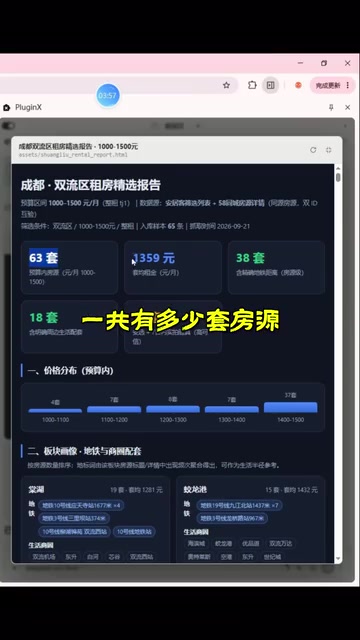
This makes the report feel more like an interactive workspace than a one-off document. When there are many matching results, narrowing by community helps users quickly zero in on a target area before diving into individual listing details — creating a much smoother decision-making flow.
A Window Into Real-World AI Agent Deployment
From a product perspective, PluginX's rental use case is a textbook example of AI agents being deployed in vertical consumer services. It automates the "search → collect → organize → compare" pipeline that users would otherwise have to piece together manually, delivering a directly usable structured report.
That said, the real-world effectiveness of such tools is heavily dependent on the coverage and timeliness of the underlying data sources. Rental listings change fast and vary in reliability, so AI-generated reports still require users to verify information on the source platform after clicking through. The judgment of what counts as a "reliable listing" ultimately still comes down to human confirmation.
For working professionals and renters with genuine urgency, the biggest value of tools like this lies in cutting down the time spent on initial information filtering. They can't replace visiting apartments in person or signing a lease — but they can genuinely move the efficiency needle on the search phase. As more consumer service scenarios integrate AI agents, the "one command, one report" experience may well become the new normal.
Data freshness is a shared bottleneck for AI agents operating in high-velocity domains like real estate, ticketing, and e-commerce. Most such tools draw data from one of two sources: real-time scraping or API calls from platforms (better timeliness, but vulnerable to anti-scraping measures), or periodically synced data snapshots (which may lag anywhere from a few hours to several days). In the rental market, a listing can go from posted to leased in just a few days. If the underlying data has a lag, listings that look promising in an AI report may already be off the market. For this reason, verifying that a listing is still active on the source platform before adding it to your shortlist remains a necessary step.
Related articles

Understanding DeepSeek in 3 Minutes: The Rise from a Quant Hedge Fund to an Open-Source AI Leader
DeepSeek's history in 3 minutes: from High-Flyer Quant's compute build-up to V2's MLA inference cost cuts, V3's $5.576M training bill, R1's open-source global shock, and V4 with a $7B Series A.

Local Creative Writing Model Showdown: Fine-tuned Qwen3.8 27B Wins, DeepSeek v4.1 Underwhelms
Bilibili creator tests seven local creative writing models: Hemingway and HumanLike Chat based on Qwen3.8 27B perform best, DeepSeek v4.1 is plain, Dongfang Shuo ranks last with confused characters. Includes three test prompts, scores, and usage advice.

Liang Wenfeng's Three Big Bets: Why Did DeepSeek Open-Source Its 82% Gross Margin?
Why did DeepSeek open-source DeepInfer, its 82% gross margin inference framework, and then launch a hundred-billion funding round? An analysis of Liang Wenfeng's three big bets and the open-source strategy.