Pluto Door: An SSH Client with an AI Agent That Gives Every Server a Desktop

Pluto Door integrates an AI agent, desktop environment, and one-click install into a Mac SSH client, lowering the server management barrier.
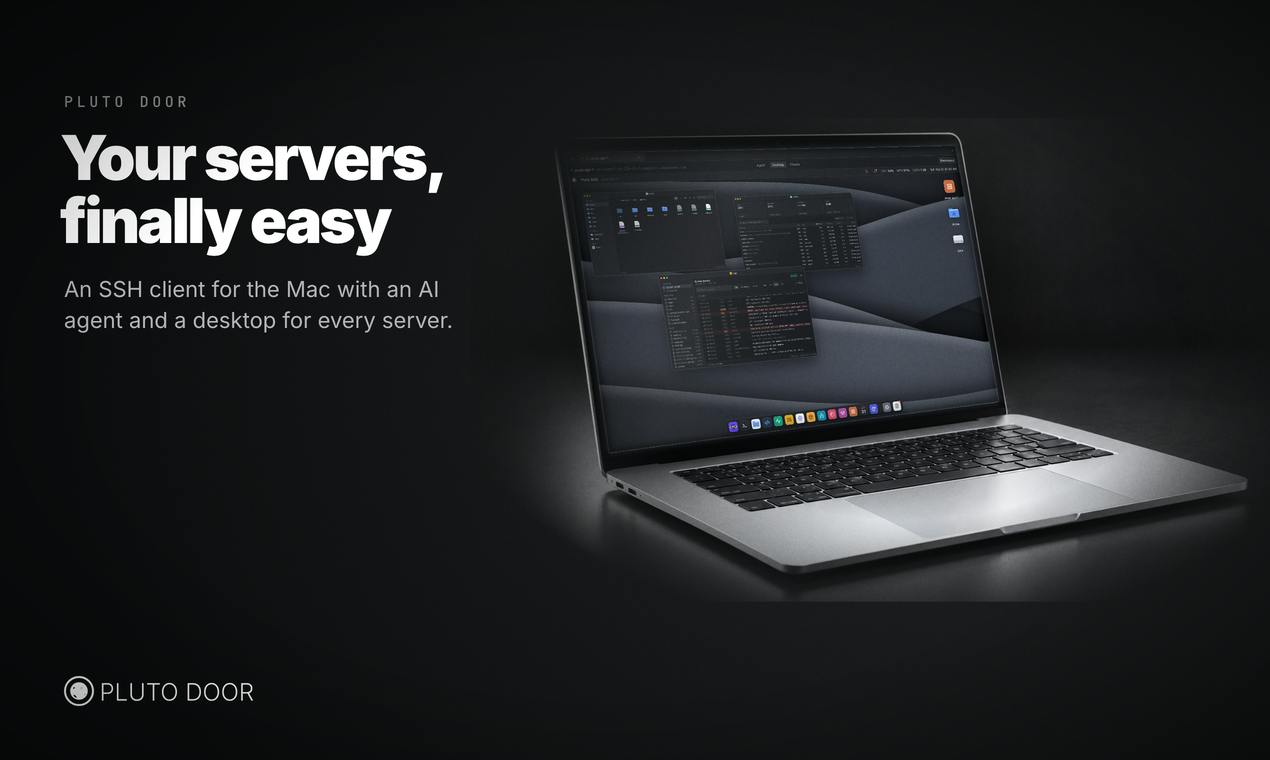
Pluto Door is a Mac SSH client featuring the embedded AI agent Ori, which reads server status and explains issues in natural language; all commands require user approval and file changes can be undone. It also provides Pluto XOS, presenting each server as a desktop with 15 apps, plus Hangar for one-click software installation. It supports scheduled alerts and multi-cloud connections to AWS, Google Cloud, and Azure, keeping servers and keys local. A 14-day free trial targets developers and small teams managing multiple servers without dedicated ops staff.
The SSH client category hasn't seen an exciting change in a long time. Traditional tools are either terminal emulators or file transfer panels, and ops engineers bounce between windows, relying on experience and logs to troubleshoot. Pluto Door, launched on Product Hunt, aims to change that: it combines an AI agent, a remote desktop environment, and one-click software installation into a single Mac app.
An AI Agent That Can Read Your Server
The core of Pluto Door's launch is Ori—an AI agent embedded in the SSH client. According to the official description, Ori can read server status, pinpoint problems, and explain what's happening in plain language. This is clearly valuable for users unfamiliar with Linux internals: issues that previously required digging through docs or asking a senior colleague can now be explained in natural language.
What really sets Ori apart from typical "AI ops assistants" is its execution model. When a server change is needed, all commands are shown to the user first, and nothing runs without approval; every modified file can be undone. This "show first, confirm, then roll back if needed" flow keeps AI automation within human-controlled bounds rather than letting it take over the shell directly.
From a product design perspective, this is a pragmatic trade-off. The biggest obstacle to AI agents in ops has never been capability but trust—no one wants an unpredictable model freely executing commands in production. Pluto Door trades an approval step and undo mechanism for that trust.
SSH (Secure Shell) is an encrypted network protocol for securely accessing remote servers over untrusted networks. Traditional SSH clients (such as PuTTY, OpenSSH, Termius) mainly provide terminal sessions and file transfer, with users interacting with servers via the command line. The introduction of an AI agent means the client no longer just passively executes commands but can actively analyze server status and diagnose problems, which relies on real-time reading and understanding of system logs, process states, configuration files, and other information.
Pluto XOS: Turning Servers into Desktops
Pluto XOS is another notable design. It presents each server as a desktop environment with 15 apps rather than a bare terminal. This shifts the remote server interface from a "command-line mindset" to an "operating system mindset," lowering the barrier to entry and making tasks like file management and service status checks more intuitive.
The accompanying Hangar handles software installation, which the official materials emphasize is done in one click. For users who frequently deploy the same environment across different servers, this saves a lot of repetitive work. However, whether this kind of abstraction layer limits flexibility in complex scenarios isn't clear from the product page—only real-world use will tell.
A remote desktop environment typically refers to operating a computer remotely via a graphical interface, but traditionally for server management it relies on protocols like VNC or RDP, which are resource-intensive. Pluto XOS's approach builds an abstract desktop layer on top of the SSH connection, packaging common server operations (such as file management and service monitoring) as app icons rather than directly exposing the command line. This design lowers the learning curve but may also hide underlying details, affecting advanced users' flexibility and scripting capabilities.
Proactive Alerts and Multi-Cloud Support
Pluto Door also offers scheduled checks that send notifications before small issues become major outages. This shift from "passive response" to "proactive prevention" aligns with the current direction of observability tools.
In terms of compatibility, the product supports AWS, Google Cloud, and Azure, covering mainstream infrastructure environments. On security, the official materials state clearly that servers and keys remain local on the user's Mac and are not uploaded to the cloud—for developers handling sensitive infrastructure, this is one of the key factors in deciding whether to adopt it.
Multi-cloud support means the product can connect to and manage server instances from different cloud providers (such as AWS, Google Cloud, Azure) simultaneously. This requires the client to abstract unified connection configurations, authentication methods, and resource models rather than relying on each cloud platform's native tools. For teams using hybrid or multi-cloud strategies, this reduces switching costs, but feature depth may be compromised due to differences in each platform's APIs.
Pricing and Positioning
Pluto Door offers a 14-day free trial. In terms of positioning, it targets developers and small teams that need to manage multiple servers but may not have dedicated ops staff. AI explanations lower the troubleshooting barrier, the desktop environment lowers the operational barrier, and one-click installation lowers the environment setup barrier—all three point toward "making server management less intimidatingly specialized."
Of course, the core skepticism such products face is also straightforward: for senior engineers accustomed to the command line, does the extra abstraction layer really improve efficiency? Are the AI agent's explanations accurate enough not to be misleading? The answers will only emerge after more users try it in practice.
As of launch, Pluto Door has 64 upvotes on Product Hunt, ranking 16th, with only 1 comment. As a developer-focused tool, its market validation is just beginning.
One-line Summary
Pluto Door combines an AI agent, desktop environment, and one-click install into a Mac SSH client, lowering the barrier to server management.
Paragraph Summary
Pluto Door is an SSH client for Mac whose core innovation is the embedded AI agent Ori, which can read server status and explain problems in natural language; all commands require user approval before execution, and file modifications can be undone. It also offers Pluto XOS, which presents each server as a desktop environment with 15 apps, paired with Hangar for one-click software installation. The product supports scheduled check alerts and multi-cloud connections to AWS, Google Cloud, and Azure, with servers and keys kept locally. Pricing includes a 14-day free trial, targeting developers and small teams that need to manage multiple servers but lack dedicated ops staff.
Related articles

AI Tools Quietly Altering Settings: Postman Silently Installs Plugin, Codex Sharing Option Auto-Resets
AI Daily reports: Postman silently installs a Mac plugin and self-approves startup hooks, logged as auto-existing upgrade; Hacker News developers say Codex data-sharing opt-out flips back. Plus Simon Willison's raw float weight experiment with QEN 3.8-27B.

AI Learns to Rewrite AI: MIT's "Weightspace Programming" Redraws the Path to Recursive Self-Improvement
MIT team proposes weightspace programming: GPT-6 Astra reads and edits AI model weights directly. Math scores jump several-fold, hand-written networks beat trained models. Eight experiments analyzed, plus Anthropic's same-day warning and the real boundaries of recursive self-improvement.

Running Qwen 3.8 on a Laptop to Read Raw Weights: 46 Minutes Per Answer
Simon Willison reproduced weight space programming with Qwen 3.8 27B on a laptop: a 17GB model file, 46 minutes per answer, 43,506 reasoning tokens, Pong over an hour, Freeway failed. Suited for interpretability researchers.