PocketBase Migrates Off GitHub, Sparking Debate on Platform Choice for Open Source Projects

PocketBase moves its development focus off GitHub, sparking discussion about platform autonomy for open-source projects.
The open-source backend project PocketBase announced it will no longer use GitHub as its primary development platform. The news, released via its issue page, sparked a Hacker News discussion with over two hundred points and nearly a hundred comments. PocketBase is an all-in-one backend written in Go that combines a database, realtime subscriptions, authentication, and file storage, often seen as a lightweight Firebase alternative. The controversy centers not on a technical failure but on the trade-off between platform convenience and project autonomy: GitHub handles code hosting, issue tracking, review, and community discovery all at once, so migration means rebuilding traffic and contributor habits. For users, the practical impact is concentrated in adjustments to update access, issue feedback, and automation workflows; the event also reflects the long-standing tension between open-source projects and hosting platforms.
The open-source backend project PocketBase has announced that it will no longer use GitHub as its primary development platform, and the related discussion has quickly gained traction in the technical community, with a Hacker News thread gathering over two hundred points and nearly a hundred comments. On the surface this looks like nothing more than a change of code hosting address, but it touches on a long-neglected question in the open-source ecosystem: how exactly should the relationship between a project and its platform be defined?
The Migration Decision and Community Reaction
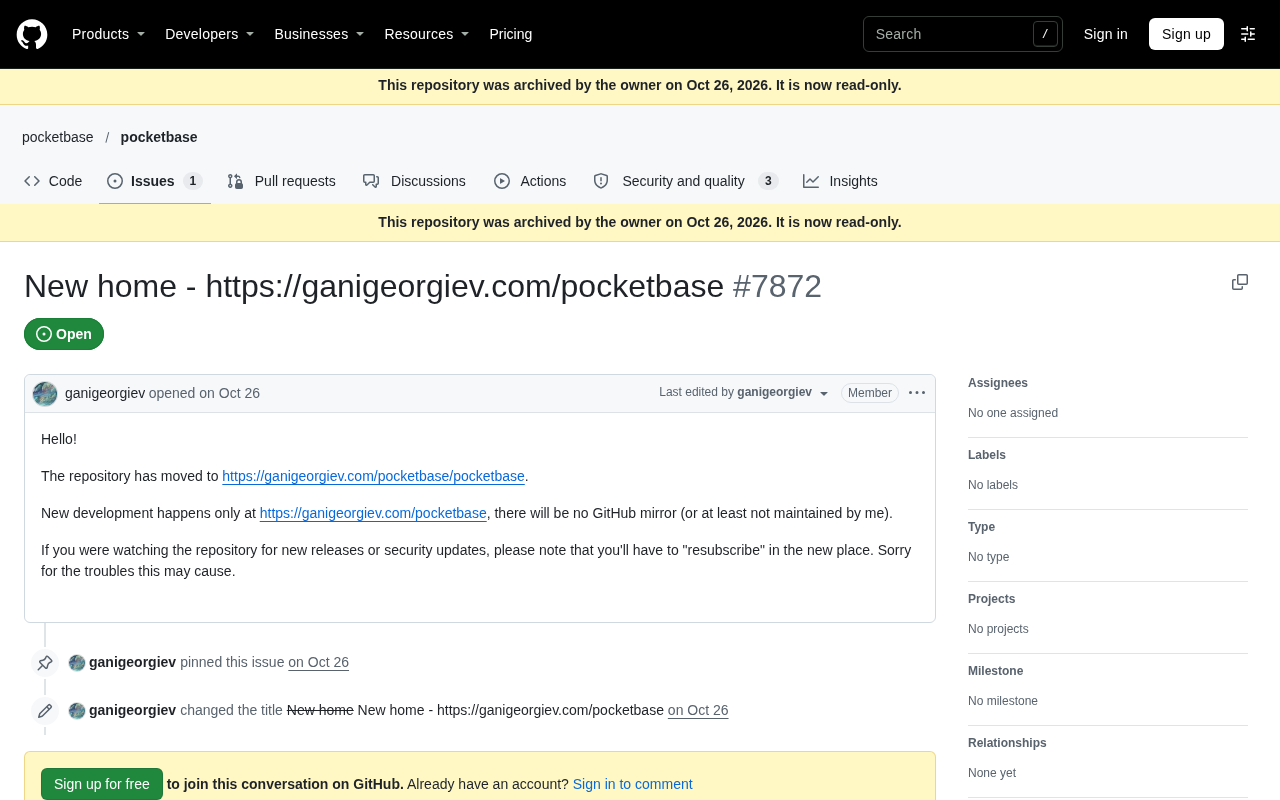
PocketBase is an open-source backend written in Go that combines a database, realtime subscriptions, authentication, and file storage in one, and is often used by developers as a lightweight Firebase alternative. According to information published on its GitHub issue page, the project has decided to move its development focus away from GitHub. The discussion on Hacker News quickly clustered together, with close to a hundred comments, indicating that this decision has generated genuine disagreement within the developer community.
Based on public information, the reason for the migration is not a technical failure but is closer to a comprehensive consideration of platform governance, project control, and long-term collaboration methods. The issue itself became a hub for information, which also shows from another angle how sensitive developers are to changes in a project's infrastructure.
PocketBase's architecture deserves a brief elaboration: it is distributed as a single executable, embeds SQLite as its default database, and includes an Admin UI, REST/Realtime API, and an email-based authentication system. This "all-in-one" design means developers do not need to assemble a database, authentication, and file service themselves, which is why it is often compared with Firebase and Supabase. Its Go implementation also means lower resource usage and a simpler deployment path, which is especially attractive in self-hosted scenarios. Understanding this helps grasp the weight of the migration event: for a project that emphasizes self-hosting and controllability, infrastructure autonomy is highly consistent with its product philosophy, and the migration is not an improvised move but a choice in line with the project's positioning.
Why a Hosting Address Sparks Debate
GitHub has long been more than just a code repository; it simultaneously handles issue tracking, code review, continuous integration entry points, and community discovery. For small and medium-sized open-source projects, GitHub stars and search weighting are almost the main source of project exposure. Once a project migrates, it must face not only a toolchain switch but also the need to rebuild community traffic and contributor habits.
This is the core tension of the discussion: the platform brings convenience and traffic, but also dependency. When a project grows to a certain stage, maintainers begin to weigh changes in platform rules and misalignment between the platform's feature roadmap and their own needs. PocketBase's choice is therefore seen by many commenters as an expression of attitude rather than merely an engineering decision.
According to viewpoints in the Hacker News discussion, supporters believe projects should take the initiative over their own infrastructure, while opponents worry that migration will raise the barrier for new contributors and weaken the project's visibility in the developer community.
Platform lock-in is the key background for understanding this debate. In the open-source context, it does not refer to restrictions at the code licensing level, but to the collaboration inertia a project builds around a platform: issue history, PR review records, CI configurations, badges, and external links all settle within the platform, and migration means these assets are difficult to carry over intact or require remapping. GitHub's API and ecosystem integrations further deepen this stickiness, as many third-party tools default to using GitHub repository addresses as project identifiers. Therefore, the real cost of migration often lies not in moving code but in rebuilding the collaboration network and discovery paths formed around the code, which also explains why a change of hosting address is interpreted as a decision with governance implications.
Practical Impact on Developers
For developers using PocketBase, the most direct change is that the entry points for getting updates, submitting issues, and participating in discussions have moved. Teams relying on GitHub automation workflows may need to adjust mirrors, notifications, or dependency tracking methods. For product teams embedding PocketBase in production environments, paying attention to the post-migration release cadence and issue handling efficiency is more important than the hosting address itself.
For dependents, a pragmatic approach is to abstract the "project source" into a replaceable configuration item. Teams using Go modules can point to the new code address through replace directives or module proxies; teams deploying containers should confirm whether the image registry has migrated in sync and switch to the new release source and version tag rules in CI. If the project moves to a self-hosted Forgejo or Gitea instance, note that issue numbering and link structures may change, and deep links in documentation need to be checked one by one. A more robust strategy is to subscribe to the project's release announcement channels rather than relying on a single platform's star reminders, and to establish version pinning and local caching for key dependencies to reduce the sudden impact of upstream infrastructure changes.
Rethinking the Relationship Between Open Source Projects and Platforms
PocketBase's migration is not an isolated case. Discussions around platform lock-in, data sovereignty, and governance transparency persist in the open-source community. A project's sustainability depends not only on code quality but also on whether its collaboration infrastructure matches the community size and maintainer capacity.
The value of this event lies in reminding developers that when choosing a technology stack, the collaboration model behind the project is also worth evaluating. An active project that relies heavily on a single platform and a decentralized project with clear governance do not carry the same long-term risk. PocketBase's next steps will become a sample for observing the practice of open-source project autonomy.
One-line Summary
PocketBase moves its development focus off GitHub, sparking discussion about platform autonomy for open-source projects.
Paragraph Summary
The open-source backend project PocketBase has announced that it will no longer use GitHub as its primary development platform. After the news was released via its issue page, it sparked a Hacker News discussion with over two hundred points and nearly a hundred comments. PocketBase is an all-in-one backend written in Go that combines a database, realtime subscriptions, authentication, and file storage, and is often regarded as a lightweight Firebase alternative. The core of the controversy is not a technical failure but the trade-off between platform convenience and project autonomy: GitHub simultaneously handles code hosting, issue tracking, review, and community discovery, so migration means rebuilding traffic and contributor habits. For users, the practical impact centers on adjustments to update access, issue feedback, and automation workflows; the event also reflects the long-standing tension between open-source projects and hosting platforms.
Related articles

Hunter Rescues Educated Youth: The Mountain-Chasing System Launches a New Warm-Hearted Viral Drama Formula
Bilibili's early-access period short drama *Everyone Thinks I'm a Poor Hunter* opens with a snowy-night rescue of an educated youth. Hunter Chen Shan activates the mountain-chasing system, using realistic hypothermia first-aid details and mutual-probing character dynamics to deliver a warm-hearted period drama without the sleaze.

Riemann Hypothesis Proven by AI? The Truth Has Nothing to Do With Your Reality
34-year-old mathematician Levent Alpöge claims to have proven the Riemann Hypothesis and Generalized Riemann Hypothesis with Claude, releasing 17 million lines of formal verification code. This article sorts out the facts, debunks myths about RSA collapse and new material revolutions, and analyzes the true significance of mathematics-AI collaboration.

G3 Test Drive Gone Wrong: Why Is the "Dog Poop Gun" So Hard to Use?
Bilibili creator tests the G3 rifle, from skeleton barrel and 50-round drum to combat failure, calling it a "dog poop gun." Analyzing the gap between mods and real gameplay.