Poco F9 Ultra vs Samsung S26 Ultra: Gaming Thermals and Battery Life Tested

Poco F9 Ultra beats Samsung S26 Ultra on gaming battery and thermals thanks to its 8050mAh cell and 100W fast charging.
This article documents a 30-minute gaming endurance comparison between the Samsung Galaxy S26 Ultra and Poco F9 Ultra, running Honkai: Star Rail at max settings from 80% battery. Poco F9 Ultra edged out the S26 Ultra on thermal control and dominated on battery life — ending at 73% versus the S26 Ultra's 66%. With an 8050mAh battery and 100W fast charging, Poco's real-world gaming stamina advantage is even more pronounced than the numbers suggest.
Two flagships from very different positions go head-to-head — the Samsung Galaxy S26 Ultra and the Poco F9 Ultra — in a 30-minute high-intensity gaming endurance test. The goal is straightforward: measure how each device handles heat and battery drain under sustained gaming load.
Test Setup and Conditions
To keep things as fair as possible, both devices started at 80% battery and ran Honkai: Star Rail at maximum graphics settings. The test duration was fixed at 30 minutes, with in-game routes and actions kept as consistent as possible to minimize variables.
This setup tests two key dimensions simultaneously: thermal management under prolonged gaming, and battery consumption over the same period. One caveat worth noting upfront — the Poco F9 Ultra has a built-in advantage on the battery side, thanks to its massive 8050mAh cell, which alone puts it ahead of most competitors before the test even begins.
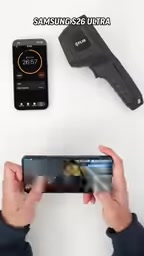
Thermals: Poco Takes a Slight Edge
After 30 minutes of gaming, the tester read the surface temperature of the Samsung S26 Ultra, then compared it against the thermal imaging data for the Poco F9 Ultra. The results showed that the Poco F9 Ultra ran slightly cooler than the S26 Ultra.
For gamers, thermal control matters beyond just comfort in hand — it directly affects long-term performance stability, since excessive heat can trigger throttling and cause frame rate dips. Poco's lead in this area suggests it may sustain more consistent output under prolonged high-load scenarios.
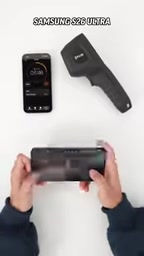
Differences in smartphone thermal performance typically come down to internal cooling architecture. Modern flagship phones commonly use Vapor Chamber (VC) cooling systems, which spread heat away from the chip across a larger area through liquid evaporation and condensation cycles. Both the Poco F9 Ultra and Samsung S26 Ultra feature VC cooling, but the chamber size, coverage of thermally conductive materials (such as graphene layers), and the thermal conductivity of the mid-frame all play a role in the final result. The processor's power limit setting is also critical — manufacturers can cap peak power consumption through software to achieve lower operating temperatures, meaning a "better" thermal result can sometimes come at the cost of deliberate performance trade-offs. It's also worth noting that thermal imaging measures surface temperature, which differs from the chip's junction temperature, so a lower surface reading doesn't necessarily mean the chip is under less stress.
Battery Life: The Big Battery Dominates
Both devices started at 80% (with matching starting states confirmed on screen). After 30 minutes of gaming, the gap was clear: the Poco F9 Ultra ended at 73%, while the Samsung S26 Ultra landed at 66%. In other words, Poco consumed roughly 7% of battery, while the S26 Ultra consumed 14%.
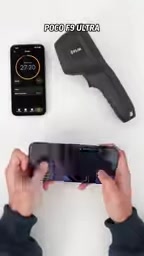
This result isn't surprising. The 8050mAh battery gives Poco a natural endurance advantage — even if the percentage gap looks somewhat modest, the larger battery base means Poco's actual playable game time will be significantly longer.
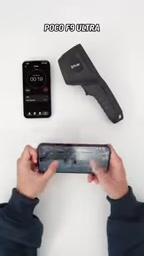
The relationship between battery capacity and battery life isn't purely linear — it's also shaped by screen power consumption, processor efficiency, and system scheduling strategies. The Samsung S26 Ultra runs a Snapdragon 8 Elite (or the equivalent Exynos flagship chip depending on region), and the Poco F9 Ultra is also built on the Snapdragon 8 Elite platform, so their silicon foundations are comparable. In this context, the battery capacity difference becomes the primary variable driving the endurance gap. In percentage terms, the S26 Ultra consumed 14% versus Poco's 7% — already a 2x difference. Converting to absolute milliamp-hours, assuming the S26 Ultra has roughly a 5000mAh battery, it consumed approximately 700mAh, while Poco's 8050mAh battery at 7% equals about 563mAh — indicating the S26 Ultra's actual power draw per unit time is also slightly higher, not purely a result of the smaller battery.
Charging Speed: 100W Fast Charging Tops It Back Up Quickly
When it's time to recharge, the Poco F9 Ultra supports 100W fast charging, and the test shows the battery percentage climbing rapidly in real time. This high-power charging further strengthens its practicality for extended use — a short break is enough to bring battery levels back to a meaningful level.
100W fast charging is one of the mainstream high-power charging specs in the premium Android space, and has been widely adopted across flagships from Chinese brands (Xiaomi, OPPO, vivo, etc.). With an 8050mAh battery, 100W charging can theoretically complete a 0–100% charge in around 50 minutes (slightly longer in practice due to thermal management intervention). By comparison, Samsung's Galaxy lineup has long maintained a 45W charging ceiling, putting it noticeably behind Chinese brands in refill speed. It's worth noting that high-power charging places greater thermal stress on the battery, and the long-term impact of frequent fast charging on battery cycle life remains a consumer concern — though most mainstream fast charging implementations now include charging protection algorithms to mitigate this.
Verdict: Two Flagships, Two Different Missions
Based on this test, the Poco F9 Ultra delivers strong results in the specific scenario of gaming endurance — larger battery, slightly better thermals, and 100W fast charging all make it a compelling option for heavy gamers. The Samsung S26 Ultra, as a comprehensive flagship, clearly offers value well beyond gaming performance alone.
It's worth reiterating that this test focused narrowly on gaming thermals and battery life — with a single sample and limited duration — and did not cover other important areas like display quality, camera performance, or software experience. For users whose primary concern is gaming, Poco F9 Ultra's big-battery approach is worth serious consideration. But a complete evaluation of either device requires data across many more dimensions.
Related articles

Understanding DeepSeek in 3 Minutes: The Rise from a Quant Hedge Fund to an Open-Source AI Leader
DeepSeek's history in 3 minutes: from High-Flyer Quant's compute build-up to V2's MLA inference cost cuts, V3's $5.576M training bill, R1's open-source global shock, and V4 with a $7B Series A.

Local Creative Writing Model Showdown: Fine-tuned Qwen3.8 27B Wins, DeepSeek v4.1 Underwhelms
Bilibili creator tests seven local creative writing models: Hemingway and HumanLike Chat based on Qwen3.8 27B perform best, DeepSeek v4.1 is plain, Dongfang Shuo ranks last with confused characters. Includes three test prompts, scores, and usage advice.

Liang Wenfeng's Three Big Bets: Why Did DeepSeek Open-Source Its 82% Gross Margin?
Why did DeepSeek open-source DeepInfer, its 82% gross margin inference framework, and then launch a hundred-billion funding round? An analysis of Liang Wenfeng's three big bets and the open-source strategy.