Podcast Master Jad Abumrad's Unconventional Passions: Butterfly Knives and Spring Pillows
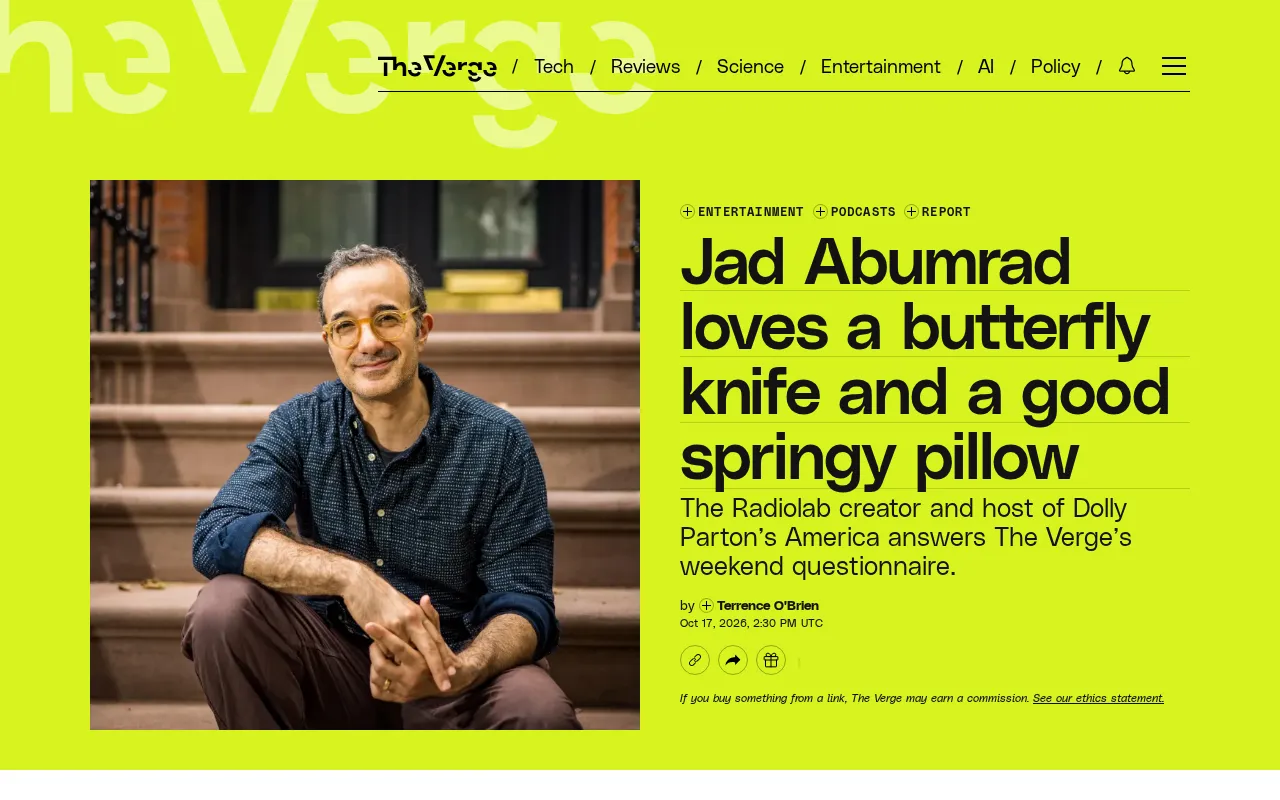
Podcast pioneer Jad Abumrad reveals the state management philosophy of creatives through butterfly knives and spring pillows.
The article focuses on podcast pioneer Jad Abumrad's creative achievements and personal interests. He founded the experimental program Radiolab, revolutionizing audio storytelling grammar, and produced two Peabody Award-winning shows, *Dolly Parton's America* and *Fela Kuti: Fear No Man*. It interprets his love for butterfly knives as a pursuit of precision and balance of danger, and spring pillows as a metaphor for recovery and elasticity, together forming the daily rhythm of creative workers switching between intense production and necessary rest, offering content and life-level implications for podcast creators.
From Radiolab to Music Legend: Jad Abumrad's Podcast Revolution
Jad Abumrad's impact on the podcast world cannot be overstated. He created and hosted two shows, Dolly Parton's America and Fela Kuti: Fear No Man, both of which won Peabody Awards, delving into the lives of two of the most important music icons of the last century in unprecedented ways. Earlier, he founded the experimental program Radiolab, which completely revolutionized the grammar of audio storytelling. According to RSS feed reports, this podcast pioneer recently shared his personal hobbies—butterfly knives and an extremely elastic pillow—revealing another side of him beyond work.
Radiolab is a radio show and podcast launched by WNYC in 2002, originally co-hosted by Jad Abumrad and Robert Krulwich. It broke the linear narrative of traditional radio, heavily using sound design, multi-layered mixing, interruptive dialogue, and philosophical inquiry to weave together science, ethics, and personal stories. Its signature "sound collage" style is considered to have redefined the auditory grammar of podcasts, inspiring a large number of later shows such as Serial and Reply All. Radiolab has won multiple Peabody Awards and is a representative case of public radio's transition into the podcast era.
The Peabody Awards, presented by the Grady College of Journalism and Mass Communication at the University of Georgia and established in 1940, are one of the oldest and most authoritative awards in the field of American electronic media, covering radio, television, podcasts, and online content. They focus on recognizing "good storytelling" and public service value rather than mere ratings or commercial success. Abumrad's two wins with Dolly Parton's America and Fela Kuti: Fear No Man demonstrate that his depth in narrating musical figures has earned dual recognition from both mainstream journalism and the humanities.
Butterfly Knives: The Art of Balancing Danger and Aesthetics
The butterfly knife (balisong) is both a tool and a weapon in Philippine tradition, and its flipping motions require extreme focus and hand-eye coordination. Abumrad's fondness for butterfly knives may resonate with the core philosophy of his podcast creation: finding a delicate balance between chaos and order. Radiolab is known for its fragmented editing, philosophical speculation, and sound experimentation—each episode is like a daring flip: one wrong move and it falls apart, but when successful, it presents a breathtaking fluidity. This fascination with the "edge of danger" is a common trait among creative workers.
Spring Pillows: A Physical Metaphor for the Comfort Zone
Compared to the sharpness of butterfly knives, Abumrad's love for "a good spring pillow" seems particularly soft. This seemingly contradictory combination precisely reflects the dual needs of creative people: they need stimulation and challenge to spark inspiration, but also reliable support to recover their energy. The "elasticity" of a spring pillow is itself a brilliant metaphor—good ideas need resilience, needing to deform under pressure without losing their shape. Abumrad has mentioned in multiple interviews that podcast production is extremely mentally draining work, and physical comfort directly affects creative state.
The Creative Lifestyle from Multiple Perspectives
Reports from a single source often capture only fragments. Combining RSS feed and public interview information, Abumrad's choice of interests is not accidental: butterfly knives represent precision and control, spring pillows represent recovery and elasticity, and together they constitute the daily rhythm of a creative worker—switching between highly intense production cycles and necessary rest. This pattern is not uncommon among top podcast producers, but Abumrad concretizes it into two specific objects, making an abstract work philosophy tangible and perceptible.
Implications for Podcast Creators
For today's podcast creators, Abumrad's case offers references on two levels. On the content level, he proved that experimental storytelling can gain mainstream recognition—Radiolab's fragmented structure has influenced an entire generation of audio producers. On the life level, his personal hobbies remind us that creative output depends not only on skill but also on how creators manage their attention and energy. Butterfly knives require practice, spring pillows require selection—both are investments in "state management."
According to the original report, Abumrad's achievements include two Peabody Award-winning shows and the groundbreaking Radiolab, while his personal interests reveal a more complete portrait of a creator. In today's increasingly competitive audio industry, this focus on "the person" may be more worth pondering than technology itself.
One-line Summary
Podcast pioneer Jad Abumrad reveals the state management philosophy of creatives through butterfly knives and spring pillows.
Paragraph Summary
The article focuses on podcast pioneer Jad Abumrad's creative achievements and personal interests. He founded the experimental program Radiolab, completely changing the grammar of audio storytelling, and produced two Peabody Award-winning shows, Dolly Parton's America and Fela Kuti: Fear No Man. The article interprets his love for butterfly knives as a pursuit of precision and the balance of danger, and views spring pillows as a metaphor for recovery and elasticity; together they constitute the daily rhythm of creative workers switching between intense production and necessary rest. The article further points out that this state management philosophy offers implications for today's podcast creators on both content and life levels, reminding people to focus on the creator themselves rather than just technology.
Related articles

AI Daily: OpenAI and Anthropic Both Publish VP≠VNP Proofs on the Same Day
AI Daily roundup: OpenAI and Anthropic both publish machine proofs of VP≠VNP on the same day, Anthropic breaks below its IPO price, GPT-6 achieves a 10.9% wet-lab hit rate in native protein design, Magic 2 and SWE 2.1 launch, Google Workspace MCP opens, agent safety tests and the purge of pure AI songs advance together.

GPT-6 Protein Design Sparks Debate: Can General Models Replace Specialized Biological Models?
OpenAI preprint shows GPT-6 series attempts protein design via general reasoning—about 10% of 300+ designs show binding signs, but screening still relies on specialized models. Plus Anthropic Siren evaluation, Meta assistant as entry point, and TIDAL removing pure AI music.

Anthropic Breaks IPO Price, GPT-6 Designs Proteins Autonomously: AI Bubble Alarm Sounds
Anthropic falls below its $83 IPO price four days after listing, wiping out all gains from the largest IPO ever; OpenAI paper shows GPT-6 autonomously designing proteins validated in labs; Claude Ship can fix code and approve. A quick look at key AI industry moves and capital signals.