Polaris Open Source Project: Building a Cursor Clone AI Code Editor from Scratch
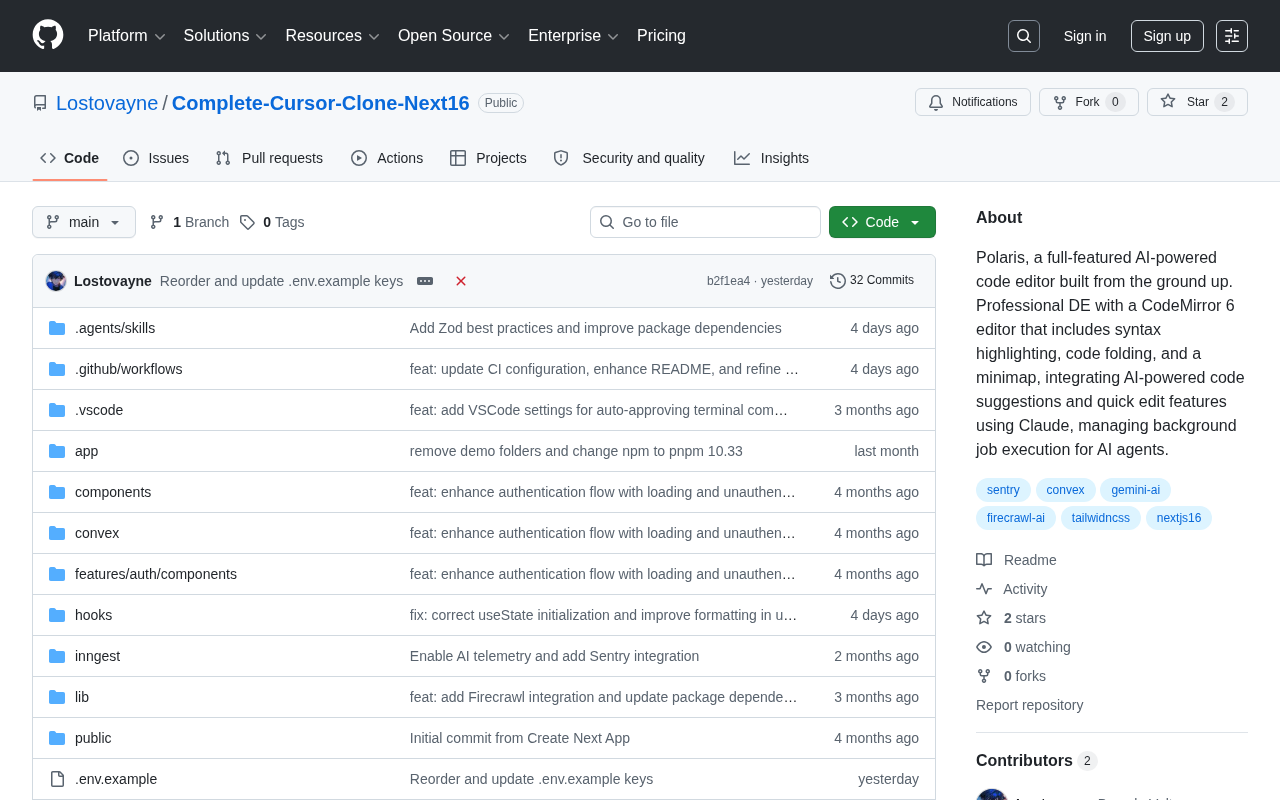
Polaris is an open-source AI code editor cloning Cursor's core features using Next.js and CodeMirror 6.
Polaris is an open-source AI code editor built from scratch with Next.js 16, TypeScript, and CodeMirror 6, aiming to fully clone Cursor's core functionality. It integrates Claude AI models for intelligent code suggestions and natural language quick editing, and implements a background Agent task management system. While still in early stages, the project offers developers a rare opportunity to understand complete AI editor architecture and reflects the open-source community's trend toward democratizing AI editor capabilities.
Project Overview: What is Polaris
Polaris is a fully-featured AI-powered code editor built from scratch, aiming to completely clone Cursor's core functionality. The project is developed with Next.js 16 and TypeScript, integrates the CodeMirror 6 editor engine, and provides intelligent code suggestions and quick editing capabilities through Claude AI models.
For developers following the AI editor ecosystem, this open-source project offers a rare learning opportunity — gaining deep insight into the complete architecture design of modern AI code editors, rather than just staying at the usage level.
Core Tech Stack Deep Dive
CodeMirror 6 Editor Engine
Polaris uses CodeMirror 6 as its underlying editor engine — a completely rewritten, modern code editor framework. CodeMirror 6 was released by renowned developer Marijn Haverbeke in 2021, is fully incompatible with the previous version (CodeMirror 5), and adopts a functional, immutable state architecture. Its core innovation is the introduction of the Lezer parsing system — an incremental, error-tolerant parser generator that only re-parses changed portions as users type, rather than the entire document. This means syntax highlighting and code analysis maintain millisecond-level responsiveness even for files with tens of thousands of lines. CodeMirror 6's extension system is based on a Facet mechanism, allowing multiple extensions to compose declaratively and avoiding the conflict issues common in traditional plugin systems. It's currently widely used in well-known products like Replit, Observable, and Chrome DevTools.
Compared to its predecessor, CodeMirror 6 represents a quantum leap in both performance and extensibility:
- Multi-language syntax highlighting: Supports precise syntax coloring for mainstream languages like JavaScript, Python, Go, and more
- Code folding: Allows developers to collapse code blocks, improving readability of large files
- Minimap code overview: Provides a global file view for quick positioning and navigation
These features combine to form a professional-grade development environment, closely matching the experience of mainstream editors like VS Code and Cursor.
Claude AI Integration
Polaris's AI capabilities are built on Anthropic's Claude model, providing two core features:
- AI code suggestions: Real-time intelligent completions during coding, similar to Cursor's Tab completion feature, predicting developer intent based on context
- Quick Edit: Modifying selected code snippets through natural language descriptions, significantly reducing the operational cost of refactoring and modifications
Claude is a large language model series developed by Anthropic, renowned for its outstanding performance in code understanding and generation. Anthropic was founded by former OpenAI Research VP Dario Amodei, focusing on AI safety research. A key technical feature of Claude models is their ultra-long context window (Claude 3.5 Sonnet supports 200K tokens), which is particularly important for code editor scenarios — it means the AI can simultaneously "see" multiple files across an entire project, providing more accurate cross-file code suggestions. At the API level, Claude supports streaming responses, allowing code suggestions to be progressively presented to users rather than waiting for complete generation before display — this is crucial for editor interaction experience.
Background Agent Task Management
The project implements a background job execution management system for AI Agents. AI can asynchronously handle complex code generation, refactoring, and other tasks in the background without blocking the user's normal editing operations. This design is fully consistent with Cursor's Background Agent feature concept and represents an important development direction for current AI editors.
Background Agent is a significant innovation direction in the AI editor space during 2024-2025. Traditional AI-assisted coding is synchronous — users send requests, wait for AI responses, then continue working. The Background Agent pattern allows AI to asynchronously execute complex tasks in independent sandbox environments, such as large-scale refactoring across multiple files, automatically fixing test failures, generating complete feature modules, etc. Cursor launched this feature in early 2025, allowing users to start multiple Agent tasks simultaneously, each working on an independent code branch. This pattern essentially elevates AI from "copilot" to "independent engineer," capable of autonomously planning, executing, and verifying code changes, with users only needing to review and merge results at the end.
Technical Architecture Analysis
From the repository name "Complete-Cursor-Clone-Next16," it's clear that Polaris uses Next.js 16 as its application framework. This technology choice brings several key advantages:
- Full-stack capability: Next.js's Server Components and API Routes handle both frontend rendering and backend AI calls simultaneously, eliminating the need for separate backend services
- Modern deployment: Can be deployed directly to platforms like Vercel, reducing operational complexity
- TypeScript-first: The entire project is written in TypeScript, ensuring type safety and long-term maintainability
Next.js is a React full-stack framework maintained by Vercel, holding a dominant position in the frontend ecosystem. Its App Router architecture introduces React Server Components (RSC), allowing components to directly access databases and APIs during server-side rendering without traditional REST/GraphQL intermediate layers. For AI editor applications, this means AI API calls can be executed securely on the server side (API keys not exposed to clients), while Server Actions enable type-safe frontend-backend communication. Notably, building code editors with web technologies is a proven path — VS Code itself is based on Electron (Chromium + Node.js), while GitHub Codespaces and Gitpod run entirely in the browser.
This architectural design allows a single developer to manage the entire project while maintaining code quality.
Learning Value and Current Limitations
Developer Learning Value
For developers wanting to understand how AI code editors work, Polaris provides a complete reference implementation:
- How to integrate large language models into editor workflows
- CodeMirror 6 plugin and extension development patterns
- Architecture design approaches for AI Agent background tasks
- Practical experience building desktop-grade applications with modern web tech stacks
Current Limitations
The project is still in its early stages (low star count), and the following points should be noted:
- Insufficient community validation; stability and compatibility issues may exist
- Feature completeness still has an obvious gap compared to the commercial product Cursor
- Lacks detailed deployment documentation and usage guides
Industry Significance for the AI Editor Ecosystem
With the rise of AI editors like Cursor and Windsurf, the open-source community's attempts to replicate such tools are growing. Polaris represents a clear trend: developers want to understand and control the core technology of AI editors through open source, rather than merely being passive users of commercial products.
As of mid-2025, the AI code editor market has formed a clear competitive landscape. Cursor (developed by Anysphere) has achieved a valuation of over $600 million and hundreds of thousands of paying users through its deep AI integration on top of VS Code. Windsurf (formerly Codeium) competes for market share with a free-tier strategy. GitHub Copilot, as the earliest AI coding assistant, is evolving from a plugin model toward a standalone editor direction. Meanwhile, open-source community alternatives are rapidly emerging, such as Void (open-source Cursor alternative) and Continue (open-source AI coding plugin). The common characteristic of these projects is attempting to democratize the core capabilities of AI editors, enabling developers and enterprises to independently control their AI coding toolchains and avoid dependency on a single commercial product.
The emergence of such projects also demonstrates that the technical barrier to building a basically functional AI code editor is rapidly decreasing. Thanks to mature editor frameworks (CodeMirror 6) and powerful AI APIs (Claude), individual developers can build prototype systems with core functionality.
For teams evaluating AI programming tools or considering building internal tools, Polaris's architectural design is worth referencing and learning from.
Key Takeaways
- Polaris is an AI code editor built from scratch with Next.js 16 and TypeScript, aiming to fully clone Cursor's core functionality
- Uses CodeMirror 6 as the editor engine, supporting professional features like syntax highlighting, code folding, and minimap
- Provides intelligent code suggestions and natural language quick editing through Claude AI model integration
- Implements AI Agent background job execution management, supporting asynchronous processing of complex code tasks
- The project is in early stages but holds significant learning value, demonstrating the complete architecture design approach for AI editors
Related articles
 Product Reviews
The Programmer's Desk Setup Guide: Building a Workspace That Feels Like Home
Discover how programmers build productive, comfortable workspaces. From multi-monitor setups to ergonomic design, explore the desk philosophy that drives focus and flow.
 Product Reviews
Qoder vs Cursor Real-World Comparison: Which $20/Month AI IDE Is Better?
Hands-on comparison of Qoder vs Cursor AI IDEs: Agent autonomy, human interaction count, and architecture decisions. Qoder needed only 2 interactions vs Cursor's 8.
 Product Reviews
Cursor Cloud Agent Demo: Eliminating Bottlenecks Across the Entire Software Development Lifecycle
Deep analysis of Cursor's Cloud Agent demo showing how cloud VMs, automated test artifacts, and a full-chain control plane systematically eliminate human bottlenecks across the software development lifecycle.