Policy Lens: Using Local AI to Uncover the Hidden Traps in Insurance Policies

Open-source tool Policy Lens uses a local LLM to parse insurance PDFs, spot exclusions, and answer questions.
Policy Lens, submitted by developer manjushapirati030 to the Hacktoberfest open-source AI challenge, uses a local LLM to tackle the information asymmetry caused by insurance contracts' dense legal jargon. It uploads health, life, and auto insurance PDFs, extracts key parameters like coverage, deductibles, co-pays, and waiting periods, scans for hidden exclusions and denial risks, and lets users query their own policies. Built on Ollama with the Gemma model running fully locally, it keeps sensitive data on-device to meet compliance needs. Monetization spans B2B subscriptions ($29–99/month), B2C micro-transactions ($5–10/report), and enterprise private deployment. Key challenges include PDF format diversity and the risk of AI misjudgments affecting user decisions.
Insurance contracts' "fine-print legalese" has long been a nightmare for consumers—you think you've bought comprehensive coverage, only to discover a pile of exclusions waiting for you when you file a claim. Policy Lens, submitted by developer manjushapirati030 to the Hacktoberfest open-source AI challenge, aims to automate this process using a local large language model.
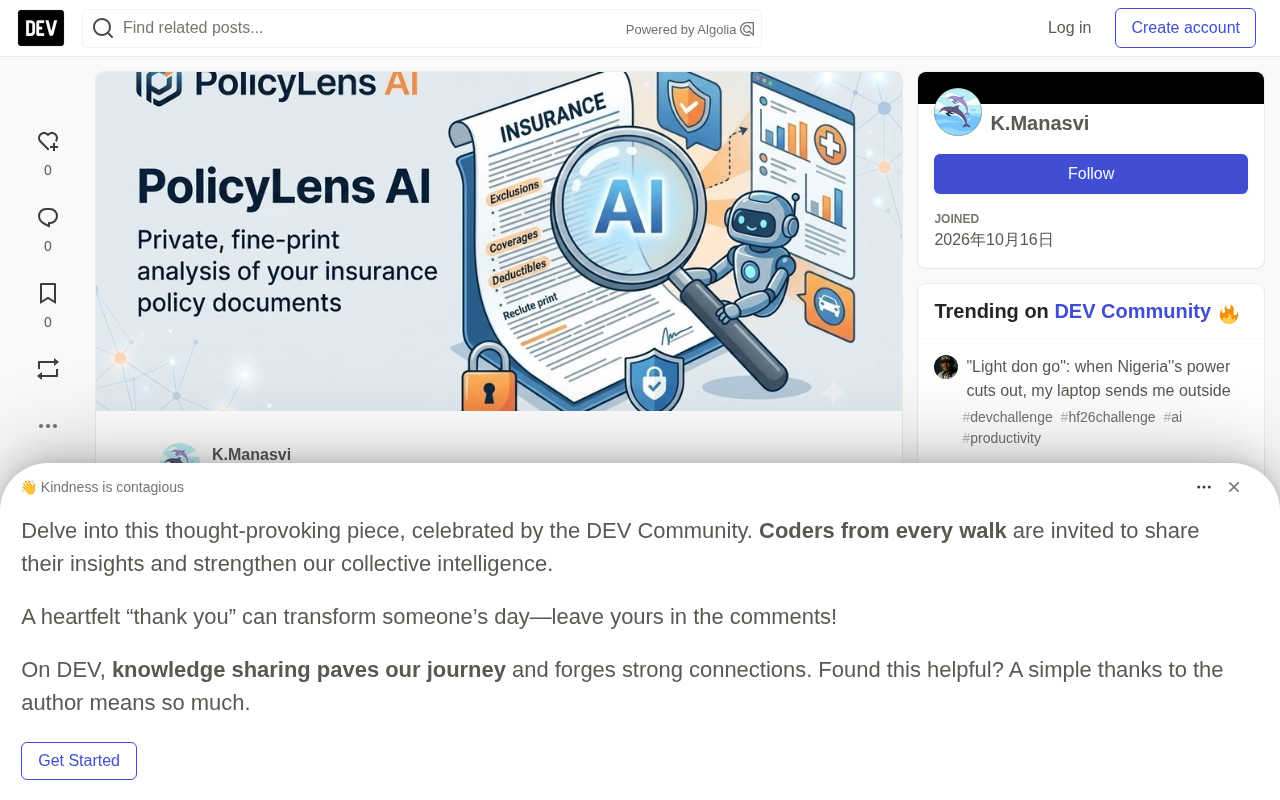
What problem does it solve
The complexity of insurance terms is no accident. The author of Policy Lens states plainly in the project description: insurance contracts are "deliberately written in complex legal jargon," leading consumers to mistakenly believe they have certain coverage when they actually don't. This information asymmetry is precisely the tool insurers use to control their payout ratios.
Another pain point comes from industry professionals. Insurance brokers and financial advisors need to read through 50+ page policy documents page by page to assess coverage scope or make product comparisons—a process that often takes hours. Policy Lens hopes to hand this kind of repetitive "close reading" work over to AI.
Privacy is equally critical. Policies contain highly sensitive information such as personal health and financial data, and uploading them to cloud AI services carries compliance risks. Policy Lens chooses to run entirely locally, which is a hard requirement in heavily regulated industries like insurance and healthcare.
Core features breakdown
Document parsing and structured extraction
Policy Lens supports uploading PDF policies for health, life, auto, and property insurance, automatically extracting key parameters such as coverage limits, co-pay, deductible, and waiting periods. This data is the foundation for judging a policy's actual value—many people only look at premiums and coverage amounts, ignoring how deductibles and waiting periods affect actual claims.
Exclusions and "red flag" detection
This is the most valuable part of the entire tool. It automatically scans contracts, flagging hidden exclusion clauses, restrictive conditions, and risk points where claims might be denied. Traditionally this work relies on manual clause-by-clause comparison, whereas AI's scanning speed and consistency are theoretically superior to fatigued human review.
Co-pay, deductible, and waiting period: three most easily overlooked keywords
A deductible is the fixed amount the insured must pay out of pocket before a claim is triggered; the insurer only covers costs beyond that amount. For example, with an auto policy that has a 10,000 yuan deductible, if repairs cost 8,000 yuan, the insurer pays nothing. A co-pay typically appears in health insurance and refers to the portion the insured bears per visit or prescription as a fixed amount or percentage—directly tied to the reimbursement ratio. A waiting period is a stipulation that specific illnesses are not covered for a certain period after the policy takes effect; health insurance commonly has 30–180 days, and life insurance can be as long as two years. These three parameters significantly raise the actual claims threshold, and many consumers look only at coverage amounts and premiums, precisely overlooking their eroding effect on "what you actually get paid." Policy Lens makes these three its top structured-extraction targets, precisely capturing the part of policy valuation most easily obscured by sales talk.
Interactive Q&A
Users can ask questions directly to their own policy, such as "Is water damage from a pipe leak covered?" The system gives context-relevant answers based on the specific content of that policy, rather than generic insurance knowledge. This RAG (retrieval-augmented generation) style of interaction is a typical pattern for current LLM deployment.
Why RAG suits insurance scenarios
The core idea of RAG (Retrieval-Augmented Generation) is: instead of cramming all knowledge into model parameters, retrieve relevant fragments from an external knowledge base before answering, then have the LLM organize an answer based on those fragments. For insurance Q&A, this brings two direct benefits. The first is fact anchoring: the model's answers must cite specific clauses from the policy rather than "making things up" from general insurance common sense, greatly reducing hallucination risk. The second is updatability: policy terms may be revised at any time—you only need to replace documents in the retrieval base, no model retraining required. Compared with direct fine-tuning, RAG has lower deployment costs and is also better suited to a scenario like Policy Lens, which processes a single policy at a time and requires precise citations.
Local inference architecture
The backend uses Ollama to drive the Gemma model, and sensitive files never leave the local machine. This means it can be used without an internet connection, and it eliminates enterprise clients' data compliance concerns. Choosing Gemma rather than a larger model suggests the developer values the feasibility and inference cost of local deployment over absolute language understanding capability.
What Ollama and Gemma are
Ollama is an open-source local LLM runtime that wraps model downloading, quantization, loading, and inference into a single command—developers can run an LLM on a laptop without wrestling with CUDA or inference frameworks themselves. Gemma is Google's open-source lightweight model family, with parameter counts ranging from 2B to 27B, designed to run on consumer-grade hardware. Compared with cloud LLMs like GPT-4, Gemma falls short in language understanding, but its advantages are that it can run fully offline, requires no per-token fees, and keeps data on the local machine. Policy Lens's choice of this combination is essentially a clear trade-off between "understanding precision" and "privacy + cost"—for relatively standardized tasks like structured information extraction, a lightweight model is often sufficient; for exception judgments requiring complex legal reasoning, it may fall short.
Who is willing to pay for it
The author lays out a clear commercialization tiering.
The B2B direction targets independent insurance brokers, financial planners, corporate HR benefits teams, and legal and public adjuster organizations. The core need of these users is efficiency—quickly reviewing client policies, identifying coverage gaps, and generating comparison reports. The author envisions a SaaS subscription price between $29 and $99 per month.
The B2C direction targets individual policyholders, with the typical scenario being a "checkup" before renewal or before filing a claim to avoid unexpected denials. The pricing model is single micro-transactions, $5 to $10 per report.
There is also local deployment enterprise licensing for regional insurance institutions—targeting clients that cannot use cloud services due to regulatory requirements. Although this direction has a long sales cycle, it offers the highest deal size and stickiness.
A pragmatic but unproven path
Judging from the project description, Policy Lens's product approach is pragmatic: choose a local model to solve privacy issues, choose insurance documents as a high-value vertical scenario, and plan a complete monetization path from B2C micro-transactions to B2B subscriptions to enterprise private deployment.
Several key questions remain unverified. Insurance clause PDF formats are extremely diverse—layout and terminology systems vary greatly across insurers—so whether extraction accuracy can reach a practical level is the first hurdle. Second, if AI-flagged "red flag" clauses are misjudged, the impact on users' actual decisions could be worse than not flagging them at all. Finally, local inference with Ollama + Gemma places non-trivial hardware demands on ordinary consumers, which may limit C-end user acquisition.
The project code is already open source on GitHub—those interested can deploy and test it themselves.
One-line Summary
Open-source tool Policy Lens uses a local LLM to parse insurance PDFs, identify exclusions, and support Q&A.
Paragraph Summary
Policy Lens is a project submitted by developer manjushapirati030 to the Hacktoberfest open-source AI challenge, aiming to use a local LLM to address the information asymmetry caused by insurance contracts' "fine-print legalese." It supports uploading PDF policies for health, life, and auto insurance, automatically extracting key parameters such as coverage amounts, deductibles, co-pays, and waiting periods, focusing on scanning hidden exclusions and claim-denial risk points, and allowing users to ask questions about the specific content of their own policies. On the tech stack, it uses Ollama to drive the Gemma model entirely locally, so sensitive files never leave the machine, meeting compliance requirements in heavily regulated industries. The commercialization path has three tiers: B2B subscriptions for insurance brokers and financial advisors ($29–99/month), single-report micro-transactions for individuals ($5–10), and private deployment licenses for regional institutions. The main challenges are the diversity of PDF formats testing extraction accuracy, and the potential negative impact of AI misjudgments on user decisions.
Related articles

Kimi K3.1 Hands-On Test: Open-Source Model Nears Opus, Video Generation Steals the Show
Kimi K3.1 completed motion graphics, 3D rendering, mini-games, and video generation in a live test. Analysis of its 2.8T MoE architecture, gap vs Opus/GPT, and hidden video generation.

Sam Altman: Why Life's Biggest Advice Should Still Come from Humans
OpenAI CEO Sam Altman on the limits of AI advice: AI can talk you out of an impulsive email, but life's biggest advice should still come from humans.

"Black October": Did AI Uncover 3% of All Critical Vulnerabilities Ever?
A Reddit post claims 3% of all critical software vulnerabilities ever were found in the past month, dubbed 'Black October.' We break down the statistical issues, how AI-assisted code auditing accelerates discovery, and how developers should respond.