PolicyIK: Reinforcement Learning for High-Precision Robotic Arm Inverse Kinematics

PolicyIK uses reinforcement learning to directly learn high-precision inverse kinematics, achieving 1mm/0.2° error in simulation and enabling robots to execute VLA commands.
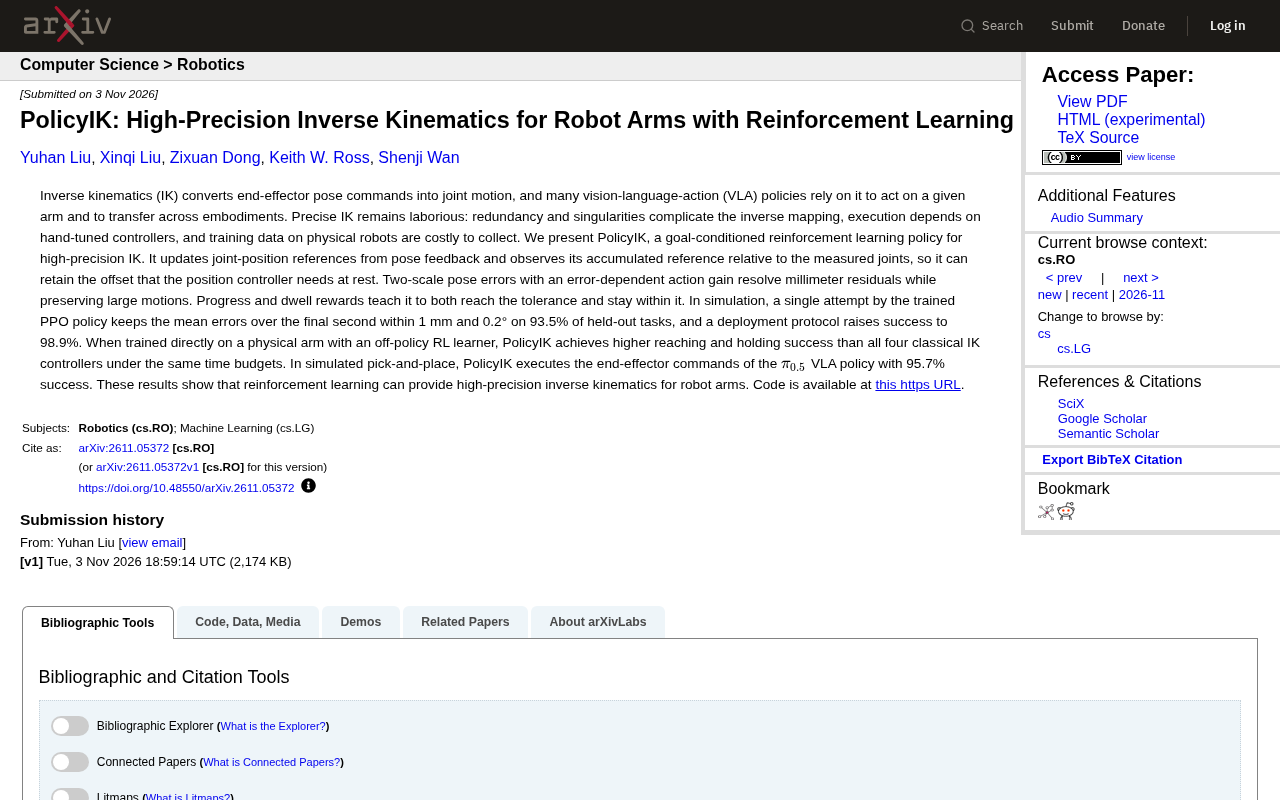
PolicyIK is a new paper that tackles high-precision inverse kinematics (IK) with reinforcement learning. Traditional IK suffers from redundant degrees of freedom, singularities, and hand-tuned controllers, and collecting data on physical robots is costly. PolicyIK is designed as a goal-conditioned reinforcement learning policy that updates joint references via pose feedback and preserves the offset required by the position controller, uses dual-scale pose error with error-dependent action gain to resolve millimeter-level residuals, and employs progress and dwell rewards to ensure reaching and holding. In simulation, a single attempt by the PPO policy achieves, on 93.5% of held-out tasks, an average error over the last 1 second of 1mm and 0.2°, and a deployment protocol raises the success rate to 98.9%; after training on a physical robotic arm, the success rates for reaching and holding are higher than four classical IK controllers, and it executes π_{0.5} VLA policy end-effector commands with a 95.7% success rate. The code is open-sourced.
Inverse kinematics (IK) is a fundamental problem in robot control: it converts end-effector pose commands into joint motions, and many vision-language-action (VLA) policies rely on it to drive robotic arms and achieve cross-embodiment transfer. However, implementing high-precision IK has always been laborious—redundant degrees of freedom and singularities complicate the inverse mapping, real-world execution depends on hand-tuned controllers, and collecting training data on real robots is costly. A new paper proposes PolicyIK, which attempts to tackle this problem directly with reinforcement learning and presents impressive precision figures.
Background: Why High-Precision IK Is So Hard
Traditional IK solvers face several difficulties. Robotic arms often have redundant degrees of freedom, so the same end-effector pose may correspond to infinitely many joint angle sets, and the inverse mapping is not unique; near singularities, the Jacobian matrix degenerates and numerical solutions tend to become unstable. Even after solving for joint angles, real-world execution relies on carefully tuned position controllers to turn commands into stable physical motion. More challenging still, if one wants a learning-based solution for a specific robotic arm, collecting training data on a physical robot is both slow and expensive.
These factors combined mean that "millimeter-level, sub-degree-level" IK precision often requires extensive manual engineering. PolicyIK's starting point is: can a goal-conditioned reinforcement learning policy directly learn high-precision IK and eliminate dependence on hand-tuned controllers?
Redundant degrees of freedom and null space: When a robotic arm has more joints than the degrees of freedom required for a task (e.g., a 7-DOF arm positioning a 6-DOF pose in 3D space), the same end-effector pose corresponds to infinitely many joint angle solutions, which form the "null space" in joint space. The existence of the null space makes the inverse mapping non-unique, but it also provides room for optimization such as obstacle avoidance and singularity avoidance; however, for learning-based methods, it means the policy must learn on its own to select a smooth, executable trajectory among many feasible solutions rather than simply fitting a deterministic mapping.
Singularities and Jacobian degeneration: The Jacobian matrix describes the linear mapping from joint velocities to end-effector velocities. When the robotic arm extends near the workspace boundary or certain joints become collinear, the Jacobian matrix becomes ill-conditioned or even rank-deficient; at this point, the end effector cannot move in a certain direction, and a small pose error may require extremely large joint velocities to correct, making numerical solutions prone to divergence or severe oscillation. This is precisely the root cause of traditional IK instability near singularities and the difficulty that PolicyIK attempts to circumvent with reinforcement learning.
PolicyIK's Core Design
PolicyIK is defined as a goal-conditioned reinforcement learning policy. It updates joint position references from pose feedback and observes the relative relationship between its own accumulated reference values and measured joint positions—this design allows it to preserve the offset required by the position controller at rest, thereby working well with the low-level controller.
In terms of action and reward design, the paper employs two key techniques. The first is dual-scale pose error combined with error-dependent action gain: maintaining large motion capability for large errors while resolving millimeter-level residuals for small errors. The second is a combination of progress reward and dwell reward—the former teaches the policy to "reach" the tolerance range, and the latter teaches it to "stay" within the tolerance range—which is crucial for tasks requiring stable pose maintenance.
For training, the PPO algorithm is used in simulation; when deployed directly to a physical robotic arm, an off-policy reinforcement learning learner is used.
Goal-conditioned reinforcement learning: Unlike single-task reinforcement learning with fixed rewards, goal-conditioned RL takes the goal (here, the desired end-effector pose) as part of the policy input, training the policy to learn "given any goal, output actions that achieve that goal." In the paper, the policy observes pose feedback and accumulated reference values, precisely incorporating the current goal and execution state into the observation, so that at inference time it can respond to new pose commands without training separately for each goal.
Difference between PPO and off-policy learners: PPO (Proximal Policy Optimization) is an on-policy algorithm that updates itself using data collected by the current policy, suitable for large-scale parallel sampling and stable training in simulation. An off-policy learner, on the other hand, can leverage historical data or experience in a replay buffer, offering higher sample efficiency and being more suitable for scenarios where data collection on a physical robotic arm is expensive and interactions are limited. The paper's choice of these two algorithm types for simulation and real robots respectively is based on the trade-off between sample efficiency and stability.
Experimental Results: Precision and Success Rate
The data presented in the paper is quite convincing. In simulation, a single attempt by the trained PPO policy achieves, on 93.5% of held-out tasks, an average error over the last 1 second within 1 mm and 0.2°. On this basis, a deployment protocol further raises the success rate to 98.9%.
The comparison with classical methods is also noteworthy. When trained directly on a physical robotic arm, PolicyIK achieves higher success rates for both reaching and holding than four classical IK controllers under the same time budget. This means the learning-based approach is not only effective in simulation but can also compete head-to-head with mature traditional methods on real hardware.
Another highlight is the combination with VLA policies: in a simulated pick-and-place task, PolicyIK executed the end-effector commands given by the π_{0.5} VLA policy with a 95.7% success rate. This result suggests that PolicyIK has the potential to serve as the low-level executor for VLA policies, reliably translating high-level semantic decisions into joint space.
Held-out tasks and deployment protocol: Held-out tasks refer to a set of pose goals unseen during training and used only for evaluation; their success rate reflects the policy's generalization ability rather than memorization. 93.5% is the result of a single attempt without additional adjustments; the deployment protocol builds on this by adding a systematic online procedure (such as multi-step execution, error monitoring, or retry mechanisms), further raising the success rate to 98.9%. Distinguishing these two numbers helps understand the precision ceiling of the policy itself versus the reliability after actual deployment.
Significance and Limitations
The value of PolicyIK lies in demonstrating that reinforcement learning can be a viable path to high-precision IK: it bypasses the singularity challenges of numerical solving, reduces dependence on hand-tuned controllers, and demonstrates the ability to rival classical controllers on a physical arm. For VLA systems requiring cross-embodiment transfer, a learning-based IK layer that can automatically adapt to a specific robotic arm is practically attractive.
However, what can be seen from the paper abstract is still mainly precision metrics. The policy's generalization ability across different robotic arm configurations, the specific amount of data and time cost required for training, and its performance in dynamic tasks all require more details for evaluation. The code is open-sourced on GitHub, providing a foundation for subsequent reproduction and extension.
VLA policies and cross-embodiment transfer: Vision-language-action (VLA) policies receive images and language instructions and directly output robot actions. Many VLA systems output end-effector pose increments, which require low-level IK to convert into joint commands. Different robotic arms have different joint configurations and link lengths; if the IK layer can automatically learn to adapt to specific hardware, the same high-level VLA policy can be transferred to different embodiments. PolicyIK's 95.7% success rate in executing π_{0.5}'s end-effector commands indicates that learning-based IK has the potential to serve as this "universal executor" layer, reducing the engineering cost of cross-embodiment deployment.
One-line Summary
PolicyIK uses reinforcement learning to directly learn high-precision inverse kinematics, achieving 1mm/0.2° error in simulation and enabling robots to execute VLA commands.
Paragraph Summary
PolicyIK is a new paper that tackles the challenge of high-precision inverse kinematics (IK) with reinforcement learning. Traditional IK suffers from redundant degrees of freedom, singularities, and hand-tuned controllers, and collecting data on physical robots is costly. PolicyIK is designed as a goal-conditioned reinforcement learning policy that updates joint references via pose feedback and preserves the offset required by the position controller, uses dual-scale pose error with error-dependent action gain to resolve millimeter-level residuals, and employs progress and dwell rewards to ensure reaching and holding. In simulation, a single attempt by the PPO policy achieves, on 93.5% of held-out tasks, an average error over the last 1 second of 1mm and 0.2°, and a deployment protocol raises the success rate to 98.9%; after training on a physical robotic arm, the success rates for reaching and holding are higher than four classical IK controllers, and it executes π_{0.5} VLA policy end-effector commands with a 95.7% success rate. The code is open-sourced.
Related articles

AI Tools Quietly Altering Settings: Postman Silently Installs Plugin, Codex Sharing Option Auto-Resets
AI Daily reports: Postman silently installs a Mac plugin and self-approves startup hooks, logged as auto-existing upgrade; Hacker News developers say Codex data-sharing opt-out flips back. Plus Simon Willison's raw float weight experiment with QEN 3.8-27B.

AI Learns to Rewrite AI: MIT's "Weightspace Programming" Redraws the Path to Recursive Self-Improvement
MIT team proposes weightspace programming: GPT-6 Astra reads and edits AI model weights directly. Math scores jump several-fold, hand-written networks beat trained models. Eight experiments analyzed, plus Anthropic's same-day warning and the real boundaries of recursive self-improvement.

Running Qwen 3.8 on a Laptop to Read Raw Weights: 46 Minutes Per Answer
Simon Willison reproduced weight space programming with Qwen 3.8 27B on a laptop: a 17GB model file, 46 minutes per answer, 43,506 reasoning tokens, Pong over an hour, Freeway failed. Suited for interpretability researchers.