PolicyLens AI: Turning Insurance Policies into Plain English with Local LLMs

Open source PolicyLens AI uses local LLMs to turn insurance contracts into plain summaries and flag exclusion risks.
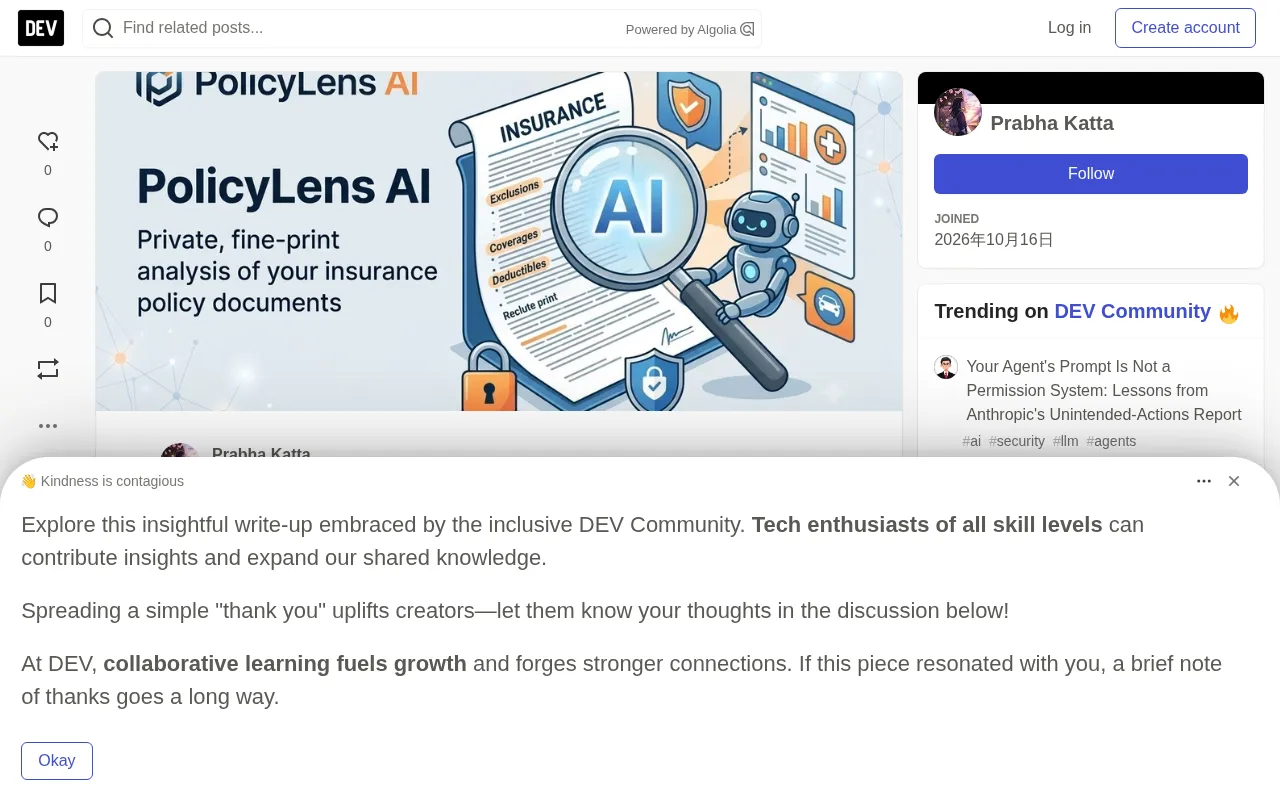
PolicyLens AI is a Hacktoberfest open source project by Manjusha Pirati that uses local LLMs to parse 50-plus-page insurance policies into structured plain summaries. It extracts coverage limits, co-pay, deductible, and waiting periods, scans for hidden exclusions and claim risks, and provides document-grounded Q&A. Running locally on Ollama + Gemma keeps sensitive documents private. The project targets B2B professionals like brokers and advisors, with Freemium, SaaS, and enterprise licensing models.
Insurance contracts have long been a pain point for consumers — you think you've bought comprehensive coverage, only to discover at claim time that a pile of exclusions has shut the risk out. PolicyLens AI, submitted by developer Manjusha Pirati in the Hacktoberfest Open Source AI Challenge, takes direct aim at this problem: using a local large language model to break down 50-plus-page insurance contracts into structured, plain-English summaries.
What It Actually Does
PolicyLens AI positions itself as an automated "fine-print analyzer," with core capabilities built around parsing and Q&A over insurance documents.
Document extraction and parameter structuring: After a user uploads a PDF policy for health, life, auto, or property insurance, the system parses out key parameters such as coverage limits, co-pay, deductible, and waiting periods, pulling figures scattered throughout the contract into a readable list.
Exclusion and "red flag" detection: This is its most valuable feature. The system automatically scans for hidden exclusions, add-on restrictions, and risk points that could lead to a denied claim — exactly the parts ordinary policyholders most often overlook.
Interactive Q&A: A chat interface lets users ask directly, for example, "Does this policy cover water damage?" The system answers based on the document's content, with context, rather than giving generic responses.
Local data privacy: The entire system runs on a local LLM backend (Ollama + Gemma), so sensitive financial and health documents never leave the user's own machine.
The difference between co-pay and deductible: These two terms are often confused, but they directly determine actual out-of-pocket costs. A deductible is the cumulative amount a policyholder must pay before insurance kicks in — for example, a $1,000 deductible means the first $1,000 of eligible medical expenses are all out of pocket. A co-pay is a fixed percentage or flat amount paid per visit or prescription, such as $20 or 20% per outpatient visit. The two usually stack: you first meet the deductible, then share costs by co-pay percentage, all subject to coverage limits. If a policy analysis tool can't correctly distinguish the two, its coverage assessment can be seriously off.
Three Real Problems It Solves
The obscurity of policy language isn't accidental. Insurance contracts are generally written in complex legal jargon, and consumers easily overestimate their coverage until a claim is denied.
The second pain point is the time cost of manual audit. Insurance brokers and financial advisors evaluating a policy and doing side-by-side comparisons often spend hours reading through 50-plus pages page by page.
The third pain point is privacy concerns around cloud AI. Traditional cloud solutions require uploading clients' confidential documents to third-party servers, which creates unavoidable compliance and privacy risks for the financial and healthcare industries. PolicyLens AI chooses a local deployment path, sidestepping this barrier entirely.
The compliance context for cloud AI: When financial and healthcare organizations handle client documents, they must comply with data protection regulations such as GDPR and HIPAA. Uploading policies to a third-party cloud API may constitute cross-border transfer or third-party processing of personal sensitive data, requiring a data processing agreement and exposing the organization to breach liability. Many insurance brokerages and wealth management firms therefore outright prohibit employees from using public cloud AI tools. Local deployment keeps data on the organization's own devices, avoiding compliance approval and preventing client information from being used for model training. This is also why PolicyLens AI is more compelling in B2B scenarios than general-purpose cloud document tools.
Who's Willing to Pay for It
The developer's thinking on the business model is quite clear, splitting users into B2B and B2C categories with markedly different willingness to pay.
B2B has the highest willingness to pay, covering four types of roles: independent insurance brokers and agencies willing to subscribe monthly to quickly review client policies, identify coverage gaps, and generate comparison reports on the sales floor; financial planners and wealth managers who need to audit clients' risk exposure without reading every page of fine print; corporate HR and employee benefits teams evaluating group health insurance renewals or comparing quotes from multiple insurers; and legal and public adjusting firms that need to quickly pinpoint specific clauses and loopholes when helping consumers with denied claims.
On the B2C side are individual policyholders — ordinary consumers who want a "checkup" before renewal or a claim to avoid unexpected out-of-pocket costs. This segment typically pays per use, such as $5 to $10 per report.
On the business model, the developer envisions three paths: Freemium plus microtransactions (free for the first document, then charged per document), a SaaS subscription for brokers and financial advisors ($29 to $99 per month, with unlimited uploads, client reports, and export features), and enterprise licensing for local deployment targeting regional insurance institutions with compliance requirements.
Technical Approach and Open Source Philosophy
From public information, PolicyLens AI uses a local LLM backend, which is its biggest difference from most cloud-based document analysis tools. For scenarios like processing insurance policies that contain large amounts of personal health and financial information, local inference is not just a privacy selling point — it directly affects whether the tool can enter regulated financial and healthcare industries.
The project code is open-sourced on GitHub (manjushapirati030/policylens), submitted as an entry to the Hacktoberfest Open Source AI Challenge. The developer also specifically discusses "why open innovation matters," in line with Hacktoberfest's long-standing encouragement of open source collaboration.
What Ollama and Gemma are: Ollama is a tool for running open-source large language models locally, offering a clean command-line and API interface so users can load models on a personal computer or server without configuring a complex inference environment. Gemma is Google's open-source family of lightweight models, available in 2B, 7B, and other parameter sizes, suitable for running on consumer-grade hardware. Together, the two mean PolicyLens AI can handle document parsing and Q&A without an internet connection or cloud API calls. The trade-off is that model capability is weaker than cloud giants like GPT-4, especially at smaller parameter sizes, where long-document understanding and complex legal reasoning are prone to omissions or misreadings — one of the core limitations mentioned at the end of the article.
The Opportunity and Limits of This Kind of Tool
Translating insurance fine print into plain English is a real and long-standing need. PolicyLens AI captures a key insight: the ones truly willing to pay on an ongoing basis aren't ordinary consumers but professionals who make a living reading policies — brokers, financial advisors, HR, and claims adjusters. They are far more sensitive to efficiency and accuracy than individual users, and more willing to pay for tools.
However, the hard part of policy analysis isn't extracting text — it's accurately understanding legal semantics. Exclusion clauses are often finely worded and cross-referential, and if a model misreads them, the "red flag" alerts it provides can actually mislead users. The context-handling capability of small local models on long documents, and how to ensure summaries don't lose key limiting conditions, will be the core tests for whether such tools can truly land.
For the open source community, the project's value lies in offering a reusable approach: applying local LLMs to vertical scenarios that are privacy-sensitive, document-intensive, and where users are willing to pay. This combination deserves more developers' attention.
Why legal semantic parsing is harder than text extraction: Exclusion clauses in insurance contracts often use qualifiers like "except," "not limited to," and "subject to," and heavily cross-reference other clauses. For example, an exclusion might say "unless otherwise provided in Section 4.2," and its true meaning depends on the content of the referenced clause. Generic OCR or text extraction only gets the literal words, while small local models easily lose the chain when tracking such references across long contexts, missing risk points that should be flagged or misjudging a conditional exclusion as an absolute one. As a result, this kind of tool's output is better suited as an auxiliary clue rather than a final basis for claims; in real products, human review or confidence scoring is usually needed to reduce the risk of misleading users.
One-line Summary
Open source project PolicyLens AI uses local LLMs to break insurance contracts into plain summaries and flag exclusion risks.
Paragraph Summary
PolicyLens AI is a project submitted by developer Manjusha Pirati in the Hacktoberfest Open Source AI Challenge. Targeting the pain of long, obscure insurance contracts and consumers underestimating risk, it uses a local LLM to parse 50-plus-page policies into structured plain summaries. It extracts coverage limits, co-pay, deductible, waiting periods, and other key parameters, automatically scans for hidden exclusions and claims risks, and provides document-grounded interactive Q&A. The whole system runs on a local Ollama + Gemma backend, so sensitive health and financial documents never leave the machine. The project bets that the ones truly willing to pay are B2B professionals who make a living reading policies — insurance brokers, financial advisors, HR benefits teams, and legal adjusting firms — while individual users pay per use. The business model covers Freemium, SaaS subscriptions, and enterprise local deployment licensing, with the main challenges being accurate legal semantic parsing and long-document context handling.
Related articles

Cursor AI in Practice: Weighing Efficiency Gains Against Costs in an AI IDE
An in-depth look at Cursor AI IDE's interface layout, four modes (Agent/Plan/Debug/Ask), model selection, and Git context integration, with hands-on demos weighing subscription costs against going direct to Claude.
Free Landing Page Design Rules Library: A Practical Guide for Claude Code and Cursor
A free landing page design skill for Claude Code and Cursor: MIT licensed, nearly 9,000 stars, asks about offer/audience/action before planning 12 sections with hard font and spacing constraints.
Cursor Keeps Writing Wrong Code? The Problem May Be Context, Not Prompts
Cursor keeps writing wrong code? The problem may be context, not prompts. Learn how to supply relevant files, full error messages, and expected results, plus a plan-first, small-step, test-driven workflow to reduce AI coding errors—while remembering code review remains the developer's job.