Poll Reveals Growing Public Backlash Against AI and Data Centers
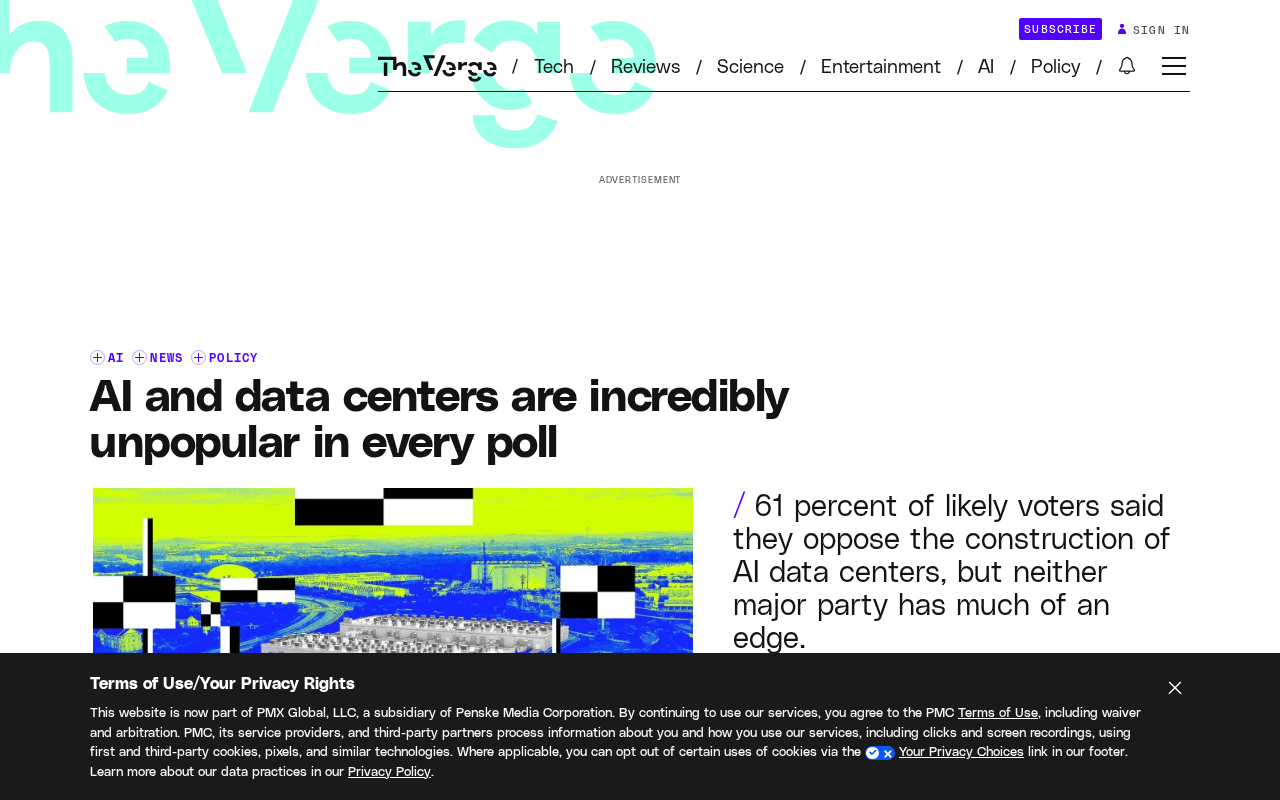
A new poll shows 61% of U.S. voters oppose building AI data centers, signaling real political headwinds for the industry.
A New York Times/Siena University poll of 1,503 likely voters found that 61% oppose building data centers to support AI — marking the moment AI infrastructure became a mainstream political issue. Public opposition is rooted in real concerns: data centers' massive energy and water demands directly affect local electricity prices, water supply, and grid stability, while commercial benefits flow primarily to a handful of tech giants. The 61% figure makes opposing data centers a near risk-free political stance, intensifying approval hurdles for the industry. The article argues that AI companies must move beyond technology narratives and deliver substantive plans on energy efficiency and community benefit-sharing to earn the social license they need to expand.
The Signal Behind a Poll
A new poll released Tuesday by The New York Times and Siena University reinforces an emerging trend: AI technology and the data centers that power it are facing widespread negative sentiment among American voters.
In the survey of 1,503 likely voters, a striking 61% said they oppose building data centers to support AI technology. That figure alone suggests the social acceptability of AI infrastructure is far lower than the industry's optimistic projections.
What makes this data especially significant is that it isn't just measuring public opinion — it's already being picked up by politicians who are responding accordingly. Once a technology issue moves from labs and capital markets into the public political arena, public attitudes tend to translate into very real policy resistance.
Why the Public Dislikes Data Centers
While the original report doesn't elaborate on the specific reasons for opposition, the well-documented controversies surrounding the data center industry make the roots of this backlash clear.
Data centers are quintessential high-energy, high-water-consumption facilities. The server halls that provide computing power for training and running large AI models consume enormous amounts of electricity and rely on large-scale cooling systems. This directly touches on the issues local communities are most sensitive to — rising electricity prices, water resource consumption, and pressure on the power grid.
For residents living near proposed data center sites, these facilities rarely bring a tangible sense of jobs and prosperity. Instead, they bring noise, land use competition, and rivalry over energy resources. When the commercial benefits of AI are concentrated in the hands of a few tech giants while the external costs are borne by local communities, public resistance is entirely understandable.
Social License to Operate is a concept developed in heavy industries like mining and energy. It refers to the ongoing acceptance and trust that a company must earn from local communities and the broader public — beyond mere legal permits — in order to operate smoothly. The data center industry has faced similar pressure in recent years: Ireland and the Netherlands have seen local governments pause approvals for new data centers citing grid capacity concerns, while Virginia's "data center corridor" has faced sustained pressure from residents and state legislators over land use and electricity costs. These cases demonstrate that community opposition isn't just an emotional reaction — it can directly affect project timelines and costs through concrete mechanisms like planning approvals, power allocation quotas, and the withdrawal of tax incentives.
The Politicization of AI Infrastructure
Perhaps the most telling insight from this poll is what it reveals about AI's transformation from a technology topic into a political one.
A 61% opposition rate means that opposing data center construction has become close to a "safe" political position among voters. For politicians seeking reelection or new office, going along with this sentiment — questioning data center projects or pushing for stricter requirements — carries almost no political risk, and may actually win voter support.
This stands in sharp contrast to the narrative prevailing in the tech industry. In capital markets and corporate communications, AI is portrayed as an unstoppable productivity revolution and a key pillar of national competitiveness. But at the level of ordinary voters' daily lives, AI's grand promises have yet to materialize as tangible personal benefits — while concerns about energy use and environmental impact have already arrived.
A Real Warning for the AI Industry
This trend in public opinion poses a challenge that the entire AI industry chain cannot afford to ignore. Expanding computing capacity is the physical foundation of every current large model race, and data centers are the vehicle for that expansion. If infrastructure construction continues to face approval hurdles and community opposition at the local level, AI companies may be forced to slow their expansion.
For the industry, simply emphasizing technological promise is no longer enough to earn social license. Delivering substantive solutions on energy efficiency, water recycling, and genuine benefit-sharing with local communities will be decisive in determining whether data centers can actually get built.
The polling numbers remind us that AI's future depends not only on algorithms and chips, but also on whether it can win the acceptance of ordinary people. When the costs and benefits of technological progress are distributed unequally, the votes of opposition that the public casts through public opinion ultimately become real friction on the road to deployment.
The energy consumption scale of data centers has surged dramatically in the recent AI computing race. According to International Energy Agency (IEA) estimates, global data centers consumed approximately 460 TWh of electricity in 2023, with that figure potentially doubling by 2026. Individual hyperscale data centers serving large model training now demand hundreds of megawatts of power — equivalent to the electricity consumption of a mid-sized city. On the cooling side, both air-cooling and liquid-cooling solutions consume substantial water resources. One widely cited study estimates that training GPT-3 consumed approximately 700,000 liters of fresh water. These concrete figures transform the "high energy, high water use" charge from an abstract description into a tangible competition over resources — and they are the direct source of the opposition voices coming from local communities.
Related articles

Letting AI Build AI Tools: A 7-Day, 31-Commit Bootstrapping Post-Mortem
An engineer ran a fully autonomous AI-builds-AI pipeline for 7 days, 31 commits, with a 1-in-6 success rate. This post-mortem covers 5 failure types, 11 structural rules, and how every mistake became a permanent immunity gate.
Building an AI-Powered E-Commerce Business from Scratch: A Real-World Account of Multi-Agent Architecture for Print-on-Demand
A blogger builds a print-on-demand e-commerce company from scratch using AI agents — documenting specialized Agent profiles, GPT-5.6 vs Claude Fable multi-model orchestration, and reusable skill accumulation.

AI Agent Earns $10K in One Week: 3 Key Upgrades Explained
A blogger shares how he earned $10K in a week with an AI Agent — not by adding more skills, but through verification, approval gates, and subagents to raise trust and enable true automation.