Pony Language: The Lock-Free Concurrent and Memory-Safe Programming Language Is Still Alive

Pony, a lock-free concurrent language with compile-time safety guarantees, continues active development without corporate backing.
Pony is an open-source, Actor model-based programming language that guarantees memory safety and data-race freedom at compile time through its unique reference capabilities type system. A recent blog post about its Arena Allocator reignited community interest, revealing the project remains actively developed despite having no major corporate sponsors — relying solely on passionate community contributors.
A Forgotten Concurrent Programming Language Returns to the Spotlight
In an era where countless programming languages compete for developer attention, those with unique designs but lacking commercial promotion are often gradually forgotten. Pony is one such language. Recently, a developer shared a blog post about Pony's Arena Allocator on Reddit, reigniting community interest in this language.
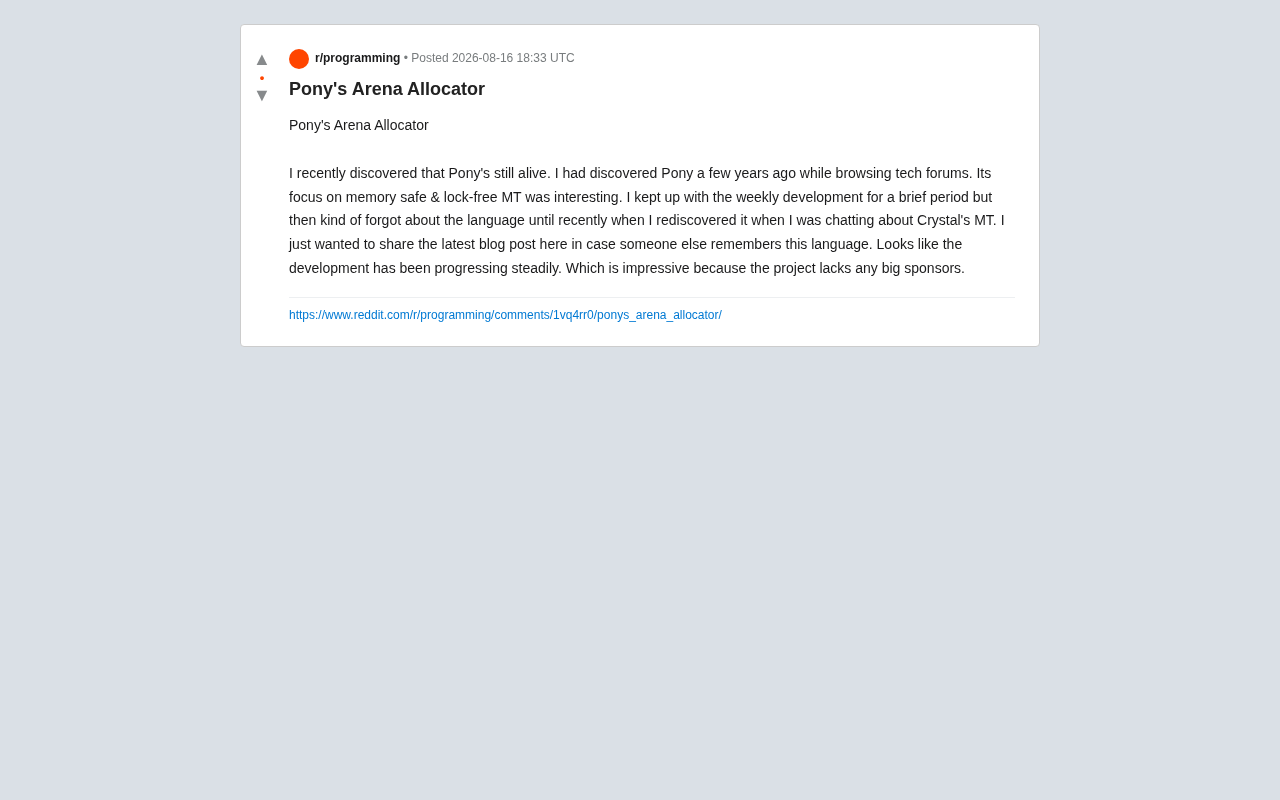
The developer admitted that they first encountered Pony several years ago while browsing tech forums, drawn to its design philosophy around memory safety and lock-free multithreading (lock-free MT). They briefly followed its weekly development updates but eventually lost track. It wasn't until a recent discussion about Crystal language's multithreading implementation that they rediscovered Pony is still "alive" and development continues to progress steadily.
What Is Pony: A High-Performance Language Built on the Actor Model
Core Positioning and Design Philosophy
Pony is an open-source, object-oriented programming language based on the Actor model. Its core positioning differs significantly from mainstream languages — rather than pursuing flashy syntax or ecosystem abundance, it focuses on solving the two most challenging problems in concurrent programming: memory safety and data races.
Pony's proudest feature is that its type system guarantees data-race freedom at compile time. This means developers writing multithreaded code don't need to rely on runtime lock mechanisms to protect shared state — the compiler verifies concurrency safety the moment your code compiles successfully.
This "compilation equals guarantee" philosophy shares conceptual similarities with Rust's ownership system, but Pony achieves a concurrency abstraction more naturally suited to the Actor model through its unique reference capabilities system.
The Dual Guarantee of Lock-Free Multithreading and Memory Safety
It's precisely this combination of "memory safety + lock-free multithreading" that gives Pony its unique appeal in high-concurrency, low-latency scenarios. Traditional concurrent programming approaches have obvious shortcomings:
- Reliance on locks: Introduces performance overhead and deadlock risks
- Reliance on developer discipline: Easily introduces hard-to-reproduce concurrency bugs
Pony attempts to completely eliminate these pitfalls through language-level type system design, making concurrency safety a compiler-enforced property rather than something developers must constantly be careful about.
The Significance of the Arena Allocator for Pony
The blog post that sparked this discussion focuses on Pony's Arena Allocator. Arena allocation is an efficient memory management strategy: it pre-allocates a large contiguous block of memory upfront, and subsequent object allocations happen directly within this region, avoiding the overhead of frequent memory requests to the operating system.
For a language like Pony that emphasizes high-performance concurrency, memory allocator design is crucial. Under the Actor model, large numbers of short-lived message objects are created. If every allocation goes through the general heap allocation path, it introduces significant performance overhead and memory fragmentation.
The core advantages of an Arena allocator include:
- Batch memory management, dramatically improving allocation and deallocation efficiency
- Reduced memory fragmentation, optimizing cache locality
- Synergy with Pony's garbage collection mechanism, balancing safety and performance
The appearance of this technical blog post itself demonstrates that the Pony team continues to refine the language's core underlying components, rather than resting on superficial feature additions.
Steady Progress Without Big-Company Backing
An Independent Open-Source Project's Perseverance
What impressed the community most is that Pony's development continues to progress steadily without any major sponsors. This is quite rare in today's competitive programming language landscape.
Consider the backing behind other well-known languages:
- Go has Google
- Rust initially had Mozilla's support, later establishing an independent foundation
- Swift has Apple
- Kotlin has JetBrains and Google
Pony relies primarily on community volunteers and a handful of core contributors' sustained efforts. Without commercial resources, there's no dedicated team, no large-scale marketing, and no forced ecosystem building. Maintaining a weekly development cadence under these conditions reflects the core team's and community's technical passion and dedication.
The Unique Value of Niche Programming Languages
Niche languages like Pony often struggle to enter mainstream developers' awareness, let alone see large-scale production deployment. But their value shouldn't be overlooked — they serve as "experimental grounds" for programming language design.
Pony's explorations in the following areas provide valuable insights and experience for the entire language design field:
- Reference Capabilities type system
- Language-level implementation of the Actor concurrency model
- Compile-time data race elimination
- Efficient memory allocation and garbage collection coordination
Many features adopted by mainstream languages today originally emerged from these unassuming experimental projects. Even if Pony itself may never become the next Go or Rust, the technical concepts it validates could influence future language evolution through other channels.
Conclusion: Why Developers Should Know About Pony
This brief Reddit share reflects a warm yet realistic side of the open-source community: there are always developers paying attention to and maintaining projects that don't get the spotlight. Pony being "still alive" is the result of these unsung contributors' dedication.
For developers interested in concurrent programming, memory safety, and language design, Pony is worth taking the time to explore — even if you'll never use it in production, its unique approach to concurrency safety problems can be inspiring. Perhaps as the original poster hoped: "Sharing this so maybe someone still remembers this language."
Related articles

JobRunner MCP Server: AI Agents Can Now Fix Failed Java Jobs
JobRunner launches an open-source MCP server enabling AI agents to view cluster status, diagnose failures, and recover Java jobs—incident response from any cloud coding environment or existing agent.

MLAI Digital Launches 9 Security Agents: MCP Server Safeguards the Full Lifecycle of Agentic AI
MLAI Digital launches Security MCP Server with nine built-in specialized security agents covering vulnerability discovery, attack simulation, prompt injection detection, API and infrastructure assessment, and accelerated remediation—embedding security validation across the full Agentic AI lifecycle from development to production.

Running Isaac Lab on H100 GPUs: Exploring Better Approaches
Exploring optimization methods for running Isaac Lab on NVIDIA H100 GPUs, including MIG configuration, mixed precision, TensorRT acceleration, and community experience to improve robotics simulation and reinforcement learning efficiency.